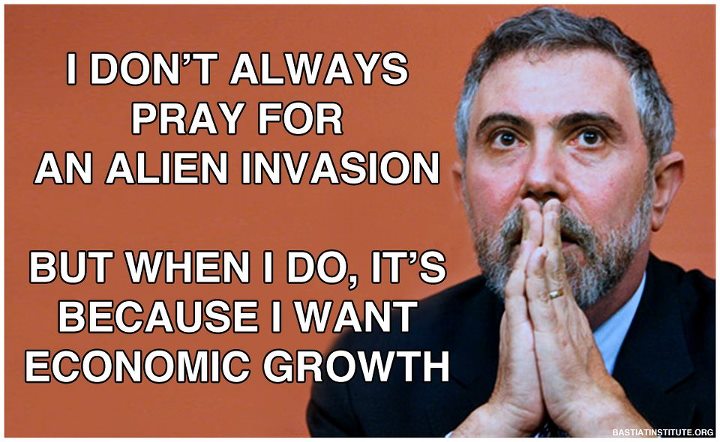
Progress.
www.thefreemanonline.org/features/how-intellectual-property-hampers-the-free-market/
". . . a republic, if you can keep it."
 Cadet pilot training course applications from white men are no longer being accepted by the SA Airways (SAA), it was reported on Friday.
SAA spokesman Kabelo Ledwaba told Beeld that the cadet programme was being advertised online as an initiative to bring pilot demographics in line with the country’s broader demographics. (Read more)
The Henderson County sheriff says people who break into homes are taking a big risk, even if their intended victim is an 87-year-old woman.
Sheriff Charles McDonald tells the Asheville Citizen-Times (avlne.ws/NTBIzy) that two men face first-degree burglary charges in connection with the break-in last week at a woman’s Highland Lake community home. He says the two men fled after she displayed a 9mm pistol. (Read more)
Cellphones have ushered in an age of interruption, with apps that notify you when you’re mentioned on Facebook or Twitter, or even if your favorite ball team scores a run.
But Apple is the ultimate arbiter of what kinds of notifications iPhone users can receive — and some apps just don’t pass muster with the tech giant.
Take Josh Begley’s idea, for example. Begley created an app that sends a push notification — or beep — to an iPhone whenever there is a U.S. drone strike anywhere in the world.
Apple blocked it from its App Store.
“They said the app has excessively objectionable or crude content,” Begley says. “Which I found somewhat curious, because it is literally just a republishing of news — just tracking when strikes happen.”
The app contains no gory pictures or classified information. (Read more)
They call the Ryan budget ‘radical,’ ‘uncompromising,’ ‘unrealistic,’ ‘tea party extremist.’


So stupid.
US trade sanctions have led game maker Blizzard to cut off access to World of Warcraft (Wow) in Iran.
Blizzard posted a statement to its player-forum site after hundreds of Iranian players said they had lost access to the game.
Access was lost recently, it said, because it had “tightened up its procedures” to comply with sanctions.
This also meant, said Blizzard, that it could not give refunds to players or transfer their accounts. (Read more)
Following up on my earlier post, several readers wrote me about my query about the Randian comments that a large government is okay in some cases. Jeff Keller writes:
I think the originator of that quote was Roger Donway (from David Kelley’s Atlas Society/TOC, not the Ayn Rand Institute). He wrote…
“Limited government” means a government restricted to certain purposes, namely, the defense of individual rights; “small government” means a government that absorbs a small percentage of the gross national product. If a country has been invaded, its government might absorb 50 percent or more of the nation’s product to mount a defense—and yet remain a “limited government” in the relevant sense. Conversely, a government that abandons its military and police missions might spend very little of the national output, but if it spends that little on health, education, and welfare, it is not a “limited government.”
The above is from a piece called Government, Yes! Leviathan, No!”
I recall hearing David Kelley make a similar point: that smallness of government isn’t the primary concern, but whether it functions within its legitimate authority (Kelley, et al.’s view of legitimacy, of course). That was at the 1999 TOC Summer Seminar, which I attended. I think it was during a debate Kelley had with Randy Barnett over anarchism vs. minarchism, but I wouldn’t swear to it.
In The Libertarians’ Albatross, Butler Shaffer recalls John Hospers who “recently wrote that ‘voting for George W. Bush is the most libertarian thing we can do,’ and that ‘a continued Bush presidency . . . might well succeed in preserving Western civilization.’ Kerry ‘will weaken our military establishment,’ he went on, quoting favorably from a statement made by Rand, in 1962, to the effect that paying 80% for taxes was justified ‘if you need it for defense.’”
As Stan Lee used to say: ’nuff said.
Hafez Rajabi was marked for life by his encounter with the men of the Israeli army’s Kfir Brigade five years ago this week. Sitting beneath the photograph of his late father, the slightly built 21-year-old in jeans and trainers points to the scar above his right eye where he was hit with the magazine of a soldier’s assault rifle after the patrol came for him at his grandmother’s house before 6am on 28 August 2007.
He lifts his black Boss T-shirt to show another scar running some three inches down his back from the left shoulder when he says he was violently pushed – twice – against a sharp point of the cast-iron balustrade beside the steps leading up to the front door. And all that before he says he was dragged 300m to another house by a unit commander who threatened to kill him if he did not confess to throwing stones at troops, had started to beat him again, and at one point held a gun to his head. “He was so angry,” says Hafez. “I was certain that he was going to kill me.”
This is just one young man’s story, of course. Except that – remarkably – it is corroborated by one of the soldiers who came looking for him that morning. One of 50 testimonies on the military’s treatment of children – published today by the veterans’ organisation Breaking the Silence – describes the same episode, if anything more luridly than Hafez does. “We had a commander, never mind his name, who was a bit on the edge,” the soldier, a first sergeant, testifies. “He beat the boy to a pulp, really knocked him around. He said: ‘Just wait, now we’re taking you.’ Showed him all kinds of potholes on the way, asked him: ‘Want to die? Want to die right here?’ and the kid goes: ‘No, no…’ He was taken into a building under construction. The commander took a stick, broke it on him, boom boom. That commander had no mercy. Anyway the kid could no longer stand on his feet and was already crying. He couldn’t take it any more. He cried. The commander shouted: ‘Stand up!’ Tried to make him stand, but from so much beating he just couldn’t. The commander goes: ‘Don’t put on a show,’ and kicks him some more.” (Read more)
David “Axis of Evil” Frum first gained notoriety as one of George W. Bush’s more polemical speechwriters. During the run-up to the Iraq war, he was all over the media, agitating for the invasion and viciously denouncing anyone who questioned the wisdom of such a course. In an infamous article for National Review, entitled “Unpatriotic Conservatives,” he attacked those conservatives and libertarians who counseled caution, smearing Robert Novak, Pat Buchanan, Llewellyn Rockwell, Samuel Francis, Thomas Fleming, Scott McConnell, Joe Sobran, Charley Reese, Jude Wanniski, Eric Margolis, Taki Theodoracopulos, and myself as, variously, “defeatist,” “conspiracy theorists,” and “anti-Semitic.” Here is Frum, in March of 2003:
“They have made common cause with the left-wing and Islamist antiwar movements in this country and in Europe. They deny and excuse terror. They espouse a potentially self-fulfilling defeatism. They publicize wild conspiracy theories. And some of them explicitly yearn for the victory of their nation’s enemies.”
Frum went on for at least three thousand words, attacking his enemies as traitors and terrorist-sympathizers. It was all lies, of course, and I answered them here. Yet now we see Frum has reinvented himself as a “moderate” Republican, and has carved out a new career for himself as the kind of conservative who gets invited on NPR and CNN to snark at his former comrades. In a recent interview with Politico, he was asked: “What do you know now that you wish someone had told you 10 years ago?” His answer:
“That the Iraq War would be a disaster. Come to think of it, they did tell me.”
In the accompanying photo, Frum is sitting on a patio somewhere, smiling and petting his golden retriever. Who, me worry? Such a blithe spirit, that Frum, who is wearing white pants with no socks. Deaf to the bitter cries of the dead and the maimed, not to mention those he accused of treason, he puts his feet up in a pose of summery relaxation. The memory of his hysterical smears – “They began by hating the neoconservatives. They came to hate their party and this president. They have finished by hating their country” – seems to have dissipated into the stratosphere. He’s put it out of his mind.
This is the New David Frum, the moderate, measured, wonkish would-be charmer, who only loses his soft edges when the subject of foreign policy is raised. After a well-publicized break with the American Enterprise Institute over his supposed opposition to Republican orthodoxy, he also broke with National Review, where he had once taken on the role of ideological enforcer, and underwent a makeover. He set up the “Frum Forum” as the online headquarters of the Frummian Republicans, a small but extremely self-satisfied gaggle of online bloviators, who sneered at the Tea Party and cheered as Frum announced the GOP was in danger of being taken over by anti-government “extremists.” (Read more)
I think a lot of starry eyed political rookies got a harsh lesson in the nature of politics. Rules are for little people.
In all fields of human endeavor, winning by cheating is losing.
In a competition, when someone cheats, he gets disqualified. The disqualification does not make the runner-up the winner. Rather, it reveals that the man who appeared to be the runner-up had in fact been the winner all along.
In the race for the GOP nomination for president, therefore, Ron Paul won.
As the New York Times wrote yesterday,
Delegates from Nevada tried to nominate Mr. Paul from the floor, submitting petitions from their own state as well as Minnesota, Maine, Iowa, Oregon, Alaska and the Virgin Islands. That should have done the trick: Rules require signatures from just five states. But the party changed the rules on the spot. Henceforth, delegates must gather petitions from eight states.
When Mr. Romney and the RNC cheat so blatantly, they make the game no longer about politics: they make themselves ineligible for the vote of anyone who cares about his own morality, his own honesty or his own integrity — regardless of his politics. And from a purely practical standpoint, they invite Americans to ask if they want to live in a nation governed with the same contempt for those who don’t toe the party line as has been displayed both in Tampa and throughout the primary process.
But as a Ron Paul supporter, I can’t remember feeling so invigorated and empowered in my cause.
Not only did my candidate win: the GOP has given the Liberty movement the greatest gift it could have given us. It has induced a righteous indignation that will ensure that there will be no lull in the Liberty movement post-convention or post-election. It has educated us; it has brought us together like only a common hurt can, and it has freed us to do whatever needs to be done for the cause we love, wherever we need to do it. (Read more)


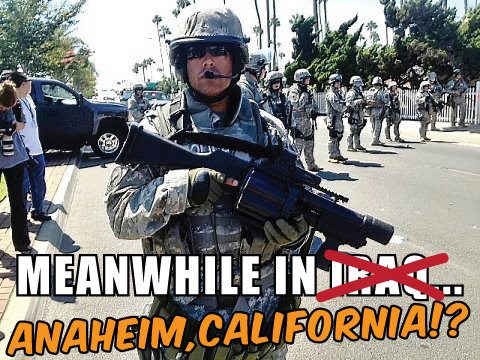
Expect more of this in the U.S.S.A.

This was one of his more colorful stupid remarks. Like all psychopaths, he wants control. His desire is so great that he considers an alien invasion a good thing. He frames it as an economic good.