Author Archives: admin
The Adam Smith Myth by Murray Rothbard
 Adam Smith (1723–90) is a mystery in a puzzle wrapped in an enigma. The mystery is the enormous and unprecedented gap between Smith’s exalted reputation and the reality of his dubious contribution to economic thought.
Smith’s reputation almost blinds the sun. From shortly after his own day until very recently, he was thought to have created the science of economics virtually de novo. He was universally hailed as the Founding Father. Books on the history of economic thought, after a few well-deserved sneers at the mercantilists and a nod to the physiocrats, would invariably start with Smith as the creator of the discipline of economics. Any errors he made were understandably excused as the inevitable flaws of any great pioneer.
Innumerable words have been written about him. At the bicentennial of his magnum opus, An Inquiry into the Nature and the Causes of the Wealth of Nations (1776), a veritable flood of books, essays, and memorabilia poured forth about the quiet Scottish professor. His profile sculpted on a medallion by Tassie is known throughout the world. A hagiographic movie was even made about Smith during the bicentennial by a free market foundation, and businessmen and free market advocates have long hailed Adam Smith as their patron saint.
‘Adam Smith ties’ were worn as a badge of honour in the upper echelons of the Reagan Administration.
On the other hand, Marxists, with somewhat more justice, hail Smith as the ultimate inspiration of their own Founding Father, Karl Marx. Indeed, if the average person were asked to name two economists in history whom he has heard of, Smith and Marx would probably be the runaway winners of the poll.
As we have already seen, Smith was scarcely the founder of economic science, a science which existed since the medieval scholastics and, in its modern form, since Richard Cantillon. But what the German economists used to call, in a narrower connection, Das AdamSmithProblem,[i] is much more severe than that. For the problem is not simply that Smith was not the founder of economics.
. . . .
The mystery of Adam Smith, then, is the immense gap between a monstrously overinflated reputation and the dismal reality. But the problem is worse than that; for it is not just that Smith’s Wealth of Nations has had a terribly overblown reputation from his day to ours. The problem is that the Wealth of Nations was somehow able to blind all men, economists and laymen alike, to the very knowledge that other economists, let alone better ones, had existed and written before 1776. The Wealth of Nations exerted such a colossal impact on the world that all knowledge of previous economists was blotted out, hence Smith’s reputation as Founding Father. The historical problem is this: how could this phenomenon have taken place with a book so derivative, so deeply flawed, so much less worthy than its predecessors?
The answer is surely not any lucidity or clarity of style or thought. For the much-revered Wealth of Nations is a huge, sprawling, inchoate, confused tome, rife with vagueness, ambiguity and deep inner contradictions. There is of course an advantage, in the history of social thought, to a work being huge, sprawling, ambivalent and confused. There is sociological advantage to vagueness and obscurity. The bemused German Smithian, Christian J. Kraus, once referred to the Wealth of Nations as the ‘Bible’ of political economy. In a sense, Professor Kraus spoke wiser than he knew. For, in one way, the Wealth of Nations is like the Bible; it is possible to derive varying and contradictory interpretations from various – or even the same – parts of the book. Furthermore, the very vagueness and obscurity of a work can provide a happy hunting ground for intellectuals, students and followers. To make one’s way through an obscure and difficult tract, to weave dimly perceived threads of a book into a coherent pattern – these are rewarding tasks in themselves for intellectuals.
. . . .
The division of labour
It is appropriate to begin a discussion of Smith’s Wealth of Nations with the division of labour, since Smith himself begins there and since for Smith this division had crucial and decisive importance. His teacher Hutcheson had also analysed the importance of the division of labour in the developing economy, as had Hume, Turgot, Mandeville, James Harris and other economists. But for Smith the division of labour took on swollen and gigantic importance, putting into the shade such crucial matters as capital accumulation and the growth of technological knowledge. As Schumpeter has pointed out, never for any economist before or since did the division of labour assume such a position of commanding importance.
But there are more troubles in the Smithian division of labour than his exaggerating its importance. The older and truer perception of the motive power for specialization and exchange was simply that each party to an exchange (which is necessarily two-party and two-commodity) benefits (or at least expects to benefit) from the exchange; otherwise the trade would not take place. But Smith unfortunately shifts the main focus from mutual benefit to an alleged irrational and innate ‘propensity to truck, barter and exchange’, as if human beings were lemmings determined by forces external to their own chosen purposes. As Edwin Cannan pointed out, Smith took this tack because he rejected the idea of innate differences in natural talents and abilities, which would naturally seek out different specialized occupations. Smith instead took the egalitarian-environmentalist position, still dominant today in neoclassical economics, that all labourers are equal, and therefore that differences between them can only be the result rather than a cause of the system of the division of labour.
In addition, Smith failed to apply his analysis of the division of labour to international trade, where it would have provided powerful ammunition for his own free trade policies. It was to be left to James Mill to make such an application in his excellent theory of comparative advantage. Furthermore, domestically, Smith placed far too much importance on the division of labour within a factory or industry, while neglecting the more significant division of labour among industries.
But if Smith had an undue appreciation of the importance of the division of labour, he paradoxically sowed great problems for the future by introducing the chronic modern sociological complaint about specialization that was picked up quickly by Karl Marx and has been advanced to a high art by socialist gripers about ‘alienation’. There is no gainsaying the fact that Smith totally contradicted himself between Book I and Book V of the Wealth of Nations. In the former, the division of labour alone accounts for the affluence of civilized society, and indeed the division of labour is repeatedly equated with ‘civilization’ throughout the book. And yet, while in Book I the division of labour is hailed as expanding the alertness and intelligence of the population, in Book V it is condemned as leading to their intellectual as well as moral degeneration, to the loss of their ‘intellectual, social and martial virtues’. There is no way that this contradiction can be plausibly reconciled.[vi]
Adam Smith, though himself a plagiarist of considerable dimensions, also had a Columbus complex, often accusing other people unfairly of plagiarizing him. In 1755 he actually laid claim to having invented the concept of laissez-faire, or the system of natural liberty, asserting that he had taught these principles since his Edinburgh lectures in 1749. That may be: but the claim ignores previous such expressions by his own teachers as well as by Grotius and Pufendorf, to say nothing of Boisguilbert and the other French laissez-faire thinkers of the late seventeenth century.
In 1769, the contentious Smith levied a plagiarism charge against Principal William Robertson, upon the occasion of the publication of the latter’s History of the Reign of Charles V. It is not known what the topic of the literary theft was supposed to be, and it is difficult to guess, considering the remoteness from Smith’s work of the theme of the Robertson book.
. . . .
In contrast, then, to those historians who praise Smith for his empirical grasp of contemporary economic and industrial affairs, Adam Smith was oblivious to the important economic events around him. Much of his analysis was wrong, and many of the facts he did include in the Wealth of Nations were obsolete and gathered from books 30 years old.
Productive vs. unproductive labour
One of the physiocrats’ more dubious contributions to economic thought was their view that only agriculture was productive, that only agriculture contributed a surplus, a produit net, to the economy. Smith, heavily influenced by the physiocrats, retained the unfortunate concept of ‘productive’ labour, but expanded it from agriculture to material goods in general. For Smith, then, labour on material objects was ‘productive’; but labour on, say, consumer services, on immaterial production, was ‘unproductive’.
Smith’s bias in favour of material objects amounted to a bias in favour of investment in capital goods, since a stock of capital goods by definition has to be embodied in material objects. Consumer goods, on the other hand, either consist of immaterial services, or they get used up – consumed – in the process of consumption. Smith’s imprimatur on material production, therefore, was an indirect way of advocating investment in an accumulation of capital goods as against the very goal of producing capital goods: increased consumption. When discussing exports and imports, Smith realized full well that there was no point to amassing intermediate objects except that they eventually be consumed, that the only goal of production is consumption. But as Professor Roger Garrison has pointed out, and as we shall see further on the question of usury laws, Adam Smith’s Presbyterian conscience led him to value the expenditure of labour per se, for its own sake, and led him to balk at free market time-preferences between consumption and saving. Clearly, Smith wanted far more investment towards future production and less present consumption than the market was willing to choose. One of the contradictions of this position, of course, is that accumulating more capital goods at the expense of present consumption will eventually result in a higher standard of living unless Smith prepared to counsel a perpetual and accelerated shift toward more and more never-to-be-consumed means of production. (Read more)
Adam Smith vs Cantillon & Turgot
I may have posted this before, but it’s fascinating. Deserves a second look.
One of the great puzzles in the history of economic thought, as we have indicated in Volume 1, is why Adam Smith was able to sweep the field and enjoy the reputation of “founder of economic science” when Cantillon and Turgot had been far superior, both as technical economic analysts and as champions of laissez-faire. The mystery is particularly acute for France, since in Britain the only schools competing with the Smithians were the mercantilists and the political arithmeticians.
The mystery deepens when we realize that the great leader of French economics after Smith, Jean-Baptiste Say (1767–1832), was really in the Cantillon-Turgot tradition rather than that of Smith even though he greatly neglected the former and proclaimed that economics began with Adam Smith. He, Say, was supposedly only systematizing the wonderful but inchoate truths found in the Wealth of Nations. We shall see below the precise nature of Say’s thought and his contributions, as well as his decidedly “French” non-Smithian, and “pre-Austrian” logical clarity and emphasis on the praxeologic axiomatic-deductive method, on utility as the sole source of economic value, on the entrepreneur, on the productivity of the factors of production, and on individualism.
Specifically, in his brief treatment of the history of thought in his great Treatise on Political Economy, Say makes no mention whatever of Cantillon. Despite the considerable influence of Turgot on his doctrine, he brusquely dismisses Turgot as sound on politics but of no account in economics, and asserts that political economy in effect began with Adam Smith’s Wealth of Nations. This curious and wilful neglect of his own forbears is made obscure by the scandalous fact that there is not a single biography of Say in the English language, and precious little even in French.
Perhaps we can understand this development given the following. In France, economics had long been associated with the physiocrats, les économistes. The ouster from the controller-generaliship of the great Turgot in 1776 and the consequent demise of his liberal reforms served to discredit the entire physiocratic movement. For Turgot was unfortunately considered in the public eye as merely a fellow traveller of physiocracy and its most influential follower in government.
After this loss of political influence, the French philosophes and the leading intelligentsia felt free to heap mockery and ridicule on the physiocrats. Some of the fanatical cult aspects of physiocracy left it vulnerable to scorn, and the encyclopédistes, though themselves generally pro-laissez-faire, led the attack.
The advent of the French Revolution accelerated the demise of physiocracy. In the first place, the Revolution was itself too intensely political to allow much sustained interest in economic theory. Second, the physiocrats’ strategic devotion to absolute monarchy tended to discredit them in an era when the monarch had been toppled and destroyed.
Moreover, the physiocrats, with their emphasis on the exclusive productivity of land, were associated with devotion to the landed, aristocratic interest. The French Revolution against aristocratic rule and against feudal landholding had no patience for physiocracy. The impatience was aggravated by the emergence of industrialism and the Industrial Revolution, which increasingly rendered obsolete the physiocratic devotion to the land.
All these factors served to discredit physiocracy totally, and since Turgot was unfortunately identified as a physiocrat, his reputation was dragged down at the same time. This situation was aggravated by the fact that Turgot’s former aide and close friend, editor, and biographer was the last of the physiocrats, the statesman Pierre Samuel DuPont de Nemours (1739–1817), who added to the problem by deliberately distorting Turgot’s views to make them appear as close to physiocracy as possible.
. . . .
Later, in the 1790s, the physiocratic remnants latched gratefully on to the Smithian coat-tails. Smith, after all, favoured laissez-faire, and he was almost outlandishly proagriculture, holding that agricultural labour was the chief source of wealth. As a result, most of the later physiocrats became early Smithians in France, led by the Marquis Germain Garnier (1754–1821), the first French translator of the Wealth of Nations, who presented Smithian doctrine to France in his Abrégé élémentaire des principes de l’économie politique (1796). (Read more)
Spain: the beginning of the end
No more lifeboats left on EU Titanic
IMF head Christine Lagarde pays no tax, is slight hypocrite
Taxes are for the little people.
Christine Lagarde, the head of the IMF, pays no taxes. The Guardian today reveals that:
As an official of an international institution, her salary of $467,940 (£298,675) a year plus $83,760 additional allowance a year is not subject to any taxes. . . The same applies to nearly all United Nations employees.
She receives a pay and benefits package “worth more than American president Barack Obama earns from the United States government, and he pays taxes on it.”
On Friday, the paper reported:
Lagarde, predicting that the debt crisis has yet to run its course, adds: “Do you know what? As far as Athens is concerned, I also think about all those people who are trying to escape tax all the time. All these people in Greece who are trying to escape tax.” She says she thinks “equally” about Greeks deprived of public services and Greek citizens not paying their tax.
“I think they should also help themselves collectively.” Asked how, she replies: “By all paying their tax.”
Russian Millionaire Tosses Paper Money Planes Out of Office Window, Laughs as People Brawl Over Them
Pavel Durov, founder of the popular Russian Facebook-alike VKontakte, took a bread-and-circuses approach to generosity over the weekend, spending time with VK’s vice president tossing paper airplanes made of money out of the company’s St. Petersburg offices.
A crowd soon formed outside the building, eager to catch every 5,000-rouble ($160) bill Durov and his cohort were throwing. As tends to happen in these situations, the scene quickly devolved into an all-out brawl.
“People turned into dogs as they were literally attacking the notes,” said one eyewitness. “They broke each other’s noses, climbed the traffic lights with their prey – just like monkeys. Shame on Durov!”
For his part, the 27-year-old, whose net worth is valued at some $260 million, appeared to be enjoying the commotion, reportedly “laughing and filming” as people trampled over each other in desperation. He later claimed he was simply hoping to create “a festive atmosphere,” and stopped as soon as “people turned into animals.” (Read more)
EU to France – You MUST accept GMO corn
Days after France attempted to ban a genetically-modified strain of maize created by the controversial agricultural company Monsanto, based in St. Louis, Mo., the European Food Safety Authority (EFSA) rejected France’s grounds for banning the maize on Monday, even though France believes the corn is harmful to the environment. (Read more)
Storm brews over forced circumcision in Uganda
The Ugandan town of Mbale was brought to a standstill on Tuesday afternoon, as a naked man ran through the streets, with more than 50 men in pursuit. He was fleeing a forced circumcision.
Deo survived the forced circumcision after guards at the administrator’s office were able to disperse his assailants, but that was not before other men had fallen victim to the enforced surgical operation.
More than 40 men of various ages have been subjected to the cut in the last two days, as the town goes through a general circumcision programme, but this has faced widespread protests.
Mbale is mainly inhabited by the Bamasaba tribe, which prescribes circumcision to all males from the age of 15, and those who do not undergo the cut are forcefully circumcised.
However, it has emerged that the 40 men who were forcefully circumcised are not of the Bamasaba tribe, but rather were forced to undergo the operation, as they either had Bamasaba wives or girlfriends.
“Since they sleep with our sisters and daughters, we felt they had to be circumcised like the rest of us,” Gerald Wambedde, an advocate of forced circumcisions, said.
The leader of the exercise, Badru Wasike said the circumcision exercise was both a cultural and health exercise.
“We are helping those who feared getting circumcised through cultural processes. We are aware that circumcised men do not easily get infected with HIV/Aids. Since they love our relatives we want them to be safe,” he explained. (Read more)
The Shocking Bullshit behind the “Circumcision prevents AIDS” lie
A handful of circumcision advocates have recently begun haranguing the global health community to adopt widespread foreskin-removal as a way to fight AIDS. Their recommendations follow the publication of three [1] randomized controlled clinical trials (RCCTs) conducted in Africa between 2005 and 2007.
These studies have generated a lot of media attention. In part this is because they supposedly show that circumcision reduces HIV transmission by a whopping 60%, a figure that wins the prize for “most misleading possible statistic” as we’ll see in a minute. Yet as one editorial [2] concluded: “The proven efficacy of MC [male circumcision] and its high cost-effectiveness in the face of a persistent heterosexual HIV epidemic argues overwhelmingly for its immediate and rapid adoption.”
Well, hold your horses. The “randomized controlled clinical trials” upon which these recommendations are based (I use scare quotes deliberately) represent bad science at its most dangerous: we are talking about poorly conducted experiments with dubious results presented in an outrageously misleading fashion. These data are then harnessed to support public health recommendations on a massive scale whose implementation would almost certainly have the opposite of the claimed effect, with fatal consequences. As Gregory Boyle and George Hill explain in their exhaustive analysis of the RCCTs:
While the “gold standard” for medical trials is the randomised, double-blind, placebo-controlled trial, the African trials suffered [a number of serious problems] including problematic randomisation and selection bias, inadequate blinding, lack of placebo-control (male circumcision could not be concealed), inadequate equipoise, experimenter bias, attrition (673 drop-outs in female-to-male trials), not investigating male circumcision as a vector for HIV transmission, not investigating non-sexual HIV transmission, as well as lead-time bias, supportive bias (circumcised men received additional counselling sessions), participant expectation bias, and time-out discrepancy (restraint from sexual activity only by circumcised men).
That’s a whole laundry list of issues, so let me highlight a few of the more egregious. First, consider the “lack of placebo control.” What does that mean? Normally, when you’re trying to determine whether some medical intervention has a disease-fighting effect specific to its own (hypothesized) mechanisms—and over and above the placebo baseline—you have to have a control group. That group gets a dummy intervention, and nobody is supposed to know which participants were exposed to the actual treatment until after the results are in.
After all, if someone knows (or thinks) that they’re getting a great big helping of medicine, they might act in various ways—whether consciously or unconsciously—that have the effect of generating positive health outcomes but which have nothing to do with the intervention itself. In the case of circumcision, however, there’s no way not to know if you’ve received the “medicine”—you have to go through a whole surgery and then you don’t have a foreskin anymore—so this basic condition of a true clinical trial is violated in the first instance.
But that’s just the tip of the iceberg. As Boyle and Hill point out, the men who were circumcised got additional counseling about safe sex practices compared to the control group, and then they had to refrain from having sex altogether for the simple reason that their lacerated penises had to be wrapped in bandages until their wounds healed – leading to what Boyle and Hill refer to as “time-out discrepancy” in the quote above. By contrast, the non-circumcised men got to keep having sex during the full two month period during which the treatment group was in recovery mode.[emphasis added] Then, mystery of mysteries, the trials were stopped early. These issues pose serious problems for the scientific credibility of the studies. Taken together with the other flaws, here is why:
Let’s assume for a second that the circumcised men really did end up getting infected with HIV at a lower rate than the control-group men who were left intact—even though, as we will see in a moment, we have very little reason to believe that this is so. Why might that outcome have happened?
If you answered, “Because those men knew they were in the treatment group in the first place, had less sex over the duration of the study (because they had bandaged, wounded penises for much of it), and had safer sex when they had it (because they received free condoms and special counseling from the doctors), thereby reducing their overall exposure to HIV compared to the control group by a wide margin” then you are on the right track.
Step 2. How not to report results
Now why should we doubt that the circumcised men actually did have a lower rate of HIV infections in the first place, poor experiment design notwithstanding, as I suggested in the paragraph above? After all, the 60% figure that’s being thrown around in media reports is a pretty big number, and it can’t be off by that much, even if the studies had some flaws, right? Not so fast. Do you know what the “60%” statistic is actually referring to? Boyle and Hill explain:
What does the frequently cited “60% relative reduction” in HIV infections actually mean? Across all three female-to-male trials, of the 5,411 men subjected to male circumcision, 64 (1.18%) became HIV-positive. Among the 5,497 controls, 137 (2.49%) became HIV-positive, so the absolute decrease in HIV infection was only 1.31%.
That’s right: 60% is the relative reduction in infection rates, comparing two vanishingly small percentages: a clever bit of arithmetic that generates a big-seeming number, yet one which wildly misrepresents the results of the study. The absolute decrease in HIV infection between the treatment and control groups in these experiments was a mere 1.31%, which can hardly be considered clinically significant, especially given the numerous confounds that the studies failed to rule out.
Step 3. How not to make public health recommendations
So far we have been discussing problems with the experiments themselves—what’s called “internal validity” in technical terms. I really want you to read the Boyle and Hill paper here, because they go into painstaking detail about each of a long parade of flaws I can’t hope to cover in one blog post. I mean, there are a lot of flaws. Please read the paper. But let’s switch gears now and talk about the flip-side of things, or what’s called “external validity” – that is, problems with taking what you’ve (supposedly) found in a (relatively) controlled setting like an experiment and applying it to the chaotic mess that is the real world.
Lawrence Green and his colleagues published an important article on just this topic as it relates to “the circumcision solution” in the American Journal of Preventative Medicine. “Effectiveness in real-world settings,” they sensibly point out, “rarely achieves the efficacy levels found in controlled trials, making predictions of subsequent cost-effectiveness and population-health benefits less reliable.”
Some major issues with trying to roll-out circumcision in particular include the fact that the RCCT participants—who were not representative of the general population to begin with—had (1) continuous counseling and yearlong medical care, as well as (2) frequent monitoring for infection, and (3) surgeries performed in highly sanitary conditions by trained, Western doctors. All of which would be unlikely to replicate at a larger scale in the parts of the world suffering from the worst of the AIDS epidemic. And of course, circumcisions carried out in un-sanitary conditions (that is, the precise conditions that are likelier to hold in those very places) carry a huge risk of transmitting HIV at the interface of open wounds and dirty surgical instruments. So this is a serious point.
What should we conclude? Green et al. get it right: “Before circumcising millions of men in regions with high prevalences of HIV infection, it is important to consider alternatives. A comparison of male circumcision to condom use concluded that supplying free condoms is 95 times more cost effective.”
. . . .
Step 4. This is serious business
The worst part about all of this is not just that the science behind “the circumcision solution” is so shaky, but that the actual implementation of these recommendations—so vociferously pushed-for by the circumcision advocates doing this research — would very likely lead to more HIV infections, not less. The big idea here is “risk compensation” – the subject of an excellent paper by Robert Van Howe and Michelle Storms.
Risk compensation occurs when people believe they have been provided additional protection (wearing safety belts) [such that] they will engage in higher risk behavior (driving faster). As a consequence of the increase in higher risk behavior, the number of targeted events (traffic fatalities) either remains unchanged or [actually] increases.
They argue:
Risk compensation will accompany the circumcision solution in Africa. Circumcision has been promoted as a natural condom, and African men have reported having undergone circumcision in order not to have to continually use condoms. Such a message has been adopted by public health researchers. A recent South African study assessing determinants of demand for circumcision listed “It means that men don’t have [to] use a condom” as a circumcision advantage in the materials they presented to the men they surveyed. [Yet] if circumcision results in lower condom use, the number of HIV infections will increase. [Citations can be found in the original paper.]
In Uganda, as Boyle and Hill uncovered, the Kampala Monitor reported men as saying, “I have heard that if you get circumcised, you cannot catch HIV/AIDS. I don’t have to use a condom.” Commenting on this problem, a Brazilian Health Ministry official stated: “[T]he WHO [World Health Organization] and UN HIV/AIDS program … gives a message of false protection because men might think that being circumcised means that they can have sex without condoms without any risk, which is untrue.”
. . . .
The studies we’ve looked at, claiming to show a benefit of circumcision in reducing transmission of HIV, are paragons of bad design and poor execution; and any real-world roll-out of their procedures would be very difficult to achieve safely and effectively. The likeliest outcome is that HIV infections would actually increase—both through the circumcision surgeries themselves performed in unsanitary conditions, and through the mechanism of risk compensation and other complicating factors of real life. The “circumcision solution” is no solution at all. It is a waste of resources and a potentially fatal threat to public health. (Read more)
Anti-democratic, Anti-sovereign banking Union Enveloping EU
A classified draft of next week’s EU summit conclusions is the first step on an emerging “roadmap” to a banking union, pooling debt via eurobonds and political union via EU treaty change over the next 10 years.
The “limite” text – published exclusively by The Daily Telegraph, is secret, restricted for the “eyes only” of diplomats and officials preparing for the 28 and 29 June European Council in Brussels.
Most of the text, the annexed “Compact for Growth and Jobs”, are deals on project bonds and other small scale EU initiatives that FranCois Hollande is trumpeting as a €120bn “growth pact”.
The first draft is relatively uncontroversial because the eurobond and “banking union” issues are currently all too sensitive to be committed to paper for officials.
Other so-called “non-papers” are circulating at a top secret level between national capitals and Brussels. (Read more)
Bernanke admits that he is ready–AGAIN–to lend dollars to Europe
The moves in Britain are the latest in a flurry of recent actions taken by European governments and central banks trying to arrest the continent’s more-than-two-year crisis. Late last year, the European Central Bank started doling out more than €1 trillion, or about $1.25 trillion, of cheap three-year loans to hundreds of banks that were at risk of running short of funds. Last week, the Spanish government said it would request up to €100 billion to help its crippled banking system.
In the U.S., Fed officials say they are prepared to reactivate several programs to provide short-term funding to markets if conditions deteriorate. Those programs, originally created during the 2008-09 financial crisis, offered cheap loans to banks and flooded the U.S. financial system with liquidity to prevent strains.
The U.S. central bank is also providing dollar funding to Europe through the European Central Bank to ensure that continent’s financial institutions have access to the U.S. currency, which they use to make loans around the world.
Fed Chairman Ben Bernanke last week said those currency swap lines were “very helpful in reducing stress in dollar-funding markets.” (Read more)
Alice Walker rejects Israeli translation of book
American writer Alice Walker won’t let an Israeli publisher release a new Hebrew edition of her Pulitzer Prize-winning novel, “The Color Purple,” saying she objects to Israel’s treatment of the Palestinian people.
Walker, an ardent pro-Palestinian activist, said in a letter to Yediot Books that Israel practices “apartheid” and must change its policies before her works can be published there.
“I would so like knowing my books are read by the people of your country, especially by the young and by the brave Israeli activists (Jewish and Palestinian) for justice and peace I have had the joy of working beside,” she wrote in the letter, obtained by The Associated Press. “I am hopeful that one day, maybe soon, this may happen. But now is not the time.” (Read more)
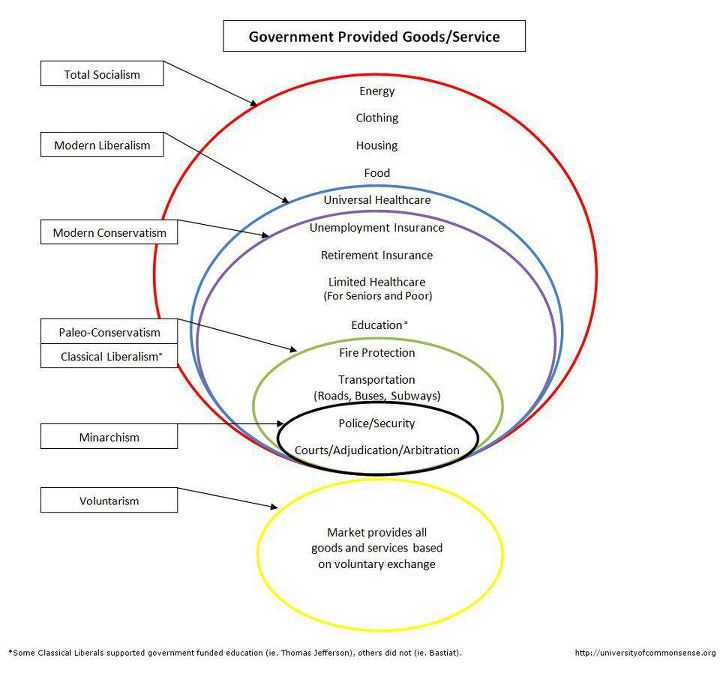
Socialism to Voluntarism Ven Diagram
Love this chart. Very accurate. Notice the similarity between modern day “liberals” and “conservatives” — the supposed poles of our political scale.
Public Schools — Chop you into squares
