Tag Archives: Big Media/Big Tech
Roubini vs the Austrian School
Patrick Barron‘s letter to the National Review:
 In his review of Crisis Economics by Nouriel Roubini and Stephen Mihm, Mr. David M. Smick calls Mr. Roubini a “media superstar” for his 2006 claim that the U.S. was in a housing bubble. If one goes to Mises.com and searches on “housing bubble”, one will find over 1,200 entries, many of which go back to 2003. Austrian economists have been right about this crisis from the beginning, because they understand the true nature of the business cycle, so ably explained by Professor Gary Wolfram elsewhere in the same NR issue. (See “Your Money Back”)
According to Mr. Smick’s review, Mr. Roubini claims that “Crises–unsustainable booms…are hard-wired into the capitalist genome.” Wrong. The boom/bust business cycle is caused by an extension of bank credit not backed by real savings. Banks are tempted to extend credit in an unsustainable manner due to their right to engage in fractional reserve banking. This is the primary source of the boom. 
Navigating the Financial Markets with an Austrian Compass
This is a great talk by hedge fund manager Kevin Duffy about Austrian Economics and Investing. It included some great quotes which demonstrate interventionists in big business, government, media and academia being wrong about the economy, corrupting history, vilifying free markets. I transcribed some of them below.
“At the rate things are going, we are all going to end up working for the Japanese.” -Lester Thurow, MIT, economist, 1989
“The United States is rapidly become a colony of Japan.” -Congresswoman Helen Bentley (R-MD), 1990
“The Cold War is over, and Japan won.” -Senator Paul Tsongas (D-MA), 1992
Austrians were able to see the bubble.
As it pertains to the investor: “Entrepreneurial judgement cannot be bought on the market. The entrepreneurial idea that carries on and brings profit is precisely the idea which did not occur to the majority. It is not correct foresight as such that yields profits, but foresight better than that of the rest. The prize goes only to the dissenters, who do not let themselves be misled by the errors accepted by the multitude.” -Ludwig von Mises
Discussing the investing challenge resulting from that fact that Austrian Economics tells you what will happen but not when. (It is in fact impossible to time markets, as Mises discusses in chapter 38 of human action.)
Vilifying free markets:
“This was about the invisible hand having a party, a non-regulated drinking party, with rating agencies handing out the fake IDs!” -Paul McCully, PIMCO, on the financial meltdown
“This laissez faire really has killed us.” -Jim Cramer, interviewing Rep. Barney Frank (D-MA), Jan 21, 2010
“No one likes to put the taxpayer into situations like this . . . Government intervention is not something I came down here wanting to espouse, but it sure is better than the alternative.” -Hentry Paulson, Treasury Secretary, on the government takeover of Fannie Mae and Freddie Mac, Sept 8, 2008
“Depression scholars – including Bernanke – tend to see the Hoover administration’s approach of balancing budgets and tightening belts during the downturn as a tragic mistake.” -Time 2009 Person of the Year article, Dec 28 2009
“Those who contended that during the period of my administration our economic system was one of laissez faire have little knowledge of the extent of government regulation.” -Herbert Hoover
“Nobody saw this coming” -Angelo Mozilo, CEO, Contrywide Financial, July 24 2007
When markets crash, instead of blaming interventionists and inflationists, there begins a witch hunt against private investors who saw it coming, often short sellers.
“It’s very natural for us all to overreact in times of stress, but I’m not a fan of unmitigated shorting. We have nearly $2 trillion in hedge funds that simply don’t have any reporting responsibilities.” -Charles Schwab, BusinessWeek, July 16, 2008
“I’m for markets. But when it felt like it had gotten abusive, when it was free money to short-sellers who were piling on, it felt less like the market and more like it was being manipulated, I corssed over.” -Lloyd Blankfein, CEO, Goldman Sachs, January 2010
Applauding regulation after Enron:
“Conviction on all 49 counts makes this unlikely in the future. This is good: it restores confidence… We were in the biggest bubble in history… I don’t think that’s going to happen for a long time… There were lessons I think that were learned.” -Jeremy Seigel, as appeared on CNBC, May 26, 2006
“Now we have a greater appreciate of the role of watchdogs. Sarbanes-Oxley was a good idea, is a good idea. Leave it alone. We need it to prevent the enrons of the future.” -Anthony M. Sabino, law professor, St. John’s University, Washington Post, May 26, 2006
Business Week Cover: It’s a low, low, low, low-rate world.
Time Cover: The New Sheriffs of Wall Street (Three women, because the problems were caused by too much testosterone, as opposed to intervention, subsidizing irresponsibility, artificially low interest)
Newsweek Cover: America’s Back! The remarkable tale of our economic turnaround (Celebrating the stimulus)
Business Week Cover: Obamanomics is working better than you think. Who Says? Wall Street. (Picture of Obama-look-alike shooting a giant nickle like a basketball)
“One trillion dollars is a big number. This is enough to buy all of Greece’s debt twice, with enough left over to buy all of Portugal’s debt. It was meant to remove any potential for contagion. Problem solved.” -Alan Skrainka, Chief Market Strategist, Edward Jones, Barron’s, May 15 2010
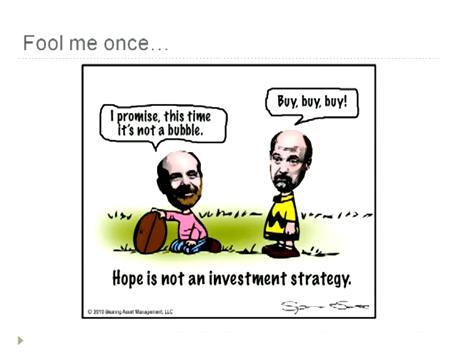
At the end of his talk, Kevin Duffy showed this cartoon. I’m not certain whether he was the creator:
Broadcast viewership hits record low
Americans avoided television in historic levels over the past week.
CBS, NBC, ABC and Fox together had the smallest number of prime-time viewers last week in two decades of record-keeping, the Nielsen Co. said. Given the dominance of the big broadcasters before then, you’d probably have to go back to the early days of television to find such a collective shrug. (Read more from washingtontimes.com)
I’m a blogger, hear me roar!
NY Times: “Lindsey Graham, This Year’s Maverick”
In a previous conversation, Graham told me: “The problem with the Tea Party, I think it’s just unsustainable because they can never come up with a coherent vision for governing the country. It will die out.” (Read more from nytimes.com)
My coherent vision for governing the country: let people keep more of their own money and solve more of their own problems.
As always, Southern Avenger’s analysis is excellent:
Harvard Study finds Big Media flipped on Torture to accommodate waterboarding
Harvard Study: From 1930s-2004,
NY Times called waterboarding torture in 81.5% of articles,
LA Times in 96.3%.
Yet from 2002â€2008,
NYT did so in only 1.4%
and LA Times in 4.8%.
The WSJ? 1.6% (1 of 63 articles)
and USA Today never called waterboarding torture or implied it was torture.
Anti-Keynesian views in WSJ!?
Today’s G-20 meeting has been advertised as a showdown between the U.S. and Europe over more spending “stimulus,” and so it is. But the larger story is the end of the neo-Keynesian economic moment, and perhaps the start of a healthier policy turn.
For going on three years, the developed world’s economic policy has been dominated by the revival of the old idea that vast amounts of public spending could prevent deflation, cure a recession, and ignite a new era of government-led prosperity. It hasn’t turned out that way. (Read more from online.wsj.com)
SA – Chris Matthews only hates third parties when they’re anti-establishment
Peter Schiff — no love from Fox News
@ 4:15 Peter discusses the lack of attention he’s gotten from Fox news.
I think this speaks to the divide between the actual tea party movement, and the neo-con establishment hijacking of the tea parties.
Peter Schiff on Greenspan Op Ed, RMB-dollar peg
Edit — more on China and the Yuan:
Don’t single out Helen Thomas
Great commentary by Saree Makdisi
If, however, it is unacceptable to say that Israeli Jews don’t belong in Palestine, it is also unacceptable to say that the Palestinians don’t belong on their own land.
Yet that is said all the time in the United States, without sparking the kind of moral outrage generated by Thomas’ remark. And while the nation’s editorialists worry about the offense she may have caused to Jews, no one seems particularly bothered by the offense felt every day by Palestinians when people — including those with far more power than Thomas — dismiss their rights, degrade their humanity and reject their claims to the most elementary forms of decency.
Are we seriously to accept the idea that some people have more rights than others? Or that some people’s sensibilities should be respected while others’ are trampled with total indifference, if not outright contempt? (Read more from articles.latimes.com)
HuffPo “experts” to Abolish Scarcity
In a recent article at the Huffington Post, Lynn Parramore assembled a team of economists to refute nine “myths” about the deficit. On the one hand, it was refreshing to see these economists discuss with such candor the fact that our financial system is backed up by nothing but green pieces of paper. On the other hand, it was shocking to see these economists laud the fact.
Believe it or not, the theme of the article is that all the handwringing over the federal budget deficit is misplaced, because Uncle Sam can print all the money he needs.
. . . .
HuffPo Myth #1: The Federal Government Should Balance Its Books
HuffPo Myth #2: Social Security Is in Crisis
HuffPo Myth #3: Government Deficits Burden Our Children
HuffPo Myth #6: Government Deficits Deplete Savings
(Read more from mises.org)
Can’t decide if this is funny or sad or deliberate propaganda.
Global Warming skeptics compared to Holocaust deniers
By every measure, the U N ‘s Intergovernmental Panel on Climate Change raises the level of alarm. The fact of global warming is “unequivocal.” The certainty of the human role is now somewhere over 90 percent. Which is about as certain as scientists ever get.
I would like to say we’re at a point where global warming is impossible to deny. Let’s just say that global warming deniers are now on a par with Holocaust deniers, though one denies the past and the other denies the present and future. (Read more from boston.com)
Paul Krugman has no understanding of libertarianism
In a New York Times opinion piece last Friday, Nobel Prize economist, Paul Krugman took a shot at libertarianism and free markets.
He points to an interview with the late Milton Friedman where he said that product safety regulation is not truly necessary because of the fear of law suits that could put companies found negligent out of business.
I agree with Friedman that the answer for issues like product liability and the oil spill is the courts.
Let me go on.
Krugman then goes on to point out the bill blocked by Sen. Lisa Murkowski that would have raised the maximum liability for oil companies after a spill from a paltry $75 million to $10 billion.
Mr. Krugman, what exactly does that have to do with libertarianism? So you are saying that liability caps like the example you used, which is very un-libertarian, as an example of the failures of libertarianism? (Read more from deskofbrian.com)