Tag Archives: Hidden History

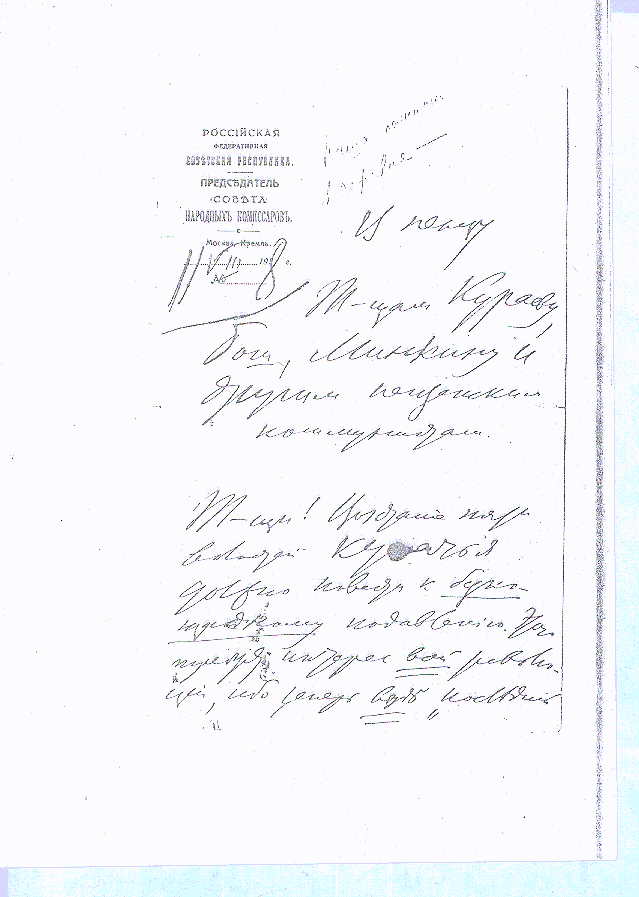
Lenin’s Hanging Order

open quote11-8-18

Send to Penza
To Comrades Kuraev,
Bosh, Minkin and
other Penza
communists

Comrades! The revolt by the five kulak volost’s must be suppressed
without mercy. The interest of the entire revolution demands this,
because we have now before us our final decisive battle “with the
kulaks.” We need to set an example.

1) You need to hang (hang without fail, so that the public
sees) at least 100 notorious kulaks, the rich, and the
bloodsuckers.
2) Publish their names.
3) Take away all of their grain.
4) Execute the hostages – in accordance with yesterday’s
telegram.

This needs to be accomplished in such a way, that people for
hundreds of miles around will see, tremble, know and scream out:
let’s choke and strangle those blood-sucking kulaks.

Telegraph us acknowledging receipt and execution of this.

Yours, Lenin

P.S. Use your toughest people for this.

…………………………….
TRANSLATOR’S COMMENTS: Lenin uses the derogative term
kulach’e in reference to the class of prosperous peasants. A volost’
was a territorial/administrative unit consisting of a few villages and
surrounding land.close quote (Read more)

Lenins Hanging Order

Lenins Hanging Order

Che Guevara calling for dictatorship

open quoteThe vanguard group is ideologically more advanced than the mass; the latter is acquainted with the new values, but insufficiently. While in the former a qualitative change takes place which permits them to make sacrifices as a function of their vanguard character, the latter see only by halves and must be subjected to incentives and pressures of some intensity; it is the dictatorship of the proletariat being exercised not only upon the defeated class but also individually upon the victorious class.close quote

–Che Guevara, Man and Socialism in Cuba (page 27)

The United States ARE . . .

open quoteIs the United States, or are the United States?

If one were to consult nearly every textbook written on the subject of the United States after the Reconstruction era, one would certainly choose the former grammatical arrangement by default. Consensus seems to have it: the United States is. But what performs the action is? Is it the “United” or the “States”? Traditional logic seems to fly in the face of post–Civil War standard American English, because logic would not allow us to make the “Union” that hides in the shadows behind the adjective “United” perform the verb that the States are supposed to be performing of their own volition.[1] Only “States” can perform an action when the noun phrase “United States” appears in the subject position. Clearly, the United States are, and they are by the rules of logic.

This problem in the application of subject-verb agreement may seem like a small quibble, but perhaps every issue at stake in the American political scene between the era of the Civil War and today’s increasing mess of government intervention can be boiled down to this same grammatical quandary. Is the United States, or are the United States? The difference lies in where we can place the power of action. Do the states, as the representatives of the people, have that power, or does the unitary power of the federal government retain a monopoly on the power of action?

In 1903, one particularly perplexed grammarian of the states’-rights position tried to tackle this issue in a letter to Harper’s Weekly. Alarmed by the change in grammar, which seemed to be making its way into the state machinery, he wrote,

It seems to be practically impossible to convince some persons of what ought to be self-evident, namely, that the text of the Constitution of the United States cannot be altered or amended in the slightest particular except by the machinery for emendation expressly provided in the text of the document itself. A paragraph is going the rounds of the press to the effect that the question whether the “United States” should be regarded as a plural or as a singular noun has been definitely settled by the Committee on the Revision of the Laws, which, it seems, in reviewing the Federal Statutes, has presumed to decide that the United States is.[2]

James Madison, the great architect of the Constitution, preferred are to that consolidated is precisely for the reason that the United States are not the singular United State.[3] Indeed, the “United State” has the ring of something dark and ominous, perhaps something not unlike Mussolini’s conception of the state as a unico mystico of man and government machinery: “No individuals or groups (political parties, cultural associations, economic unions, social classes) outside the State.”close quote (Read more)

The Forgotten Depression of 1920

open quoteThe conventional wisdom holds that in the absence of government countercyclical policy, whether fiscal or monetary (or both), we cannot expect economic recovery — at least, not without an intolerably long delay. Yet the very opposite policies were followed during the depression of 1920–1921, and recovery was in fact not long in coming.

The economic situation in 1920 was grim. By that year unemployment had jumped from 4 percent to nearly 12 percent, and GNP declined 17 percent. No wonder, then, that Secretary of Commerce Herbert Hoover — falsely characterized as a supporter of laissez-faire economics — urged President Harding to consider an array of interventions to turn the economy around. Hoover was ignored.

Instead of “fiscal stimulus,” Harding cut the government’s budget nearly in half between 1920 and 1922. The rest of Harding’s approach was equally laissez-faire. Tax rates were slashed for all income groups. The national debt was reduced by one-third.

The Federal Reserve’s activity, moreover, was hardly noticeable. As one economic historian puts it, “Despite the severity of the contraction, the Fed did not move to use its powers to turn the money supply around and fight the contraction.”[2] By the late summer of 1921, signs of recovery were already visible. The following year, unemployment was back down to 6.7 percent and it was only 2.4 percent by 1923.close quote (Read more)

Veterans Can Proceed With Drug- Experimentation Suit Against CIA

open quoteA federal judge refused to dismiss a lawsuit that claims the CIA used U.S. veterans as human guinea pigs in Cold War-era drug experiments.
Vietnam Veterans of America filed a class action against the Army and CIA in 2009, claiming that at least 7,800 soldiers had been used as guinea pigs in Project Paperclip.
Soldiers were allegedly administered at least 250 and as many as 400 types of drugs, among them Sarin, one of the most deadly drugs known, amphetamines, barbiturates, mustard gas, phosgene gas and LSD.
Using tactics it often attributed to the Soviet enemy, the U.S. government sought drugs to control human behavior, cause confusion, promote weakness or temporary loss of hearing and vision, induce hypnosis and enhance a person’s ability to withstand torture, according to the complaint.
The veterans say that some soldiers died, and others suffered seizures and paranoia. They say the CIA knew it had to conceal the tests from “enemy forces” and the “American public in general” because the knowledge “would have serious repercussions in political and diplomatic circles and would be detrimental to the accomplishment of its mission.”

. . . .

The parties disputed the number of claims at issue. While the CIA claimed the “secrecy oath” claim is the only one remaining, the veterans say the government had an obligation to notify them of the drugs’ effects and provide them health care.close quote (Read more from )

No, Paul Krugman, WWII Did Not End The Great Depression

Wow! Can’t believe this is making it into mainstream publications!

open quoteIt’s a recurring fantasy for left wing academics fascinated by central planning that in cyclical downturns government should act decisively on a scale equivalent to war. Nobel Prize recipient Paul Krugman exemplifies this intellectual longing to steer our lives.

Krugman effortlessly slides into a war footing espousing intervention comparable to America’s crusade against Hitler, who, take note, centrally planned an economy himself:

“World War II is the great natural experiment in the effects of large increases in government spending, and as such has always served as an important positive example for those of us who favor an activist approach to a depressed economy.”

After WWII until its glaring failures manifest in the Seventies, Keynesianism inundated economic thought. Paul Samuelson’s textbooks became mainstays across the academy. Samuelson championed mathematical analysis, which transformed macroeconomics into a pseudo science spawning waves of budding planners infatuated with statistics.

From this basis the myth prevails that WWII finally overcame the Great Depression. History has revised Hoover, easily the most meddlesome peacetime president before FDR, into a laissez-faire reactionary. The New Deal – a disastrous example of everything not to do during downturns became beneficial, only it supposedly wasn’t aggressive enough.close quote (Read more from forbes.com)