Tag Archives: Hidden History

Chilling quote from an American socialist

Norman Thomas was an American socialist and frequent presidential candidate for the Socialist Party of America. He said the following:

The American people will never knowingly adopt Socialism. But under the name of ‘liberalism’ they will adopt every fragment of the Socialist program, until one day America will be a Socialist nation, without knowing how it happened.

Edit: Did he really say that? www.snopes.com/politics/quotes/socialism.asp

Macaulay’s advice, 1830

From Thomas Babington Macaulay‘s brilliant and timeless 1830 essay “Southey’s Colloquies on Society”:

“It is not by the intermeddling of Mr. Southey’s idol, the omniscient and omnipotent State, but by the prudence and energy of the people, that England has hitherto been carried forward in civilization; and it is to the same prudence and the same energy that we now look with comfort and good hope. Our rulers will best promote the improvement of the nation by strictly confining themselves to their own legitimate duties, by leaving capital to find its most lucrative course, commodities their fair price, industry and intelligence their natural reward, idleness and folly their natural punishment, by maintaining peace, by defending property, by diminishing the price of law, and by observing strict economy in every department of the state. Let the Government do this: the People will assuredly do the rest.”

Requiem for Samuelson by Dr. Yuri Maltsev

Paul Anthony Samuelson (May 15, 1915 – December 13, 2009), first American Nobel Prize laureate (1970) has died, at the age of 94.

I was lucky to meet him at the M.I.T on the glorious day of November 9, 1989, the day of the fall of the Berlin Wall, the day that symbolized the end of the world system of the communist slavery.

We are all advised against speaking ill of the dead. I shall not. Paul Samuelson was a witty, humorous and very friendly and pleasant man. He was the only one I knew that rivaled Murray Rothbard in the elegance of wearing bow ties.

When I was learning economics in the USSR in the 1970s Samuelson was the only Western economist whose textbook was translated into Russian. I remember his famous graph depicting dynamics of per capita GNP in the Soviet Union and the United States according to which the USSR would surpass the US in the standard of living by 1990. He frankly admitted to me that that was mistake. “Who could know that it was all fake?”

His “Economics” was the most widely used college textbooks in the history of the world. First published in 1948, it was translated into 22 languages, and was selling over 50,000 copies a year making his author the richest economist after Ricardo.

. . . .

Robert M. Solow, a fellow Nobel laureate and colleague of Samuelson’s at M.I.T. pointed out that when economists “sit down with a piece of paper to calculate or analyze something, you would have to say that no one was more important in providing the tools they use and the ideas that they employ than Paul Samuelson”.

Samuelson was fully aware of his world-wide influence. He declared that “I don’t care who writes a nation’s laws — or crafts its advanced treatises — if I can write its economics textbooks”.

In his textbook he praised central planning and predicted the future higher standard of living in the communist world. Murray Rothbard reviewed the book in the following words:

“Samuelson’s Economics differs from its rivals largely in being bigger, more indigestible, and filled with the flip and unsupported wisecracks with which Samuelson is wont to dismiss deviant economic views.”

Paul Samuelson’s legacy is overwhelming – he will not write any more textbooks, but he will still command thoughts and deeds of academics and government officials. As Paul Krugman, his best and brightest student and admirer wrote: “It’s hard to convey the full extent of Samuelson’s greatness. Most economists would love to have written even one seminal paper — a paper that fundamentally changes the way people think about some issue. Samuelson wrote dozens: from international trade to finance to growth theory to speculation to well, just about everything, underlying much of what we know is a key Samuelson paper that set the agenda for generations of scholars. . . .” (Read more from blog.mises.org)

The Great Thanksgiving Hoax

Happy holiday’s everyone.

The Great Thanksgiving Hoax
1999 by Richard J. Maybury

The official story has the pilgrims boarding the Mayflower, coming to America and establishing the Plymouth colony in the winter of 1620-21. This first winter is hard, and half the colonists die. But the survivors are hard working and tenacious, and they learn new farming techniques from the Indians. The harvest of 1621 is bountiful. The Pilgrims hold a celebration, and give thanks to God. They are grateful for the wonderful new abundant land He has given them.

. . . .

The problem with this official story is that the harvest of 1621 was not bountiful, nor were the colonists hardworking or tenacious. 1621 was a famine year and many of the colonists were lazy thieves.

In his ‘History of Plymouth Plantation,’ the governor of the colony, William Bradford, reported that the colonists went hungry for years, because they refused to work in the fields. They preferred instead to steal food. He says the colony was riddled with “corruption,” and with “confusion and discontent.” The crops were small because “much was stolen both by night and day, before it became scarce eatable.”

In the harvest feasts of 1621 and 1622, “all had their hungry bellies filled,” but only briefly. The prevailing condition during those years was not the abundance the official story claims, it was famine and death. The first “Thanksgiving” was not so much a celebration as it was the last meal of condemned men.

But in subsequent years something changes. The harvest of 1623 was different. Suddenly, “instead of famine now God gave them plenty,” Bradford wrote, “and the face of things was changed, to the rejoicing of the hearts of many, for which they blessed God.” Thereafter, he wrote, “any general want or famine hath not been amongst them since to this day.” In fact, in 1624, so much food was produced that the colonists were able to begin exporting corn.

After the poor harvest of 1622, writes Bradford, “they began to think how they might raise as much corn as they could, and obtain a better crop.” They began to question their form of economic organization.

This had required that “all profits & benefits that are got by trade, working, fishing, or any other means” were to be placed in the common stock of the colony, and that, “all such persons as are of this colony, are to have their meat, drink, apparel, and all provisions out of the common stock.” A person was to put into the common stock all he could, and take out only what he needed.

This “from each according to his ability, to each according to his need” was an early form of socialism, and it is why the Pilgrims were starving. Bradford writes that “young men that are most able and fit for labor and service” complained about being forced to “spend their time and strength to work for other men’s wives and children.” Also, “the strong, or man of parts, had no more in division of victuals and clothes, than he that was weak.” So the young and strong refused to work and the total amount of food produced was never adequate.

To rectify this situation, in 1623 Bradford abolished socialism. He gave each household a parcel of land and told them they could keep what they produced, or trade it away as they saw fit. In other words, he replaced socialism with a free market, and that was the end of famines.

Many early groups of colonists set up socialist states, all with the same terrible results. At Jamestown, established in 1607, out of every shipload of settlers that arrived, less than half would survive their first twelve months in America. Most of the work was being done by only one-fifth of the men, the other four-fifths choosing to be parasites. In the winter of 1609-10, called “The Starving Time,” the population fell from five-hundred to sixty.

Then the Jamestown colony was converted to a free market, and the results were every bit as dramatic as those at Plymouth. In 1614, Colony Secretary Ralph Hamor wrote that after the switch there was “plenty of food, which every man by his own industry may easily and doth procure.” He said that when the socialist system had prevailed, “we reaped not so much corn from the labors of thirty men as three men have done for themselves now.”

From Mutual Aid to Welfare State: How Fraternal Societies Fought Poverty and Taught Character

Most of my socialist leaning friends would be at a loss to tell me how to poor were cared for before the growth of our massive welfare state. Perhaps they assume that before Medic Aid in 1965, people were stepping over corpses on their way to work. Most of my non-socialist friends also do not know.

The following are excerpts from an important essay about the role Fraternal Societies used to play before government killed them off.

Thoough I’m not certain it was written as an academic study, I makes me think of how few academics pursue things that actually matter. Most humanities Phd’s I know are the first to admit their subject is bullshit. They compare lengths of dresses, catalog break-dance movies, and deciding how the trauma of immigration is evident in some obscure writer’s description of nature. What a waste…

Mutual aid was one of the cornerstones of social welfare in the United States until the early 20th century. The fraternal society was a leading example. The statistical record of fraternalism was impressive. A conservative estimate is that one-third of adult American males belonged to lodges in 1910. A fraternal analogue existed for virtually every major service of the modern welfare state including orphanages, hospitals, job exchanges, homes for the elderly, and scholarship programs.

But societies also gave benefits that were much less quantifiable. By joining a lodge, an initiate adopted, at least implicitly, a set of survival values.

Societies dedicated themselves to the advancement of mutualism, self-reliance, business training, thrift, leadership skills, self-government, self-control, and good moral character. These values, which can fit under the rubric of social capital, reflected a kind of fraternal consensus that cut across such seemingly intractable divisions as race, sex, and income.

The record of five societies that thrived at or near the turn of the century illustrates the many variants of this system. Each had a distinct membership base. Two of the societies, the Independent Order of Saint Luke and the United Order of True Reformers, were all-black. Both had been founded by ex-slaves after the Civil War and specialized initially in sickness and burial insurance. The other societies had entirely white memberships. The Loyal Order of Moose was an exclusively male society that emphasized sickness and burial benefits. It became best known during the 20th century for its orphanage, Mooseheart, near Aurora, Illinois. The Security Benefit Association (originally the Knights and Ladies of Security) followed in a similar tradition but broke from the mainstream by allowing men and women to join on equal terms. During the 1910s and the 1920s, the Knights and Ladies of Security established a hospital, a home for the elderly, and an orphanage all in a single location near Topeka. The Ladies of the Maccabees was an all-white, all-female society. It provided such health benefits as surgical care. It is worth noting that the women who belonged to these societies, regarded themselves as members of fraternal rather than sororal societies. For them, fraternity, much like liberty and equality, was the common heritage of both men and women. To this end, an official of the Ladies of the Maccabees asserted that “Fraternity in these modern days has been wrested from its original significance and has come to mean a sisterhood, as well as a brotherhood, in the human family.”

. . . .

During the 1930s, officials of the homes for the elderly and orphans of the SBA cited Social Security and other welfare programs as justification not only for rejecting applicants but for closing down entirely. The Security Benefit Association, for instance, closed its orphanage because of “a lack of demand or need for that form of benevolence attributable to public funds now available for the support of dependent children.” It used the same justification to discontinue its home for the elderly several years later. While Mooseheart remained open and even increased capacity, applications fell off rapidly in the decades after the Depression because of a rise in social-welfare alternatives such as Aid to Families with Dependent Children.

Mutual aid was a creature of necessity. Once this necessity ended, so too did the primary reason for the existence of fraternalism. Without a return to this necessity any revival of mutual aid will remain limited. Moreover, fraternal membership, although still heavily working class, no longer includes the very poor who most need social welfare services.

Nevertheless, a reinvigoration of mutual aid (though not necessarily through fraternal societies) is not out of the question in the 21st century. One reform that would encourage such a trend is to repeal or revise laws that subsidize third-party insurance. Perhaps the leading example is legislation enacted during World War II, which exempts employer-provided fringe benefits, such as health insurance, from income tax. According to John C. Goodman, the annual value of this exemption adds up to an enormous $130 billion. For a typical autoworker, for example, it is over $1,200 per year. Federal tax policy has not only tied workers to their jobs but has undermined their incentives to purchase health insurance through non-governmental organizations such as fraternal societies. It has also created a perverse system where workers lose all their benefits when they change jobs or become unemployed. By contrast, if individuals had the same tax incentives to purchase insurance from associations, such as lodges, as they do now from their employer they could still retain full coverage even if they changed jobs.

The shift from mutual aid and self-help to the welfare state was not just a simple bookkeeping transfer of service provisions from one set of institutions to another. As many of the leaders of fraternal societies had feared, much was lost in an exchange that transcended monetary calculations. The old relationships of voluntary reciprocity and autonomy have slowly given way to paternalistic dependency. Instead of mutual aid, the dominant social-welfare arrangements of Americans have increasingly become characterized by impersonal bureaucracies controlled by outsiders. (Read more from heritage.org)

About the author: David T. Beito is assistant professor of history at the University of Alabama in Tuscaloosa and is the author of From Mutual Aid to the Welfare State: Fraternal Societies and Social Services, 1890-1967 (University of North Carolina Press).

Operation Health Freedom

I’m extremely impressed with this video series from the Campaign for Liberty. I learned something from every single one of the videos:

Optometrist & Senatorial candidate Rand Paul. Who are the uninsured?

British MEP Daniel Hannan talks about the National Health Service (NHS):

Peter Schiff on taxes, incentive, & free markets in healthcare:

Judge Andrew Napolitano on the regulation of interstate commerce & healthcare:

Economist Tom Woods and life before Medicare/Medicaid and its effect on society.

Health Care Reform Is More Corporate Welfare

By Ron Paul
Published 09/19/09

Last Wednesday the nation was riveted to the President’s speech on healthcare reform before Congress. While the President’s concern for the uninsured is no doubt sincere, his plan amounts to a magnanimous gift to the health insurance industry, despite any implications to the contrary.

For decades the insurance industry has been lobbying for mandated coverage for everyone. Imagine if the cell phone industry or the cable TV industry received such a gift from government? If government were to fine individuals simply for not buying a corporation’s product, it would be an incredible and completely unfair boon to that industry, at the expense of freedom and the free market. Yet this is what the current healthcare reform plans intend to do for the very powerful health insurance industry.

The stipulation that pre-existing conditions would have to be covered seems a small price to pay for increasing their client pool to 100% of the American people. A big red flag, however, is that they would also have immunity from lawsuits, should they fail to actually cover what they are supposedly required to cover, so these requirements on them are probably meaningless. Mandates on all citizens to be customers of theirs, however, are enforceable with fines and taxes.

Insurance providers seem to have successfully equated health insurance with health care but this is a relatively new concept. There were doctors and medicine long before there was health insurance. (Read more from campaignforliberty.com)

Gorbachev era Economist on History, Socialism & Healthcare

Dr. Yuri Maltsev was a member of then-President Gorbachev’s perestroika reform team. In this great interview with Radio Free Market, he corrects the generous perception historians have of Gorbachev, illustrates the flaws of Socialism, and speaks at length about the healthcare in America.

Much of the early discussion in this interview traces Dr. Maltsev’s essay (here).

Is Ben Bernanke The “Machiavelian Monster” Equivalent Of Nicholas Biddle?


Mises does a great profile of Nicholas Biddle (1786-1844), president of the Second Bank of the United States – the central bank that preceded the Federal Reserve, and provides some useful analogues to not just the current Chairman of the Fed, but to all Fed-friendly crony insitutions that are doing all in the power to perpetuate the hegemony of Wall Street.

Like Ben Bernanke today, Nicholas Biddle cultivated the veneer of a benign civil servant calculating serenely far above the political fray. In reality he, like Bernanke, was up to his neck in the backroom game of power.

When Biddle’s bureaucratic cradle was rocked, he quickly morphed into a Machiavellian monster. Keep that in mind as Ben Bernanke gets progressively cornered by Ron Paul and the bourgeoning anti-Fed movement. (Already the Fed is less popular than the IRS.)

When you hear about the Federal Reserve Transparency Act getting stalled in committee, think of Daniel Webster, bought and paid for with central bank money. When you read Fed apologia in the New York Times, The Economist, and the Wall Street Journal denouncing the “reckless populism” of the Act, think of the newspaper editors in Biddle’s pocket.

The full must read article can be found here. (From zerohedge.com)

Time Magazine (1974): Another Ice Age?

“As they review the bizarre and unpredictable weather pattern of the past several years, a growing number of scientists are beginning to suspect that many seemingly contradictory meteorological fluctuations are actually part of a global climatic upheaval. However widely the weather varies from place to place and time to time, when meteorologists take an average of temperatures around the globe they find that the atmosphere has been growing gradually cooler for the past three decades. The trend shows no indication of reversing. Climatological Cassandras are becoming increasingly apprehensive, for the weather aberrations they are studying may be the harbinger of another ice age.

Telltale signs are everywhere —from the unexpected persistence and thickness of pack ice in the waters around Iceland to the southward migration of a warmth-loving creature like the armadillo from the Midwest.Since the 1940s the mean global temperature has dropped about 2.7° F. Although that figure is at best an estimate, it is supported by other convincing data. When Climatologist George J. Kukla of Columbia University’s Lamont-Doherty Geological Observatory and his wife Helena analyzed satellite weather data for the Northern Hemisphere, they found that the area of the ice and snow cover had suddenly increased by 12% in 1971 and the increase has persisted ever since. Areas of Baffin Island in the Canadian Arctic, for example, were once totally free of any snow in summer; now they are covered year round.” (Read more from time.com)

See Also:
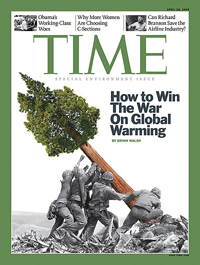
How to win the war on Global Warming

Shadow Government Statistics in the U. S. S. A.

I wanted to share an excellent website a friend introduced me to: www.shadowstates.com.

“John Williams’ Shadow Government Statistics is an electronic newsletter service that exposes and analyzes flaws in current U.S. government economic data and reporting, as well as in certain private-sector numbers, and provides an assessment of underlying economic and financial conditions, net of financial-market and political hype.”

Unemployment too high? No problem. Redefine people who can’t find jobs as something other than “unemployed.”

Even the consumer price index is showing inflation? No problem. Stop tracking food and energy.

GDP too low? No problem. Track GNP instead.

Still too low? No problem. Send it back to the Commerce Department until those anti-revolutionary Kulaks get it right!

***

· During the Kennedy administration, unemployment was redefined with the concept of “discouraged workers” so as to reduce the popularly followed unemployment rate.

· If Lyndon Johnson didn’t like the growth that was going to be reported in the GNP, he sent it back to the Commerce Department, and he kept doing so until Commerce got it right. The Johnson administration also was responsible for gimmicking the accounting that hides most of the federal deficit.

· Richard Nixon had a highly publicized war with the Bureau of Labor Statistics on the unemployment data. Nixon wanted to report the unemployment rate as the lower of the seasonally adjusted or unadjusted number, at any given time, but not specify same to the public. While that approach was unconscionable at the time and never used, basically the same methodology was introduced in 2004 as “state-of-the-art” by the current Bush administration.

· The Carter administration was caught deliberately understating inflation.

· Systemic changes were introduced during the Reagan administration to boost reported GNP/GDP growth on a regular basis. The wildest manipulations, however, happened at the time of the 1987 liquidity panic. In addition to intervention in the futures markets by the New York Fed to help prop the stock market after the October 19th crash, direct and heavy manipulation of the trade deficit data, under the direction of the Federal Reserve and U.S. Treasury, was used in conjunction with massive currency intervention to help bottom the dollar and to contain the currency panic at year-end 1987.

· The first Bush Administration began efforts at the systematic reduction of the reported rate of CPI inflation, and worked an outside-the-system GDP manipulation aimed at helping with the failed 1992 reelection bid.

· As former Labor Secretary Bob Reich explained in his memoirs, the Clinton administration had found in its public polling that if the government inflated economic reporting, enough people would believe it to swing a close election. Accordingly, whatever integrity had survived in the economic reporting system disappeared during the Clinton years. Unemployment was redefined to eliminate five million discouraged workers and to lower the unemployment rate; methodologies were changed to reduce poverty reporting, to reduce reported CPI inflation, to inflate reported GDP growth, among others.

· The [current] Bush administration has expanded upon the Clinton era initiatives, particularly in setting the stage for the adoption of a new and lower-inflation CPI and in further redefining the GDP and the concept of seasonal adjustment.