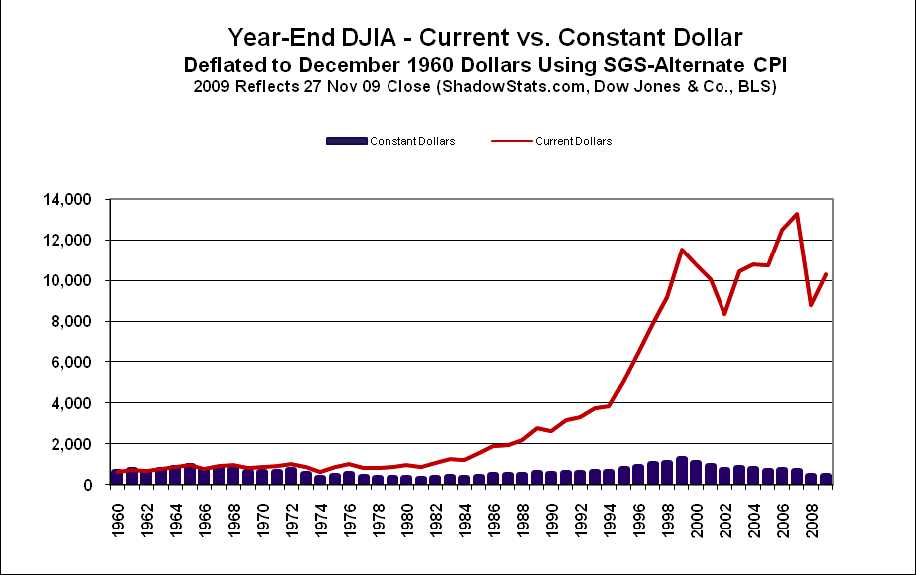
This and other wonder charts are from ShadowStats.com.
". . . a republic, if you can keep it."
This and other wonder charts are from ShadowStats.com.
The term hyper-inflation itself is interesting. It is a word which seems to universally mean the sudden, dramatic drop in the value of money (ie. the sudden, dramatic rise in prices). The word inflation is more contested.
The government prefers to consider inflation a rise in prices. Why? Because government measures inflation by the heavily manipulable consumer price index, which can be twisted to ignore food and fuel costs. The government hates bad economic news. It also adjusts its many redistribution of wealth according to the CPI, so having control over it helps.
Followers of the Austrian School (me) use the term inflation to mean, simply, an increase in the monetary supply. Price increases are merely a consequence of inflation, as is the wage/price spiral so many economists enjoy obsessing over. So when government, and government minions scrutinize about what they call inflation, my friends and I think they are paying attention to the sideshow of prices, and avoiding the real issue: the printing of money out of thin air.
We do lack a word, however, for the sudden, dramatic drop in the value of money (rise in prices), hence we rely on hyper-inflation.
What does it look like?
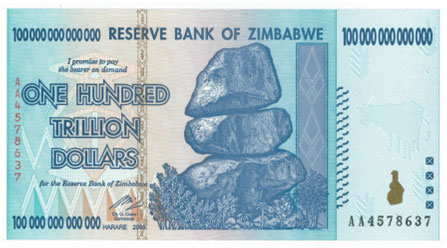
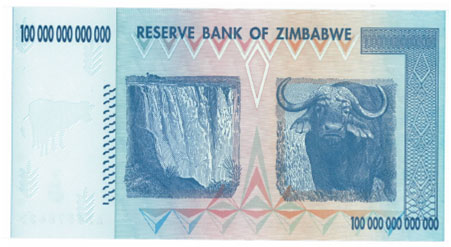
Here is a note for a hundred trillion Zimbabwean dollars. I don’t think it’s worth the paper it’s printed on. Initially, governments like printing money, because it transfers wealth more subtly than taxation, but eventually you get this:
Turkey to use national currencies in trade with Iran, China
 Turkey is switching to national currencies in trade with Iran and China, ending dependence on the U.S. dollar and the euro for about 20% of its commodity turnover, local media reported on Wednesday.
Turkey has already switched to settlements in national currencies with Russia amid weakening confidence in the greenback as the world’s major reserve currency. The move was initiated by Turkish President Abdullah Gul during his visit to Moscow in February. (Read more from rian.ru)
Bernanke reassures markets on dollar
The Federal Reserve is monitoring currency markets “closely” and will conduct policy in a way that will “help ensure that the dollar is strong”, Ben Bernanke said on Monday in rare comments on the US currency.
In remarks apparently aimed at reassuring markets and foreign governments that the central bank is not indifferent to the fate of the US currency, the Fed chairman said “we are attentive to the implications of changes in the value of the dollar”. (Read more from ft.com)
Stopping the dollar’s demise means stopping Congresses endless spending on war, healthcare, bank bailouts, etc. Not very likely.
“The business site Bloomberg is running a story today titled Yuan Deposes Dollar on China’s Border in Sign of Trade’s Future. [Interestingly, after being up for over an hour, this story suddenly went away between 1 and 2 am. Before coming back in what seemed like a slightly less hard hitting form.]
When Treasury Secretary Geithner spoke on June 1st to students at Peking University and claimed that America was in good shape and China’s dollar investments were safe. His assurances were greeted with loud hoots of laughter from the assembled students, many of them the sons and daughters of China’s elite. Geithner humiliation was barely reported in America, but it seemed to resonate much more strongly elsewhere around the globe. Spawning many stories similar to the story running today at Bloomberg.com about how people are digging up that jar full of dollars and replacing them with gold or border traders switch from dollars to other currencies. The disbelieving laughter of China’s students may well mark a sea change. The begin of the end for the dollar’s reign as the world’s reserve currency. With America’s politicos planning to spend approximately double what they expect to collect in taxes this year, it is easy to see why the students were amused by Geithner posturing. But the chaos that will ensue if a dollar crisis were to suddenly force America’s politicos to start living within America’s means won’t be funny.” (from humods.com)
“The US administration has been saying it sees the first green shoots of economic recovery. However consumer spending remains low in America, and some experts argue the signs are misleading.
What can you get for a dollar? Not much these days.
Its value dropped considerably at the end of June – and this is despite the Obama administration announcing signs of an economic rebound.
Experts think these are false claims of hope. They see a gloomy future for the dollar and say the $787 billion stimulus package passed earlier this year is only making things worse.” (Read more from geraldcelentechannel.blogspot.com)
Schizophrenia is a euphemism. Hypocrisy and/or idiocy is more apt.
“As Hulsmann explains, the ‘leadership of the U.S. Federal Reserve is aware of this situation.’ (Page 233) OK. That’s reassuring. But if U.S. officials are concerned about the terrible consequences of a POSSIBLE dumping of dollars on the U.S. market, why are they UNCONCERNED about the consequences of their own efforts to stimulate the economy, which involves the same mechanism that they so fear from foreign actions; that is, massive expansion of the money supply?
The government has taken two actions that will expand the money supply every bit as much as possible foreign actions to dump the dollar–expansion of the monetary base by the Federal Reserve Bank and the Obama administration’s spending spree.” (Read more from patrickbarron.blogspot.com)
Predictions from seekingalpha.com:
Prediction one. The twenty-five-year equities bubble pops in 2009. U.S. and foreign equities markets will stop treading water and realign with economic reality. Stock prices will cease to reflect the “greater fool” mentality and will return to being a function of dividend yields, which have long been miserable. The S&P 500 will sink below 500. In a bid to stem the panic, the government will enforce periodic “stock market holidays”, and will vastly expand the scope of its short-selling prohibitions—eventually banning short-selling altogether.
Prediction two. With public pension systems and tens of millions of 401k holders virtually wiped out—and with the Baby Boomers retiring en masse—there will be tremendous pressure on the government to get into the stock market in order to bid up prices.
Therefore, sometime in 2010, the Federal Reserve will create and loan out hundreds of billions of fresh dollars to the usual well-connected suspects, instructing them to buy up stocks on the public’s behalf. This scheme will have a fancy but meaningless name—something like the “Taxpayer Assurance Equities Facility”. It will have no effect other than to serve as buyer of last resort for capitulating smart-money types who want to get out of stocks entirely.
Prediction three. Millions of new retirees—including white-collar people with high expectations for a Golden Retirement—will be left virtually penniless. Thousands will starve or freeze to death in their own homes. Hundreds of thousands will find themselves evicted and homeless, or will have to move in with their less-than-enthusiastic children. Already strained by the rising tide of the working-age unemployed, state and local welfare services will be overwhelmed, and by 2012 will have largely collapsed and ceased to function in many parts of the country.
Prediction four. “Quantitative easing” will fail to restart previous patterns of lending and consumption. As the government sends out additional “rebate” checks and takes ever-more drastic measures to force banks to lend, hyperinflation could take hold. However, comprehensive debt relief via a devaluation of the dollar is even more likely. This would entail the government issuing one “new” dollar for some greater number of “old” dollars—thus reducing both debts and savings simultaneously. This would make for a clean slate a la Fight Club.
As there are many more debtors than savers in the U.S., the vast majority would support devaluation. The Chinese and other foreign holders of our bonds would be screaming mad, but unable to do anything. Every country that has not found a way out of dollar-denominated reserve assets by 2012 will see its reserves eliminated.
Prediction five. The government will stop pretending that it can finance continuous multi-trillion-dollar deficits on the private market. By late 2010, the sole buyers of new U.S. Treasury and agency bonds will be the Federal Reserve and a few derelict financial institutions under government control. This may or may not lead to hyperinflation. (See prediction four).
Prediction six. As the need for financial industry paper-pushers declines and people have less money to spend on lawyers and Starbucks (SBUX), unemployment will rise until the private sector has eliminated all of its excess capacity and superfluous or socially needless jobs. The government’s narrow unemployment figure (U3) will rise into the high teens by late 2010. The government’s broader unemployment figure (U6) will cease to be reported when it reaches 25 percent—it will simply be too embarrassing. Ultimately, one in three work-eligible Americans will be unemployed, underemployed, or never-employed (e.g. college grads permanently unable to find suitable work).
Prediction seven. With their pension dreams squashed, and their salaries frozen or cut, police and other local government workers will turn to wholesale corruption in order to survive. America’s ideal of honest, courteous, and impartial cops, teachers, and small-time local functionaries will have come to an end.
Prediction eight. Commercial overcapacity will strike with a vengeance. By 2012, thousands of enclosed malls, strip malls, unfinished residential developments, motels, truck stops, distribution centers, middle-of-nowhere resorts and casinos, and small-city airports across America will turn into dilapidated, unwanted, and dangerous ghost towns. With no economic incentive for their maintenance or repair, they will crumble into overgrown, plywood-and-sheet-rock ruins.
Prediction nine. By the end of 2010, tens of millions of households will have fallen behind on their mortgages or stopped paying altogether. Many banks will be unable to process the massive volume of foreclosure paperwork, much less actually seize and resell the homes.
Devaluation (as mentioned in prediction four) could ease the situation for those mortgage holders still afloat, but it would also eliminate any incentive for most banks to stay in the mortgage business. In any case, the housing market in many parts of the country will lock up completely—nothing bought or sold.
With virtually no loans being made, even the government will finally acknowledge that most banks are fundamentally insolvent. A general bank run will only be averted through a roughly one trillion-dollar recapitalization of the FDIC, courtesy of new money from the Federal Reserve.
Prediction ten. As an economy is never independent of the society within which it functions, the next few paragraphs will focus on social and political factors. These factors will have as much of an impact on market and consumer confidence as any developments in the financial sector.
Whether rightly or not, President Obama, having come to power at the dawn of this crisis, will be blamed for it by over 50 percent of the population. He will be a one-term president. In response to his perceived socialization of America, there will be a swarm of secessionist and extremist activity, much of it violent. Militias and armed sects will be more prominent than in the early 1990s. Stand-off dramas, violent score-settlings, and going-out-with-a-bang attacks by laid-off workers and bankrupted investors—already a national plague—will become an everyday occurrence.
For both economic and social reasons, millions of immigrants and guest workers will return to their home countries, taking their assets and skills with them. The flow of skilled immigrants will slow to a trickle. Birth rates will plummet as families struggle with uncertainty and reduced (or no) income.
Property crime will explode as citizens bitter over their own shattered dreams attempt to comfort themselves by taking what is not theirs. Mutinies and desertions will proliferate in an increasingly demoralized, over-stretched military, especially when states can no longer provide the educational and other benefits promised to their National Guard troops.
There will be widespread tax collection issues, and a huge backlash against Federal and state bureaucrats who demand three-percent annual pay raises while private sector wages remain frozen or worse. In short, the “Tea Parties” of tomorrow will likely not be so restrained.
The fact that a Forbes columnist used the D-word is very significant. Usually the media supports the government’s desire to maintain confidence in the dollar. Government needs this confidence to preserve the dollar’s value as it prints trillions from thin air to support wars, domestic spying and the salaries of 22 million federal employees. Why are rumors of devaluation dangerous? Think about it. What would you do if you knew dollars were about to lose half their purchasing power?
In my mind, the fact of devaluation’s discussion is news in itself.
“What began as government social tinkering–with implied threats to banks and mortgage companies to extend home loans to even the most marginal of borrowers–led to a greed-blinded mortgage banking business and the meltdown we are experiencing today. Now we are asked by the same congressional leadership to go along with taxpayer-funded bailouts of the very banksters who, while making millions, created the mess.
Despite the trillions of dollars already expended recapitalizing banks, there is very little, if any, progress to show. Will a few trillion more do the trick? That seems to be the consensus among Congress and the banks. ‘They are simply too big to let fail,’ or are they really just too big to save? We can go back to “Plan A” and buy the toxic assets. If so, at what price? What if a few trillion does not remove enough toxic waste from the system or doesn’t get credit flowing again and the economy bustling?”
“A quick dollar devaluation would work wonders for submerged borrowers. Don’t kid yourself: It could happen.”
“It can be done on a country-by-country basis, but a coordinated devaluation would work best. A devaluation of 30% would raise the dollar value of all assets by 43%. A $200,000 home with a $230,000 mortgage would become a $286,000 home with the same mortgage. Presto! The homeowner who was $30,000 upside-down now has $56,000 equity and a good reason to make his payments. Both the homeowner and the bank are immediately better-off.
It would even benefit those who purchased their homes responsibly, as the value of their homes would rise by the same 43%. The current course of throwing trillions of dollars at the culprits is without any benefit to those who acted responsibly. Admittedly, this is not a solution without the price of inflation.” (Read more from forbes.com)
I started paying attention to our monetary system since watching the very disturbing America: Freedom to Fascism.
Two Ron-Paul clips about how inflation happens:
–Speech in Iowa — inflation is often a transfer of wealth from the working masses to the bankers and government institutions that spend newly-printed (and not yet inflated) money.
–On the floor of Congress discussing the integrity of the dollar.
The occasion for this post is this: The Federal Reserve (which is about as federal as Federal Express) has just injected $31.25 BILLION into the economy. I think the key to understanding this is picking apart the process behind the word “injected.” It results in the transfer of wealth described by Ron Paul in the clip above. That’s not to say money should never be printed, but it ought to be done by Congress, as specified in the Constitution. In 1913, they abrogated their responsibility by creating the private and very secretive Federal Reserve.