Tag Archives: Lost Republic Original

Dick Morris’s notable exclusion

So, if you had to guess which much-discussed potential Republic presidential candidate was excluded from Dick Morris’s review of contenders, who would it be?

Here’s a clue from this Hannity interview:

Still confused?

Here Peter Schiff interview Dick Morris, who quits the interview, and mentions the unmentioned man — RON PAUL.

I think this interview reveals that Dick Morris, like most Republicans favored by big media, wants to replace Obama’s socialism with their own brand of socialism.

So it should be no surprise that Morris ignores true anti-socialist, Ron Paul. Ignoring Dr. Paul seems to be a common tactic:

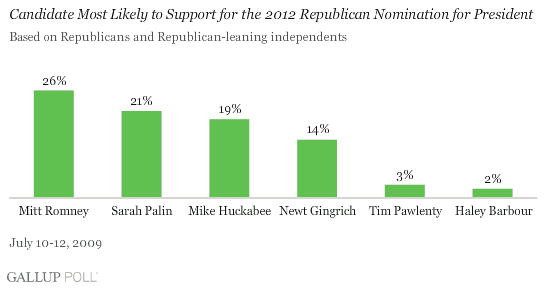
Gallup Poll excludes Ron Paul

Rasmussen excludes Ron Paul

Washington Post’s debate commentary 2007 excluded Ron Paul

Glenn “Bandwagon” Beck’s poll excluded Ron Paul

BBC’s election guide excluded Ron Paul

And the list goes on, and on, and on.

Check out my two earlier posts for more:
Censoring Ron Paul (then and now)
Censoring Ron Paul – Why the rEVOLution will not be televised

Public vs. Private bankruptcy — the turmoil in Wisconsin

When private enterprises are inefficient/losing money/unwanted they go bankrupt. The turmoil is confined to the owners, workers and investors. As a last ditch effort they try to improve efficiency and quality.

When public enterprises are inefficient/losing money/unwanted they attempt to increase/maintain their share of tax dollars. The turmoil is thrust in the face of every citizen. As a last ditch effort, they resort to spectacle and demagoguery.

People’s Revolutionary masses take to the streets in London

Great pictures of the London protests can be found here.

These are the socialists. They believe they are entitled to receive something and a price of their choosing. No doubt they also consider the ongoing economic crises (which is about to get *MUCH* worse), as part of the same conspiracy that raises their tuition.

It is important for those of us who believe in liberty to win the intellectual debate, to point out to the world that it is exactly the same sense of entitlement felt by government, its vast bureaucracies, and its constituencies, that leads to the catastrophic economic crisis we are about to face.

As regular readers of this blog know, I am wary of police and the government monopoly on violence. However this is a protest in which security (public or private) had a very appropriate role.

One of the pictures shows blatant, senseless destruction of private property by protesters:

Commentary on the recent repeal of gay-marriage Iowa

I consider this issue another tragedy of public property. Because the definition of marriage is presided over by the state, those of us who have strong beliefs about it are FORCED to do battle.

Can you imagine a world in which the government didn’t even know if I was married, didn’t preside over the definition and didn’t require a $40 fee for permission?

Conflicting points of view co-exist more peacefully when government isn’t involved.

In a such a world, the fact that two people choose to call themselves married, or the fact that some people don’t consider my marriage legitimate is no more a threat to me than, say, my neighbor adopting dietary habits that I consider nonsensical and counter productive.

Please feel free to disagree with me. Most of my friends do. :)

Commentary on the election of Rand Paul

I guess we’ll wait and see. I like his support for auditing the Federal Reserve and limiting spending. I like this skepticism about our wars too, though greatly prefer this father’s outright opposition.

I’m also very much influenced by Hans Herman Hoppe’s earth-shattering book, Democracy the God that Failed. I’ve begun to doubt that Democracy works, so I’m largely just an amused bystander when a politician is elected who seems to support my belief in individual liberty.

The Constitution was good, so good that it took 300 years for power to become centralized, concentrated, and predatory, but nevertheless, here we are. Realize that we used to be a nation in which half the population didn’t have to work.

Perhaps the best thing that can happen is a falling apart of the United States, preferably into 310 million independent nations. (peacefully!)

The case against coersive taxation

From a correspondence with friends:

I hold the very radical belief that taking someone’s property by force or threat of force is stealing, regardless of whether it’s done by an individual or institution or government, regardless of whether you call it taxation, and regardless of what virtues are invoked to justify the violence.

***

My apologies for the long-winded reply, but this stuff is my passion. I’m happy to make my case, even if we agree to disagree afterward:

> “Is it wrong to keep a standing army?”

Yes. The United States did not keep a large standing army during peacetime until 1948. Since then, we’ve had a foreign, undeclared war every decade, and never mind the fact that our Constitution requires congress to declare war. The psychopaths in government are having too much fun sending suckers like me off to war and their friends are making too much money.

How you like them apples? You’re a citizen of a country that can’t go a single decade without invading another.

How about the fact that we spend more than the rest of world COMBINED on “defense” which to me looks more like “offense”?

> “With all that you own and all that was given to you just by virtue of being born in the US, don’t you think that is worth protecting?”

I feel tremendous admiration and gratitude to all the entrepreneurs who risk their personal wealth to produce goods and services they hope I will VOLUNTARILY buy.

These are the people we should revere. These are the people to whom we should build monuments, not the power hungry politicians and bureaucrats who are too stupid, lazy, and cowardly to provide us with things we want. They cannot serve society, so they seek to rule it. Entrepreneurs build civilization. They are the ones who need protection, primarily from their government.

> “You use the services of the country, therefore, you have to pay your share.”

1- There are many that don’t use, which I’m also required to pay for.

2- I’d hardly categorize the wars in Iraq and Afghanistan, the bank bailouts, the nationalization of General Motors, the TSA’s pornographic body scanners, the NSA’s eavesdropping on my telephone calls, the Guatemalan Syphilis Experiment, and the BULLSHIT speeding ticket I got as “services.”

3- I’d absolutely *love* to stop using ALL public “services” in exchange for keeping all the money which people VOLUNTARILY give me for my work.

But regardless, I’m glad you at least used the words “have to.” You acknowledge then that government-provided services are coercive.

Violence will be used against me if I attempt to do without the benefit of infecting unsuspecting Guatemalans with Syphilis, for example. Initially, my refusal to pay for this public “service” will only inspire increasingly menacing letters from the tax collector, but ongoing refusal to pay will be met with physical violence, including lethal force should I attempt to defend my property. (btw, I pay all my taxes — out of fear.)

Please acknowledge the violence.

It can be justified only if you believe that a peaceful system of voluntary exchanges cannot provide education, security, food for the hungry, housing the poor, transportation, culture, etc.

Then you are faced with a dilemma: Should we leave the poor to their fate or should we violently separate people from their wealth? Should remain ignorant about the advanced stages of Syphilis or should we use the threat of violence to force people to pay for government experiments?

Of course, I believe there is overwhelming evidence that all these things are better provided in a free market (all the ones which are worth doing that is, and none of the ones which aren’t) . Therefore, the dilemma you might feel between violent taxation and some societal need doesn’t even exist.

Because your statist approach is the violent approach, I think the burden of proof lies with you; you must to demonstrate the government’s superiority to the free market. Nevertheless, I’ll make the case that the free market is the better provider, just because it’s so easy to do:

> 1) Security.

If you search for “mall cop tasers” on youtube, you don’t find anything (I didn’t), because privately hired security, unlike security hired by the greedy, lazy, cowardly, power-hungry sociopaths in government is accountable.

You might also be interested in the not-so-wild west where private security flourished, and the murder rate was lower than that of most modern-day U.S. cities:
www.independent.org/publications/tir/article.asp?a=552

Also, gun town USA — where crime nearly vanished, and not a single person has been murdered in the 25 years since a renegade mayor required every household to purchase a gun:
www.wnd.com/?pageId=41196
(I’m philosophically against the requirement, because it’s coercive, but I think this demonstrates the ability of people to protect themselves peacefully.)

> 2) Transportation

The railroad was build on private initiative in pursuit of private profits. It worked great until government strangled it with regulation, then killed it by FORCING everyone to subsidize an interstate highway system.

The obvious failure of the free market then precipitated the nationalization of Amtrak, a government monopoly, which, if I remember correctly, has lost 32 billion dollars to date.

Despite the best efforts of the statist ideologues, Indiana, Chicago and California are considering selling roads to entrepreneurs who are willing to risk their private wealth in the providing of transportation services.

> 3) need a structured state government to implement changes

Like a hole in the head.

Local governments have either outlawed or required people to kiss the ring of governance, beg permission and pay a hefty licensing fee for the following privileges:
-arranging flowers in Louisiana
-selling coffins in Louisiana, even for monks
-interior designing in DC or Florida
-showing tourists around in Boston
-labeling GMO-free foods “GMO-free”
-selling raw milk
-running lemonade stands in Portland ($120 health department fee)
-selling pumpkins and Christmas trees into Lake Elmo MN
-delivering your neighbors garbage to the dump in San Francisco
-putting signs in your store windows in Dallas
-eyebrow threading in Texas
-training Yoga instructors in Virginia

You risk the violence of government for committing these “crimes.”

4) civil services

How about the fact that poverty in the US fell by 1% a year from 1950 until 1968 when the government’s “war on poverty” began? Since the government’s “war on poverty,” the poverty rate stagnated and remained so despite a quadrupling of the government’s anti-poverty budget.

Source:
www.youtube.com/watch?v=064YTtSxVSo#t=46m10s

Consider this next time you hear someone say the free market punishes the poor.

5) (I’ll cover education, though you didn’t list it.)

As I said, I believe the burden of proof lies with the advocates of violence. I challenge you to find any evidence that public education has been anything but a pathetic, disastrous failure despite a tripling of the federal education budget, and a doubling of the number bureaucrats per student:
www.lostrepublic.com/archives/4630

There’s also the fact that before America’s first public schools appeared in Massachusetts, there was near 100% literacy.

I think all the evidence of the superiority of the free market in providing services generally provided by government is irrefutable. You may find ways spin, question and undermine it, but instead of doing that, can you find evidence that the government approach is superior? Can you find any evidence whatsoever to justify the coercive funding of public “services”?

A parable reflecting the common, unimaginative objections to privatizing education

People in the Soviet Union were standing in line for butter. After several hours, one of them said:

“This sucks. Why does government control food distribution?”

There were some nods of agreement, but the young man behind him, a Phd student, said “the free market is great for the rich, but what about the poor? Who would feed the poor?”

“Can you imagine a system in which food is only grown and sold for profit??? A system in which everything was about MONEY!” said another man. “How barbaric!”

“I can speak to this personally,” said a fourth man, a drunk who wobbled on his legs. “Every day of my life I eat from my government quota of food. If it wasn’t for the government, I would starve!”

“Yes, you’re right, the original dissenter agreed. Perhaps food is too important to be left to the free market.”

Commentary on Libertarian Environmentalism

A corresondence with a friend about to begin studying libertarianism:

You’re asking all the right questions about government’s role and environmentalism. I’m happy to share my perspective.

W.r.t. Global Warming, I’m personally skeptical. I think it’s going to go the way of many other government endorsed “scientific consensuses” of the previous century, like eugenics (50,000 American citizens were FORCIBLY sterilized), the consensus that black people’s brains were anatomically inferior, the coming ice age of the 1970s, the imminent over-population problem of the 1980s, and of course the fact that peak oil has been predicted since Standard Oil struck black gold in Texas.

Whenever there is a “scientific consensus” about a threat to humanity whose solution calls for the use of massive government power, be skeptical.

So, I’ll limit this discussion to pollution, conservation and water.

Pollution and conservation are best handled by private property. If you own woods and want to chop them down, no problem. If you, however pollute the ground water which contaminates your neighbor’s property, then there is a role for the justice system.

This is a philosophically different approach from the arbitrary regulations set by government.

* In this lecture, Stephen Kinsella mentions how California’s environmental law requires all gas companies to purchase a specific gadget, which, by the way, is patented by a politically connected California company. This means more expensive gas for everyone. Government controls are rife with corruption. Contrast this with the private-property approach — So long as you’re not polluting your neighbor, who cares what technology you use?

* Government controls also take an all-or-nothing approach. Either entrepreneurs are completely forbidden for turning vast stretches of resources into goods that you and I want, or the government leases the resources with far too few restrictions to a mining/logging/drilling company whose only goal is to extract as much as possible, as fast as possible.

Imagine if you and I owned a stretch of woods. Imagine all the innovations which we’d create negotiating with loggers, meeting their needs, but also maintaining the land for future use. Politicians don’t have this foresight. Perhaps we would make money from hikers, campers, hunters.

Another characteristic of government controls is that no matter how much lobbying happens, the government remains just a few pen strokes away from swinging from one extreme to the other.

The vast resources spent lobbying government about control of government-owned resources would be better spend, buying, owning and managing natural resources. Sadly, it’s illegal for people to buy / own very much land. Realize, also, that the environmental lobbies are extremely well-funded and powerful, and could realistically buy vast amounts of land for the purpose of conservation.

The method of privatization, of course, is an important and difficult issue, but in general, I think private property is a much better scheme for environmentalism than government regulation.

Have confidence that every human desire is a business opportunity, including the desire to preserve/enjoy nature. Maybe our privately owned woods can out-compete other privately owned woods for the business of hikers by preserving endangered species. What a great blurb this might be on our billboards. Private ownership creates a market-incentive to protect endangered species. This is in stark contrast with the government approach of punishment. If you do happen to own a little bit of woods and the government finds some endangered animal on it, you’re fucked, and the way people deal with this is to shoot, shovel and shut-up.

Water. I just read a great little book called “water for sale” which studies privatization of water distribution. (I’d be more interested in the more radically libertarian idea of private ownership of water, but this doesn’t really exist anywhere.) In any case, the short little books addresses all the common objections — how can we force the poor to pay for water???

It makes an exhaustive and brilliant case for privatization of water distribution. There are many places in the world where, after privatization, poor neighborhoods received potable water for the first time ever. It’s a great success story, which it’s critics have a hard time denying.

Expect a whole lot of socialist propaganda in your courses.

These issues are similar to food freedom issues, in that the socialists and I usually agree on the problem, but have exact opposite solutions.

For example, you can try to reduce the amount of Ecoli in beef by having the government do more — stricter laws, stricter enforcement, stricter regulation — that is the socialists’ solution.

Or you can reduce the amount of Ecoli in beef by having the government do less — end the MASSIVE subsidies of corn. Corn-fed cows have 3x the amount of ecoli as grass-fed. The latter is only done because government subsidy makes it economical.

Here‘s a review I wrote of a documentary about Monsanto.

(More on food freedom)

Conversing with Critics

Well, the Mises Institute has done it to me again. I was so taken by Jeffrey Tucker’s recent lecture, “How Government is Unraveling Civilization by Force,” that I posted it on a social news site, calling attention to what I considered the lecture’s most provocative moment: Tucker’s quoting of Lew Rockwell: “It’s as if the socialists discovered that their plan creates poverty, so they decided to change their name to environmentalists to make poverty the goal.” Aside of its provocative tone, the quote summarized the lecture rather well.

Sometime I think I engage in online economic and political debates because they sharpen my rhetorical skills and to force myself to re-examine and re-explore my libertarianism. Other times, I think I’m driven by a masochistic determination similar to the impulse which led me to sport of distance running as a teenager.

I immediately found myself in another long, long, frustrating debate about the Austrian school with a anonymous user who at least seemed earnest in his belief.

I’ve always admired the willingness of the Austrian School, and that of its great ambassador, Ron Paul, to address the best of the opposition. The willingness stands in stark contrast to the usual public debate, in which each side acknowledges only the most ridiculous, desperate, disreputable members of its opposition as if they represented the whole. The public debate consists of little more than building and burning straw-men.

I want to share the debate which ensued not to burn my own straw-man, though I admit, it occasionally lapsed into absurdity, but to demonstrate how statist ideology fails to live up even to the standards by which it judges and condemns the Austrian School.

One of the most challenging steps in my eventual acceptance of the Austrian School, was realizing the supremacy of theory over empiricism. I do not blame anyone for initially recoiling at the suggestion that economics defies empiricism, or, at least, defies an empiricism comparable to that of the hard sciences. I did.

When asked to live up to their own empirical standards, it becomes evident that statism begins with axiomatic acceptance of state power and free-market fallibility, and relegates the empiricism and math they so readily demand of the Austrian School to a role no more important than that of parsley on a steak. It is a garnish; little more than counting. They count taxes, budgets, unemployment checks, paper dollars, volumes of concrete, cheese, meat, corn, cosmonauts, tanks. They attempt to understand human society in all its complexity but their only tool is a tape measure.

Here’s the debate:

HIM:

That statement is so far removed from reality it’s disturbing to know that people consciously make this their world view in order to support an equally delusional ideology that actually creates poverty in the real world.

> Austrian economics was ill-thought of by most economists after World War II because it rejected mathematical and statistical methods in the area of economics.[27] Its reputation rose somewhat in the late 20th century with the work of Israel Kirzner and Ludwig Lachmann, as well as a renewed interest in Hayek after he won the Bank of Sweden Prize in Economic Sciences in Memory of Alfred Nobel (a.k.a. the Nobel Prize in Economics).[28] Following Hayek, one of Ludwig von Mises’s students, Murray Rothbard, became prominent in both Austrian applied theory and Libertarian philosophical thought.[29] However, it remains a distinctly minority position, even in such areas as capital value.

It’s interesting to know that the Austrian School of Economics has basically been unable to show that any of their principals actually hold up in the real world. The whole sub field of economics basically only works as a thought experiment.

ME:

For the sake of argument:

> It’s interesting to know that the Austrian School of Economics has basically been unable to show that any of their principals actually hold up in the real world.

Keynesian Economics vs. Austrian Economics

Applying Economics to American History

HIM:

Applying theory after the fact is something any idiot can do. There is no mathematical or scientific basis to anything Austrian School economists claim. It’s like Voodoo Economics, it’s all faith based.

ME:

Well, the first of the two videos I posted show Peter Schiff, a follower of the Austrian School predicting the crash of the housing market at a time when Bernanke, the Fed, and all the Media’s talking heads were saying it was impossible. Watch the video and you’ll see him ridiculed for making his prediction.

Other examples:

– In his book Socialism (1920), Ludwig Von Mises not only predicted the collapse of the Soviet Union, but said the country would be full of factories which produced almost no ready consumer good.

– Congressman Ron Paul, Austrian School follower, July 16, 2002:

> by transferring the risk of a widespread mortgage default, the government increases the likelihood of a painful crash in the housing market. This is because the special privileges of Fannie, Freddie, and HLBB have distorted the housing market by allowing them to attract capital they could not attract under pure market conditions.

– When the world entered the all-paper money regime, most economists said than the price of gold would fall from $35. The Austrians predicted the opposite.

– The Austrians were right about the 1970s stagflation and the explosion in the price of gold after the gold window was closed.

Your move. :)

HIM:

There is nothing more than theory to any of that. That’s the entire point and you’re actively trying to ignore and obfuscate that point.

Show me where there are any mathematical or scientific examples that support those things happening in real world situations.

There are none, the Austrian School of Economics has never worked as anything other than a theory.

ME:

A valid concern. This point deserves more attention that we can give it here. Nevertheless:

I believe economics, the study of human action, defies mathematical or “scientific” modeling because of its complexity. In fact, mathematical modeling seems to always cherry pick whichever data provides the best propaganda — like the Soviet Union claiming a high GDP as evidenced by the fact that it produced vast quantities of concrete. Never mind the fact that citizens (subjects?) didn’t want more concrete. They wanted food, jeans, cosmetics, condoms, etc.

From F.A. Hayek’s Nobel acceptance speech:

> It seems to me that this failure of the economists to guide policy more successfully is closely connected with their propensity to imitate as closely as possible the procedures of the brilliantly successful physical sciences an attempt which in our field may lead to outright error. It is an approach which has come to be described as the ?cientisticattitude an attitude which, as I defined it some thirty years ago, ?s decidedly unscientific in the true sense of the word, since it involves a mechanical and uncritical application of habits of thought to fields different from those in which they have been formed.. . . . Unlike the position that exists in the physical sciences, in economics and other disciplines that deal with essentially complex phenomena, the aspects of the events to be accounted for about which we can get quantitative data are necessarily limited and may not include the important ones.

edit: PS — how can you read Ron Paul’s 2002 statement about a housing bubble, or watch that Peter Schiff video where he gets ridiculed for predicting the housing crash, and not respect the forecasting power of Austrian Economics?

HIM:

That’s not a valid excuse for explaining why their models don’t work when in real world situations. If human behavior was too difficult to predict then how is it that they have developed an economic model that predicts how a free market would operate?

It’s not too difficult, they just got it wrong, that’s why the Austrian School of Economics is a relic from over a century ago.

ME:

Human behavior is not too difficult to predict and model with theory — artificially low interest rates create business cycles, minimum wages cause unemployment, government subsidies of loans cause irresponsible lending.

Human behavior too difficult to predict and model with math.

HIM:

BS, absolute bs. The whole field of statistics exists to predict human behavior. Google is so good at predicting human behavior using their alogrithmns that they know what you’re thinking.

Austrian Economists deny this because their philosophy of economics does not stand up to any real scrutiny.

http://www.huppi.com/kangaroo/L-ausmain.htm

> Summary
>
> The Austrian School of Economics is a tiny group of libertarians at war with mainstream economics. They reject even the scientific method that mainstream economists use, preferring to use instead a pre-scientific approach that shuns real-world data and is based purely on logical assumptions. But this is the very method that thousands of religions use when they argue their opposing beliefs, and the fact that the world has thousands of religions proves the fallibility of this approach. Academia has generally ignored the Austrian School, and the only reason it continues to exist is because it is financed by wealthy business donors on the far right. The movement does not exist on its own scholarly merits.

A pre-scientific approach? Please. Austrian Economics was destroyed a long time ago.

ME:

I’ve offered many examples of Austrians accurately forecasting economic events.

Can you offer examples of where the number crunchers have done similar things?

Can you offer examples of economic theories arrived at by your “scientific” approach from whichever school of economic thought you believe has the best approach?

Also, if you’re in the mood, why didn’t all those number crunchers see the housing bubble collapse coming?

> http://www.huppi.com/kangaroo/L-ausmain.htm

They quote Paul Samuelson, the mathematician/economist, who, as late as 1989, claimed the Soviet economy was poised to overtake ours, and that it served as proof that command economies can thrive.

> Mainstream economists believe in fiat money; Austrians believe in the gold standard.

> Mainstream economists assert that the mystery of the business cycle is deep and poorly understood; Austrians claim the government causes it.

I would say these two points are accurate.

Perhaps I’d be better off agreeing to disagree, but I think the case for business cycles caused by artificially low interest rates is closed. I think it’s supported both deductive and empirically.

Likewise, the case for commodity money (money that can’t be printed) is huge. I’m surprised anyone out there is even attempting to defend fiat money.

HIM:

But, you just said that people actions are impossible to predict, are they or aren’t they?

Why won’t proponents of Austrian economics test their theories like everyone else?

Why does Austrian economics fail to stand up when tested like other ideas about economics are able to?

Why? Because it’s a failed theory that real economists gave up on over 100 years ago. It’s a rich mans philosophy that’s sold to plebes to keep their hopes alive.

It’s voodoo economics, it’s faith based optimism, it’s religion disguised as economics, nothing more than worshiping the false god of the market.

ME:

> But, you just said that people actions are impossible to predict, are they or aren’t they?

No I didn’t. I said human behavior is too complex for physics-like mathematical models. Reread my comments.

I offered you many examples of accurate forecasts of important events made by Austrian School economists when all “mainstream” economists were predicting the opposite.

Do you have any examples of the triumphs of mathematical modeling in economics?

HIM:

Yes you did, you said human behavior is impossible to predict and then you claimed Austrian Economists had predicted human behavior plenty of times. Take your hocus pocus fruity economic theories and find someone dumb enough to buy them because no one with half a brain has given a fuck about Austrian economics in over 100 years. Except suckers.

ME:

Just re-read this whole thread. Nope, I didn’t. I said it’s impossible to model with math.

Perhaps we should agree to disagree about Austrian Economics.

Can you make the case for mathematical modeling in economics? Perhaps cite some instances where mathematical economics predicted significant events?

HIM:

That’s why Austrian economics is a myth, it’s been placed on the scrap heap of failed economic thought.

Peoples behavior can be quite reliably predicted using mathematical models, all modern theories are tested that way to insure that they work. The only people who claim that mathematical and scientific models don’t work are Austrian economists because those models show that Austrian economics don’t work.

Do you know what they call theories that don’t work? Failures, that’s when you pick yourself up and make new observations and come up with new theories that actually represent what happens in the real world.

That’s what most people do anyway. If you’re an Austrian School Economist you hold onto a dead theory for 100 years after it was tossed on the scrap heap of failed economic theories.

The Austrian School of Economics is worthless.

ME:

Can you name some non-Austrian economic theories that work?

Can you name some successes of your approach to economics, or successes of economists who believe in your approach?

HIM:

There are currently only two basic schools of economics, supply side and demand side. Economics alternates between serving the needs of one before switching back to serving the needs of the other. These two elements are constantly in and out of balance. Take away all of the names and different schools of thought and that is all economics ever tries to achieve.

The Austrian School is really just old school supply side economics.

All currently used economic models have been tested in the real world economy and all share similar elements. Regardless of that, it always comes down to an argument over who to favor in order to create a successful economy.

The wealthy claim that they make the economy run and rewarding them with more money means that they can create an even greater economy.

Everyone else, when they’ve really examined how money flows, tends to see that demand creates a healthy economy. So they favor a system that doesn’t punish effort but ensures that there is enough consideration for the demand side of the equation to keep things working.

ME:

Okay, you still haven’t cited any successful predictions, or articulated any theories, but thanks for the explanation. Serious questions here:

> The wealthy claim that they make the economy run and rewarding them with more money means that they can create an even greater economy.

Who does the rewarding?

> they [everyone else] favor a system that doesn’t punish effort but ensures that there is enough consideration for the demand side of the equation to keep things working.

What sort of system gives “consideration for the demand side”?

Also, if you think of any successful predictions of significant economic events made by non-Austrians please let me know. Or let me know of any theories.

HIM:

Those who continue to work and support their empires while accepting less and less for more productivity every year. Ultimately this leads to demoralized workers who rightly demand their contribution to the success of the overall system be recognized.

You have a very limited idea of who should be rewarded for a successful nation.

I’m apparently not answering your questions in a way that you can understand I’m answering them.

ME:

1) Nothing you’ve said rests upon a foundation of mathematical proof similar to what you’ve demanded of Austrian Economics.

2) I cited examples of when Austrian economists accurately forecasted major economic events (despite mass denial and ridicule). Can you cite examples of non-Austrian economists accurately forecasting major economic events?

3) All your theories (none of which seem to involve any math or empirical study), presuppose a very powerful, very benevolent force which presides over an economy, selecting winners, and upholding “justice”. For example:

> it always comes down to an argument over who to favor in order to create a successful economy.

> The wealthy claim that they make the economy run and rewarding them with more money means that they can create an even greater economy.

> favor a system that doesn’t punish effort but ensures that there is enough consideration for the demand side of the equation to keep things working.

> workers who rightly demand their contribution to the success of the overall system be recognized.

> You have a very limited idea of who should be rewarded for a successful nation.

I’m interested to hear you elaborate on who does the “rewarding,” “favoring” and “ensuring,” how they do it, and what would happen if they didn’t.

HIM:

Dude, you just don’t get it. That’s life.

ME:

Obviously not. Thanks for the dialogue.

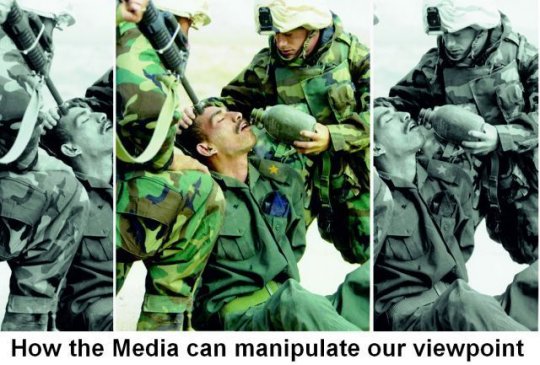
Media Manipulation, as usual

As usual, when something important happens that might reflect poorly on the government, our media does what it does best: it lies.

Here’s the latest example. The original, widely published story was this:

A U.S.-led military rescue operation ended in failure Friday when a Taliban militant set off explosives that killed a British aid worker kidnapped two weeks ago in eastern Afghanistan, Western officials said Saturday.

. . . .

During the rescue, Western officials said, one of the captors detonated explosives near Norgrove, killing himself and the aid worker, who was spearheading a development project run by Development Alternatives Inc., an international consulting firm based in Washington, D.C.

It’s become a little harder to find the original. I excerpted the above from this McClatchy Newspaper.

Only later, after the shock, and false-reality sets in, after our interest wanders elsewhere, do we get the actual story:

A grenade thrown by U.S. forces may have killed a kidnapped British aid worker in Afghanistan, British Prime Minister David Cameron said Monday, as the U.S. military announced an investigation into the failed rescue attempt.

(source)

. . . but, but, but, the original was so convincing. I mean I could almost see it. Just like in the movies: selfless rescuers coming to the aid of an attractive woman, while evil terrorists stand ready to blow up her (and themselves) in the name of evil fanaticism.

Looking back at the original report, it seems the military anticipated, i.e. “prepped the battlefield” for the apology they’d eventually be making:

“There was no choice,” said a senior official with the U.S-led military coalition in Afghanistan who asked not to be identified because he was not authorized to officially discuss the incident. “There was good information that this needed to be done because there were concerns that her life was in imminent danger.”

I’m going to go out on a limb and presume the “Western officials” were well versed in the 25 disinformation techniques and knew from the start their duty was to bullshit. I mean, look at the level of detail in the original misinformation:

Two Western officials said the captor used a suicide vest.

Some might even call it . . . . L-Y-I-N-G.

I intend no disrespect to the fallen or to the soldiers. I myself served in Kunar province where the incident took place, and know some of its valleys as well as I know the back of my hand. I’ve enjoyed great friendships with my fellow soldiers, Afghans and aid workers.

R.I.P. to all the fallen.

I make this critique because I’m soooooooo sick of all the fucking lying.

In war, truth is the first casualty. ~Aeschylus (525 BC – 456 BC)

See also:

media manipulation

Tell us what’s going on with our money

I was disappointed last week to discover that despite his co-sponsorship of the Audit the Fed amendment, Rep. Dave Loebsack voted against its inclusion in a package of financial reforms.

The Audit the Fed amendment had 320 co-sponsors and broad bi-partisan support. The fact that Loebsack and more than 100 other co-sponsors betrayed the amendment at its decisive moment reflects the power of the Federal Reserve.

The Fed is a semi-private bank that sets interest rates by an elaborate process that ultimately amounts to printing money and thereby diluting the value of the money in our wallets, bank accounts and mattresses. (Read more from press-citizen.com)

Critique of Bill Moyers Show

I’m a long-time fan of Bill Moyers, but I think he’s been completely off the mark on economics. I posted the comments below on his website. After a couple hours, they vanished.


0:00 – Don’t even get me started about Michael Moore’s movie. He blames Capitalism for government bailouts of wall street, even though that’s the opposite of capitalism. Then he tries to make a point for socialism at the end without providing any support for it, or acknowledging the ruin it has sowed all over the world.

4:15 – SIMON JOHNSON: Remember Wall Street convinced us that trading derivatives without any regulation, that all these kind of crazy housing loans, which are very dangerous for consumers. That all of this was sensible. All of this was a good way to sustain growth.

My reaction: Trading derivatives would not have been a problem if the traders were allowed to fail. GOVERNMENT did not let anyone fail. That’s why there was recklessness. We don’t need more regulation. We need to let irresponsible people fail. The example of “crazy housing loans” is even more glaring. GOVERNMENT REQUIRED BANKS to hold a certain portion of bad loans, mostly in minority neighborhood. REQUIRED! Also, almost all loans were subsidized by Freddie Mac and Fannie Mae. These institution were run by government regulators – thousands of them working forty hours of week. It is government intervention that failed, not a lack of regulation.

4:45 – BILL MOYERS: ‘Does this crisis reflect something about the disproportionate influence of a few incompetent investment bankers or a deeper breakdown of capitalism?’

This is not capitalism. It’s socialism for the rich.

6:10 – SIMON JOHNSON: . . . the Obama Administration has is leaning in a better direction.

WTF? Obama, Bush W., McCain were all unanimous is supporting the bank bailouts. Obama is running the biggest deficit in history, he’s appointing the same banksters to top jobs, and he’s ignoring the most important opportunity for ‘change’ which is Ron Paul’s bill to audit the Federal Reserve.

7:30 – MARCY KAPTUR: [story about JP Morgan Chase]

Instead of encouraging people to break the law, how about encouraging Congress to STOP GIVING JP MORGAN OUR MONEY.

12:00 – MARCY KAPTUR: . . . And we know the basic rules of economics. Housing leads us to recovery. Housing was the precipitating factor in this economic downturn. Unless you dealing with the housing sector, you aren’t going to have growth in this economy.

This statement is nonsense.

12:30 – SIMON JOHNSON: This is capitalism, Bill.

No, it’s not.

15:00 – PRESIDENT OBAMA: . . . Those on Wall Street cannot resume taking risks without regard for consequences, and expect that next time, American taxpayers will be there to break their fall.

You should not have given them MY money to begin with.

16:30 – MARCY KAPTUR: . . . with the largest financial crisis in American history, in the largest transfer of wealth from the American people to the biggest banks in this country, that every committee of Congress would be involved in hearings, that this would be on the news, that people would be engaged in this. What we’re seeing is– tangential hearings on very arcane aspects of financial reform . . . rather than hearings on the fundamental new architecture of reforming the American financial system, so that we have prudent lending, capital accumulation at the local level again; that we encourage savings and limit debt by the American people. Our country needs this. Those aren’t the hearings that are happening.

I don’t doubt her sincerity but I doubt her understanding. This conversation seems almost irresponsible with it’s non-mention of the money printing federal reserve. If she wants to encourage savings, stop printing money (end the fed), so that the purchasing power of somebody’s savings will be preserved. If she wants to limit debt, stop printing money (end the fed).

To me this interview seems like a “tangential hearing on a very arcane aspect” of the financial crisis.

17:15 – MARCY KAPTUR: If you want a marker at the Federal level of how serious we are to get justice out of this financial crisis, look at the F.B.I. Look at the number of people who are really prosecuting and investigation mortgage fraud and securities fraud. It is so small . . . And until those numbers increase, we will not begin to get justice.

Much easier (and cheaper) than prosecuting people is simply letting them face the consequences of their irresponsibility. Stop subsidizing bad loan, stop bailing out corrupt banks.

21:00 – MARCY KAPTUR: . . . When they messed up during the 1980s, they put their bill through the savings and loans crisis on the American people. $140 billion. . . . But that, you know, it opened the flood gates. They go, ‘Oh, we can get away with $140 billion?’ This time how many trillions have they gotten away with?

Here the conversation swing sooooooo close to the truth. The next sentence should be “We need to stop bailing them out,” or “The problem is government involvement,” or, “If we only let people fail . . .” Instead, the next sentence is a call for more government.

25:30 – MARCY KAPTUR: [discussion of cover contracts with the Federal Reserve]

Say the words, Congresswoman. END THE FED. or, at least AUDIT THE FED. SAY IT, Dammit!

27:30 – MARCY KAPTUR: [talks about restricting fundraising]

If government wasn’t controlling everything, industry wouldn’t need to lobby.

In general, this discussion is grossly incomplete. It completely ignores the federal reserve, and the cause of the financial crisis. The crisis was not cause by corrupt banks, although they certainly had a lot to do with it. The crisis was caused by artificially low interest rates set by the Federal Reserve which flooded the world with cheap money and created an unsustainable boom. This is the Austrian Theory of the Business Cycle with has predicted this and many other crashes caused by artificially low interest rates. It is almost universally ignored by governments and media.

Jim Rogers on letting people fail, and why we don’t need even more regulation:

On Food Safety & Freedom – to all my socialist friends

I’ve been paying more attention to Food Freedom issues. Food Freedom is interesting because, like the War on Drugs, it’s an issue where the hippie, I-♥-socialism crowd agrees with the liberty crowd. We agree on the problems, but, unsurprisingly, recommend exact opposite solutions.

Last month, I watched The World According to Monsanto, which is available for free online in ten parts:

The movie presents very strong evidence i.m.o. that genetically modified (GM) foods got a pass from the F.D.A.’s testing despite indications that they caused health problems. Scientists in the U.S. and Britain lost their jobs for insisting on publishing findings suggestive of the dangers of GM foods.

Shelly Roche makes the case against GM foods in this short video:

It also seems that Big Media (surprise, surprise) has been complicit in suppressing the dangers of GM foods. During last year’s epidemic killing honey bee the mainstream press unanimously ignored the possibility of GM foods killing the bees, even when speculating about long lists of possible causes.

Fox “News” spiked the Monsanto story and fired a pair of journalists:

Anyway, back to the documentary. I could imagine the socialists in the audience saying “We need more rules! We need better rules! We need stronger government!” This is the socialist approach to everything — the force of government.

In fact, government is not our protector from powerful companies like Monsanto. Government is their enabler through the granting of privilege and elimination of competition. This has always been the case. More than anything else, realizing this made me a libertarian. Government doesn’t protect me from the powerful, it protects the powerful and grants them privileges.

To my socialist friends, I would point out:

– Monsanto has written seed laws and gotten legislators to put them through, that make cleaning, collecting and storing of seeds so onerous in terms of fees and paperwork that having normal seed becomes almost impossible. (source) More freedom would legalize competition.

– Much legislation is designed to cut down on Monsanto’s competition:

More freedom would legalize competition.

– Obama has put a former Monsanto vice president in charge of America’s food safety: Obama appoints Monsanto fox to guard food safety hen house.

– In much of the country, it is illegal to label milk “hormore free” or “rbgh free”. (source) Again, more freedom would legalize competition.

The failures detailed in The World According to Monsanto, and evident elsewhere suggest to my libertarian mind that we should get rid of the F.D.A.. Government is incapable of regulating something so important with such incentive for corruption. Private organizations like the Organic Consumer Association would do a much better job, and we would have the liberty to decide for ourselves whom to trust. Private organizations will believe in their cause and be passionate about it.

What am I personally doing about my food? I joined my local co-op, which helps me avoid GMOs, at least in my groceries.

Want more advice? Top 4 Ways to Identify & Avoid Genetically Modified Foods:

1. Look at the PLU sticker on fruit.

  • 4 digits = conventionally grown
  • 5 digits beginning with 9 = organic
  • 5 digits beginning with 8 = GM

2. Buy local and talk to your farmers. (85% of prepackaged/processed foods contain GMOs)
3. Avoid the four top GMO crops: soy, corn, canola & cotton seed.
4. Encourage “GMO free” labeling. (which, I think, is illegal)

Not Left vs Right, Power vs Liberty

“These are perilous times to believe in liberty. Because I oppose Obama’s expansion of government (socialized health care), people assume I was for Bush’s expansion of government (wars, domestic spying, suspending habeas corpus for detainees, monitoring domestic travel, etc.).

Such is the world through the lens of left-versus-right glasses. I’ve been lumped together with neo-cons, called a Republican agent, and faced such comments as, ‘Think of [alternative-energy subsidies] this way: It’s a new weapon to use against the Middle East. It’s weapons research. That should satisfy your tiny repubtard mind.’

I’ll note that I voted for neither McCain nor Obama — neither for the old white guy who believes in bank bailouts and expanding foreign, undeclared wars, nor for the young black guy who believes in bank bailouts and expanding foreign, undeclared wars.

In both cases, dissenters were/are portrayed as fringe, radical, unreasonable, and irrelevant. In both cases, the conflict is crammed into a paradigm of left versus right, and, in both cases, it’s an uphill battle for those of us who oppose an expansion of government.” (from DailyIowan.com)