DNC goes full communist. Let’s ban corporate profit:
I think this also shows why Democracy is a disaster.
". . . a republic, if you can keep it."
DNC goes full communist. Let’s ban corporate profit:
I think this also shows why Democracy is a disaster.
This is worth watching. Philipp is the man when it comes to understanding the EU.
They call the Ryan budget ‘radical,’ ‘uncompromising,’ ‘unrealistic,’ ‘tea party extremist.’

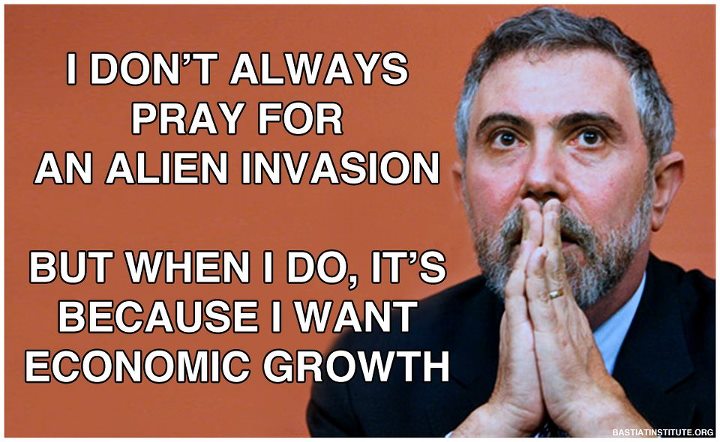
This was one of his more colorful stupid remarks. Like all psychopaths, he wants control. His desire is so great that he considers an alien invasion a good thing. He frames it as an economic good.
 … is from page 613 of the 2003 Liberty Fund collection, edited by Henry C. Clark, Commerce, Culture, and Liberty: Readings on Capitalism Before Adam Smith; specifically, it’s from the 1777 J. Justamond translation of Guillaume-Thomas-Francois, abbe Raynal’s 1770 essay, “A Philosophical and Political History of the Settlements and Trade of the Europeans in the East and West Indies”:
The Spaniards though possessed of all the gold in the world remained or became poor; the Dutch presently acquired riches, without either lands or mines. Holland is a nation at the service of all the rest, but who sells her services at a high price. As soon as she had taken refuge in the midst of the sea, with industry and freedom, which are her tutelary gods, she perceived that she had not sufficient quantity of land to support the sixth part of her inhabitants. She then chose the whole world for her domain, and resolved to enjoy it by her navigation and commerce. She made all lands contribute to her subsistence, and all nations supply her with the conveniences of life.
We are told that austerity in Europe has failed. The elections in France and Greece, for instance, are supposedly evidence of people’s opposition to severe cuts in spending. However, the growing anti-austerity backlash against Europe ignores one fundamental point: If there is austerity in Europe, in most cases it hasn’t taken the form of massive spending cuts. (Read more)

In today’s Telegraph, we argue:
‘It will not be the case that the south will get the so-called wealthy states to pay. Because then Europe would fall apart.” Thus spoke Horst Köhler, former German president, finance secretary and IMF head, almost two decades ago.
Köhler’s remarks are worth pondering. A series of multi-billion-euro bail-outs – and more to come – have now planted a north-south political divide at the heart of the European project. Taxpayers in Europe’s north resent underwriting their southern neighbours, while voters in the south are equally frustrated at having austerity imposed upon them from abroad. As has been noted repeatedly, this is the greatest tragedy of this crisis: a project that was meant to bring people together, now risks driving them further apart. Alas, events in the eurozone this autumn could further exacerbate this tension. There are at least five key stand-offs to watch over the next few months:
Greece v Germany: Greece managed narrowly to escape running out of money today by raising almost 4 billion euros in short-term debt. But Athens will face an excruciating autumn. On almost every count, Greece is miles away from meeting its EU-mandated austerity targets, which raises the questionof whether Germany – or the IMF – will pull the plug on the country in October when its next progress report is due.
Though there is still scope for muddling through, almost any outcome will lead to rising political tensions. If Germany sticks to its guns, the popular disillusion in Greece will grow massively. If Berlin gives in, it faces a serious backlash from the country’s public – a majority of which wants to kick Greece out.
Spain v the North: Amid continued problems, Spain could possibly request EU cash as early as September. But the country is simply too big for a Greece-style bail-out, while Madrid would not accept having its economic policies fully decided in Brussels and Berlin. Instead a third way must be found involving less money and softer conditions, probably with heavy and controversial ECB involvement. The North will dislike such an arrangement – particularly cheap ECB money going to Spain – but may give in for fear of worse.
The bail-out funds v national democracy: On September 12, Germany’s constitutional court will rule on whether the eurozone’s permanent bail-out fund – the European Stability Mechanism (ESM) – is compatible with the country’s “basic law’, following a host of complaints. Though unlikely, should it strike it down, the markets will go absolutely crazy. Regardless, the ruling will leave a bad taste in Germany and shows how the ESM is becoming an increasingly toxic issue, with southern and northern politicians disagreeing fundamentally on its size and whether it should be given a direct credit line to the ECB.
The Dutch v Europe: September 12 will also see another example of national democracy reasserting itself: the Dutch elections. Geert Wilders, leader of the super-populist PVV, is seeking to turn the campaign into a referendum on Europe, hoping to tap into the Dutch anti-bail-out mood. At the same time, the Dutch socialists – currently leading in the polls – have vowed to resist both the EU fiscal treaty and further transfers of power to the EU without approval in referendums. A divided Dutch parliament and more assertive government will almost certainly make eurozone politics even more complicated.
Germany v France: This autumn will also see negotiations over whether the eurozone will take the next big leap towards an economic union, with an October EU summit tasked with providing a “road map” for more integration. Ideas include a banking union (with a single supervisor and joint backstop) and collective government borrowing in the form of eurobonds. The issues are tremendously complicated, subject to a cobweb of disagreements and will take years to clear away. But importantly, this could widen the gap between Germany and France, with the two disagreeing fundamentally on the order of events. Berlin wants a political union first, meaning greater German control over others’ finances in return for underwriting them – while Paris wants to press ahead with stronger bail-out mechanisms, via the ECB and others, leaving the oversight for later. The Franco-German axis is not about to break, but maintaining it will become increasingly difficult.
So how should Britain respond to all of this? Simple: try to control what it can control and leave the rest behind. The UK is right to seek to buffer up against a potential euro meltdown. It is also right to look for ways to ensure that further eurozone integration – such as a banking union – is not detrimental to Britain or the single market. But the UK government needs to stop giving unwelcome advice on the need to turn the eurozone into a “debt union” or for the ECB to start spraying the Continent with cheap money – both options effectively involving Angela Merkel completely running over her own voters.
The eurozone crisis has unleashed some seriously unpredictable political forces. EU leaders may have to choose between maintaining the euro and maintaining national democracy as we know it. In either case, we have no idea how voters – in the North and South alike – will respond. (Read more)
The city is on the hook for more than $800 million in unfunded liabilities for pensions and other post-employment benefits.
London’s tourism industry is struggling to compete with the impact of the Olympic Games, which has left the host city a “ghost town”, businesses said today.
Many traditional tourist hotspots have reported a fall in ticket sales as visitors flock to Olympic venues across the capital.
Theatre companies said they were seeing a “mixed picture” with many companies struggling due to the lack of footfall in the West End. (Read more)
Patrick Barron:
From today’s Open Europe news summary:
The Times reports that the continuing eurozone crisis has compelled Royal Dutch Shell to withdraw some of its substantial cash reserves from European banks, intensifying fears of capital flight from the eurozone. Separately, the FT reports that in addition to reducing their net exposure to troubled eurozone countries, US banks have been working “behind the scenes” to ensure that if a country leaves the eurozone, they will not have to receive payments in its new devalued currency.
Times FT
This may be how the euro ends…large depositors and foreign banks pull their deposits, creating a liquidity crisis that the ECB tries to paper over with even more funny money…which merely causes even more depositors to pull their deposits until the euro loses its value completely. This is called an old-fashioned bank run, which exposes the fraud of fractional reserve banking.
Ha. Leftists would hate everything about this article. They’ll hate it the way they hate economics.
Now that three California cities have declared bankruptcy, perhaps it’s time to consider the lessons of Wisconsin.
One of the reasons Wisconsin Democrats couldn’t unseat Republican Gov. Scott Walker in the state’s recall election was that his challenger exemplified how Walker’s narrowing of collective bargaining privileges for government workers benefited the state.
As mayor of Milwaukee, Tom Barrett had relied on Walker’s reforms to balance his city’s budget. And Barrett wasn’t alone among Wisconsin officials. Walker comfortably defeated Barrett in large part because in the 11 months that the governor’s reforms were in effect, Wisconsinites got a good glimpse of how they worked, even in Milwaukee, where the savings allowed government to remain solvent and avoid widespread layoffs. (Read more)
The Constitution gives Congress the exclusive right to tax Americans at the federal level. Yet Congress continues to give away this most fundamental responsibility to international organizations, the most dangerous of which is the Paris-based Organization for Economic Cooperation and Development (OECD).
Most Americans probably would not approve of their tax dollars being used to support an international organization that undermines their fundamental liberties and promotes giving their hard-earned money to other governments, often run by corrupt or dictatorial regimes. This is precisely what the OECD is doing, with the blessing of the majority members of Congress.
The OECD has just released a report bragging about its “progress” in getting countries to engage in automatic sharing of tax information. The report states: “The automatic exchange of information involves the systematic and periodic transmission of ‘bulk’ taxpayer information by the source country to the residence country concerning various categories of income (e.g., dividends, interest, royalties, salaries and pensions).” The Obama administration is actively supporting this effort.
This means that the most vile governments will receive financial account information automatically about individuals from other countries. Assume you are standing up to or protesting some corrupt or authoritarian regime in your own country – there are too many to name – and to protect your family, you have a bank account in the United States, Switzerland or some other nation that offers basic protections of civil liberties. Under automatic information-sharing, the thugs you are opposing will be receiving information about your finances from the U.S. government and other governments, which can put your property and your life at risk. The response from the bureaucrats in the OECD and Obama administration is “we protect confidential information,” as if they had never heard of Wiki-Leaks or the other never-ending hacks of government data. (Read more)
Are you upset about rapidly rising food costs and high gas prices? You can thank members of Congress and the administration for this situation. Much of the United States is in the midst of a major drought. That’s not the fault of the political class, but those folks have made the consequences of the drought far worse for the entire world.
First, the facts: Corn and soybeans are the biggest U.S. grain crops and are used in many of the foods that almost everyone consumes each day. Congress subsidized and mandated the use of ethanol in motor fuel. Currently, about 40 percent of the U.S. corn crop is used in the production of ethanol. Corn prices rose as a result of the government creating an artificial, additional demand. As a result of higher corn prices, many farmers grew more corn and fewer other crops, such as wheat, which, in turn, caused the prices of those other crops to rise because of lower production.
The drought is resulting in a much smaller corn crop, but by law, much of the remaining corn must be used to produce ethanol, resulting in even higher prices for corn, which reached a record high last week. (Read more)