@ 7:00 Peter Schiff reviews his taxes, explains how he’s paying 50% of his income in taxes
federal 35%
Connecticut 6.5%
Medicare 5 %
Property, Social Security, Sales, Corporate Taxes
Time spent in compliance and fees
". . . a republic, if you can keep it."
@ 7:00 Peter Schiff reviews his taxes, explains how he’s paying 50% of his income in taxes
federal 35%
Connecticut 6.5%
Medicare 5 %
Property, Social Security, Sales, Corporate Taxes
Time spent in compliance and fees
 Three of the ten planks of the Communist Manifesto (1848) are still universally accepted.
2. A heavy progressive or graduated income tax.
5. Centralization of credit in the hands of the state, by means of a national bank with state capital and an exclusive monopoly.
10. Free education for all children in public schools. Abolition of children’s factory labor in its present form. Combination of education with industrial production, etc.
The ten planks were supposed to be the means of ushering in the classless society of Communism. The next sentence after plank #10 revealed the utopianism of Marxism.
When, in the course of development, class distinctions have disappeared, and all production has been concentrated in the hands of a vast association of the whole nation, the public power will lose its political character.
Classes did not go away in the Communist paradises. There were the haves and the have-nots. The basis of access into the minority class of the haves was through membership in the Communist Party.
The state never went away. It got stronger and more demanding. It became more pervasive.
. . . .
So, Marx and Engels got 30% of their program accepted by the bourgeoisie world.
Then there was this plank:
3. Abolition of all rights of inheritance.
Because of a peculiarity of the tax code, the inheritance tax has been suspended in the United States for 2010. But next year, the old system returns: up to 55%. So, to impose taxes on the rich, the voters have adopted another of the planks, at least in principle.
So, where are we today? Maybe at 32% of the Communist program. Let’s round it up to one-third. That’s close enough for government work.  (Read more from lewrockwell.com)
very, very encouraging.
While it may be a little dangerous to speak so soon, a remarkable gulf is growing between the responses of the British and the French public to their governments’ attempts to balance the books. In Britain, there has been a calm reaction to the cuts so far announced, with a clear majority supporting the government’s bungled announcement that it is to restrict child benefit payments. In France, the only austerity measure to speak of is raising the minimum retirement age from 60 to 62 — and it has brought protesters to the streets. Three million are on strike, with two thirds of the public supporting them. . . .
The state continues to account for over half the French economy — as it does, now, in Britain.
But while we seek to reverse this, Sarkozy is compounding the problem by setting up a fund to increase government-owned stakes in large companies. His resolve, of which we heard so much on his election in 2007, seems to be evaporating. . . .
A banner hanging in Paris this week sums up the sense of entitlement felt by too many French to a life of ease. It reads, ‘We don’t want to lose our lives by earning a living.’ . . .
France’s problem is that, for too long, the economy has been run as a kind of job club for French workers. They are virtually impossible to sack, which makes membership of this club an unattainable dream for those outside it — many of them young Muslims, languishing in the banlieues. It has long been a popular belief among French politicians that jobs are a finite resource that can be shared around more fairly through the application of short working weeks and early retirement. That theory does not sit easily with France’s scandalously high structural unemployment rate, which was around 10 per cent even during the boom years.
Britain and France believe in liberty, but have different definitions of it. Ours involves liberty from government, the idea behind David Cameron’s dismally expressed ‘big society’ agenda. In France, they still like the big state and squeal at the prospect of being removed from its teat. . . .
Even the introduction of a 35-hour working week caused consternation among civil servants who previously had worked only 32 hours a week. Technically, employers now have the ability to ask staff to work longer. In practice, no one dares. . . .
To respond to a debt crisis with more debt is to enter a form of denial — a form that we can see on the streets of Athens and Paris. Germany and Sweden have chosen the hard path to fiscal credibility, and have seen economic momentum restored. As Barack Obama waits in vain for his $800 billion ‘stimulus’ to work, it is clear that governments cannot borrow their way to recovery.
The British have always understood this. (Read more from newstaging.spectator.widearea.co.uk)
#1: The US Fed is now the second largest owner of US Treasuries.
That’s right, this week we overtook Japan, leaving China as the only country with greater ownership of US Debt. And we’re printing money to buy it.
. . . .
#2: “There are only about $550 billion of Treasuries outstanding with a remaining maturity of greater than 10 years.”
This horrifying fact comes courtesy of Morgan Stanley analyst David Greenlaw. And it confirms what I’ve been saying since the end of 2009, that the US has entered a debt spiral: a time in which fewer and fewer investors are willing to lend to us for any long period of time… at the exact same time that we must roll over trillions in old debt and issue an additional $100-150 billion in NEW debt per month in order to finance our massive deficit.
And only $550 billion of the debt we’ve got to roll over has a maturity greater than 10 years!?!?
So we’re talking about TRILLIONS of old debt coming due in the next decade.
. . . .
#3: The US will Default on its Debt
… either that or experience hyperinflation. There is simply no other option. We can NEVER pay off our debts. To do so would require every US family to pay $31,000 a year for 75 years.
* Gold, Swiss Frank making new records.
* Currency war = each country trying to destroy itself most quickly
* Big Media still interpreting bad economic news as good for stocks b/c it causes Fed to ease.
* CNBC Gold Bug “Gold not a hedge against inflation, but a hedge against a weakening dollar.” Huh?
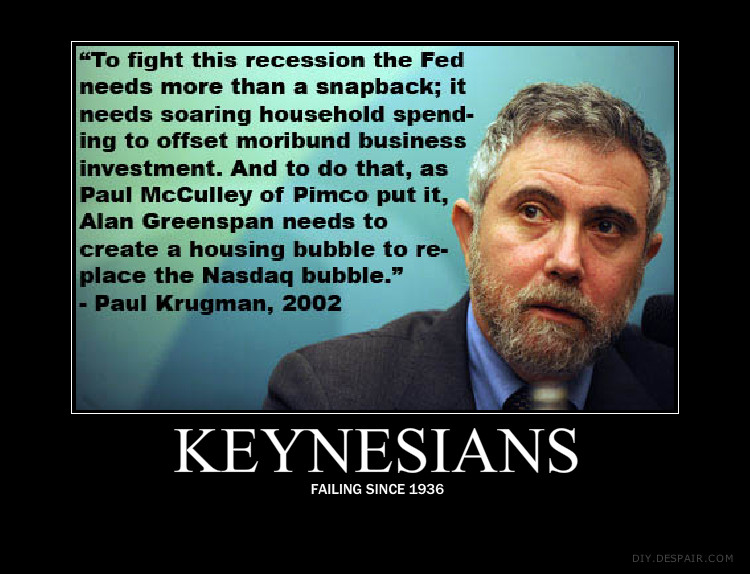
* Krugman took a jab and Schiff — “How’s that hyperinflation thing going?”
* Peter ends with explanation of why he’s setting up a business off shore.
What witch doctors are to health, Geithner’s reasoning is to economics. See “Why the Hell Do We Care if China Manipulates Its Currency in Our Favor?” post to learn why China only hurts itself by undervaluing its currency.
In a surprisingly blunt speech, U.S. Treasury Secretary Timothy Geithner took China to task for maintaining what the U.S. considers a deliberately undervalued exchange rate aimed at helping China’s export industries.
“When large economies with undervalued exchange rates act to keep the currency from appreciating, that encourages other countries to do the same,” said Mr. Geithner, using language that referred directly to China, in an address at the Brookings Institution, a Washington think tank. “This sets off a dangerous dynamic” as nations compete to keep their currencies undervalued. (Read more from online.wsj.com)
Dear Sirs:
The Geithner speech is nonsense on two levels. Number one, and most importantly, if a country holds its currency cheap, it is subsidizing the living standards of its trading partners. If the Chinese are foolish enough to subsidize our lifestyle–which, by the way, they have been doing for some time now–then why would we desire that they stop? Secondly, the logic of his argument is childish. If we think China’s monetary policy is wrong, why are we encouraged to do the same thing? (I can just hear Mrs. Geithner asking her little boy Timothy why he jumped in the mud puddle…and little Timothy telling his mother that he did it because his friend did it.)
No country can force another country to pay its bills or cause another country to have higher unemployment. The most damage that a country can do to another is indirectly–by adopting policies that reduce its contribution to the world economy. For example, the world is worse off because Cuba is a communist country and does not produce goods for the world market.
Patrick Barron

These votes are much more powerful than democratic votes. Let’s hope we retain what remains of our freedom to spend our money the way we choose.
“the ‘substitution of political for economic power’ now so often demanded means necessarily the substitution of power from which there is no escape for a power which is always limited.” – F.A. Hayek, The Road to Serfdom
I’m a redditor and occasionally participate in Reddit’s /r/politics to see what all the socialists, Leninist, and statists of various stripes are saying.
Here’s the stupidest comment I’ve encountered:
If regulations really weren’t good for business, corporations wouldn’t hire lobbyists with 6- and 7-figure salaries to get regulations passed.