The level of B.S. in this commentary is off the charts. Kudos to the reporter for sounding at least a little suspicious. It used to be hard for me to believe that this can be coming from a Princeton professor, Nobel Prize winner and NY Times columnist, but I think over the course of the past few years, my respect for those institutions has sunken to a more appropriate level.
When Paul Krugman furrowed his brow and stroked his chin and told the audience that the Obama administration’s plan to create 3.5 million jobs is . . . here he slowed his speech, demonstrating his thoughtfulness . . . “about the right size,” he neglected to elaborate on how government creates jobs.
If government has the power to create 3.5 million jobs, what is the moral justification for stopping at 3.5 million? Why not 4 million, or 10 million? Why not 150 million, so America’s entire labor force can feed from the government trough?
The fact is that government cannot create jobs. Government can only redirect them. Taxes must destroy private sector jobs which produce goods and services people want, so that government may pay for public sector jobs, which exist for political reasons.
The stimulus will make us poorer, and when it does so, Mr. Krugman will furrow his brow and stroke his chin and tell us very thoughtfully that it probably wasn’t big enough.
He cautioned against the “temptation to dwell on the causes of the bubble,” which seems completely nonsensical to me. . . . .
* Bernanke is ready to keep printing.
* STOP DEFLATION! STOP DEFLATION! STOP DEFLATION! (Deflation would actually be a very good thing. It would reveal who is productive, and who is unproductive.)
* Saint Louis Fed Chairman James Bullard DOES NOT ANTICIPATE A DOUBLE DIP RECESSION. Let’s remember he said this. Shall we?
* Bill Ford, former Atlanta Fed Chairman, makes the same prediction — no double dip recession, though he offers some good analysis. Perhaps that’s why no longer with the Fed.
* People are surprised by recent bad news in the housing market, but they’ve got much further to fall. It’s government stimulus propping up prices.
* Renting vs. owning.
* Dollar made low against Yen. Would have fallen further if Japan’s central bank didn’t make easing announcement. This drove up precious metals.
* WSJ article about Peter Schiff portrays him as charlatan, ignores his accurate predictions: worst recession since Great Depression, over 10% unemployment, housing bubble would burst, 30% drop in real estate prices, Fannie and Freddie would go bankrupt, many leading banks would fail, government would bail them out, 1-2 trillion dollar a year deficits.
* Bernanke reiterates commitment to inflation. Gold and silver responds.
* Deflation fears misplaced.
* Some economists (Roubini) are now increasing their prediction of a recession. Duh.
* Gold stocks & the WSJ interviewer’s interest in Peter’s crib
* Bond Fund manager and Freddie/Fannie-guaranteed mortgage holder Bill Gross advocated the Freddie/Fannie bailout. He has recently suggested government should 100% nationalize Freddie and Fannie, and allow everybody to refinance at a lower rate.
* Bill Gross argued this would stimulate consumer spending and thereby the economy. Of course, what our economy needs is more savings, not spending.
* Real Estate prices are still too high and should never have been propped up. They need to come down. Artificially high prices for homes deprive more productive endeavors of resources.
* Do not buy Government Motors IPO. Some profit might be made by those with good timing, but they will go bankrupt again. The bailout prevent the restructuring they needed. They company is not run to produce good cars at a profit. It is run to serve labor.
* Dollar strengthens despite bad news based on weakness in stocks. Old habits (like buying dollars on bad news) die hard.
* Congressional Budget Office increases deficit estimate, but the estimate remains complete bullshit. Nothing to do with reality.
* Big Media (Robert Reich) continues to sing the praises of debt, and demonize saving.
* Peter’s predictions about Freddie and Fannie come true.
* Refinancing homes at (artificially suppressed) lower rates is creating a ticking time bomb for banks who will be holding 30-year paper. Once the paper becomes worthless there will be rampant bank failures.
* NY Times publishes BS article about why we won’t have a recession. Sheer propaganda. The implicit argument is that a zero Fed rate will avoid a recession. This is nonsense.
* Bonds remain overpriced, as Americans who attempt to save decide to lend money to the government. Inflation will punish bond-buyers.
* A better scheme for unemployment benefits would be an initial lump sum. This would avoid the disincentive to work. Of course, we’d all be better off if people decided for themselves whether or not to buy unemployment benefits, creating a market for various flavors of unemployment insurance.
* Peter has bet against the advice he gives. If the government actually followed his advice, it would undermine his investments.
* The sooner the crash happens, the better, because the longer the malinvestment persists, the more effort it will take for the economy to restructure.
It always troubles me to see professionally produced, economically illiterate videos condemning capitalism. Here’s one:
David Harvey asks if it is time to look beyond capitalism towards a new social order that would allow us to live within a system that really could be responsible, just, and humane?
@ 3:20 — The fifth of his list of “popular explanations of the crisis” is pretty much correct, though Glenn Beck and the World Bank are hardly apostles of deregulation. Why doesn’t he cite Ron Paul, Peter Schiff, Mises, etc? This guy would do well to study the Austrian School.
@ about 3:40, the narrator asks, “What kind of plausible story can I write [explaining our economic crash] which is none of the above?” I think, WTF? Uniqueness is not how we should judge economic theories. How about a meticulous logical examination? “Renowned academic,” my ass.
@ 4:20, the narrator relates a story about the Queen of England asking economists why they didn’t see it coming. “Story” is a good description for what David Harvey is telling. He ignores the many Austrian Economists who did see it coming, and now see things getting much, much worse before they get better. Maybe we should listen to them before we try David Harvey’s workers’ paradise.
@ 6:00, he speaks from Marx’s flawed class analysis. In a free market, the interested of capital are not opposed to those of labor. They are complimentary. In fact, capital competes with other capital for the best of labor, and labor competes with labor for the best jobs. If you consider each a monolithic class opposed to the other, you will be blind to much of the world. Significantly, Marx, in his writing, never defined his most crucial term: class.
@ 7:15 — Capitalism DOES solve its own crises, if you let people fail, and let people accept whatever they damn well please as money. Bailouts and forcing people to use fiat money have nothing to do with free markets or capitalism.
@ 8:50 — Financial innovation does not empower financiers. Government bailouts and government subsidies empower financiers. If firms were allowed to go bankrupt they would regulated themselves / be regulated by their investors.
@ 10:15 — “I don’t have the solutions.” Here, I completely agree with you, Mr. Harvey.
From their website: For over 250 years the Royal Society for the encouragement of Arts, Manufactures and Commerce (RSA) has been a cradle of enlightenment thinking and a force for social progress. Our approach is multi-disciplinary, politically independent and combines cutting edge research and policy development with practical action.
That’s not enlightenment suckling in their cradle. I think the previous century has seen enough of their sort of “progress.”
* Dollar continues to decline.
* US continues to follow misguided Keynesian stimulus philosophy.
* GM (government motors) spends bailout money to buy sub-prime-like auto loan business.
* GM bailout was actually bailout of auto workers union.
* The most interesting part of this video begins at 6:00. He talks about how Goldline, a gold selling company, has abused customers by selling overprices antique coins. Peter predicts that this will be leveraged to attack all gold dealers. Remember, tyrants have always hated gold.
* 7th week in a row of declining value of the dollar.
* Propagandists say that the U.S. will not be like Japan. Peter argees only in a perverse way: the U.S. will suffer much, much more than Japan did in the 80’s.
* GDP is bullshit. It’s recent increase is completely attributable to debt and deficit spending.
* Politicians claiming credit for the abomination that was the auto bailout. They will need another bailout soon.
* The 2008 crisis was a UNITED STATES crisis. The world was exposed to it because they had loaned us so much money, but don’t believe the propaganda of the U.S. getting caught up in a world crisis.
* Expect people to begin fleeing the dollar, and U.S. assets. Expect gold to make another run, despite some talking heads claiming that it’s about to crash.
* No sign of a stricter Federal Reserve. As November elections approach, all incumbent politicians will fight for more easy money — which will be like drinking more booze to avoid a hangover.
The plot continues to thicken at Germany’s constitutional court, a body with power of life or death over Europe’s monetary union.
Contrary to general belief, Germany’s eurosceptic professors have not abandoned their legal efforts to block the EU rescues for European banks exposed to Greek debt, and since May 7 for banks exposed to debt from Spain, Portugal, and Ireland as well.
Should they succeed, of course, the eurozone risks disintegration within days, and perhaps hours. I am not sure that investors in New York, London, Tokyo, Beijing, or indeed Frankfurt quite understand this.
There are now four cases at the court – or Verfassungsgericht – arguing that these disguised bank bail-outs breach multiple clauses of EU treaty law, and therefore breach Germany’s supreme and sovereign Basic Law. (Read more from blogs.telegraph.co.uk)
Nice to know it’s being challenged, but I’d be surprised if whatever judges hearing the case didn’t simply do as they were told by the powers that be.
This is a great talk by hedge fund manager Kevin Duffy about Austrian Economics and Investing. It included some great quotes which demonstrate interventionists in big business, government, media and academia being wrong about the economy, corrupting history, vilifying free markets. I transcribed some of them below.
“At the rate things are going, we are all going to end up working for the Japanese.” -Lester Thurow, MIT, economist, 1989
“The United States is rapidly become a colony of Japan.” -Congresswoman Helen Bentley (R-MD), 1990
“The Cold War is over, and Japan won.” -Senator Paul Tsongas (D-MA), 1992
Austrians were able to see the bubble.
As it pertains to the investor: “Entrepreneurial judgement cannot be bought on the market. The entrepreneurial idea that carries on and brings profit is precisely the idea which did not occur to the majority. It is not correct foresight as such that yields profits, but foresight better than that of the rest. The prize goes only to the dissenters, who do not let themselves be misled by the errors accepted by the multitude.” -Ludwig von Mises
Discussing the investing challenge resulting from that fact that Austrian Economics tells you what will happen but not when. (It is in fact impossible to time markets, as Mises discusses in chapter 38 of human action.)
Vilifying free markets:
“This was about the invisible hand having a party, a non-regulated drinking party, with rating agencies handing out the fake IDs!” -Paul McCully, PIMCO, on the financial meltdown
“This laissez faire really has killed us.” -Jim Cramer, interviewing Rep. Barney Frank (D-MA), Jan 21, 2010
“No one likes to put the taxpayer into situations like this . . . Government intervention is not something I came down here wanting to espouse, but it sure is better than the alternative.” -Hentry Paulson, Treasury Secretary, on the government takeover of Fannie Mae and Freddie Mac, Sept 8, 2008
“Depression scholars – including Bernanke – tend to see the Hoover administration’s approach of balancing budgets and tightening belts during the downturn as a tragic mistake.” -Time 2009 Person of the Year article, Dec 28 2009
“Those who contended that during the period of my administration our economic system was one of laissez faire have little knowledge of the extent of government regulation.” -Herbert Hoover
“Nobody saw this coming” -Angelo Mozilo, CEO, Contrywide Financial, July 24 2007
When markets crash, instead of blaming interventionists and inflationists, there begins a witch hunt against private investors who saw it coming, often short sellers.
“It’s very natural for us all to overreact in times of stress, but I’m not a fan of unmitigated shorting. We have nearly $2 trillion in hedge funds that simply don’t have any reporting responsibilities.” -Charles Schwab, BusinessWeek, July 16, 2008
“I’m for markets. But when it felt like it had gotten abusive, when it was free money to short-sellers who were piling on, it felt less like the market and more like it was being manipulated, I corssed over.” -Lloyd Blankfein, CEO, Goldman Sachs, January 2010
Applauding regulation after Enron:
“Conviction on all 49 counts makes this unlikely in the future. This is good: it restores confidence… We were in the biggest bubble in history… I don’t think that’s going to happen for a long time… There were lessons I think that were learned.” -Jeremy Seigel, as appeared on CNBC, May 26, 2006
“Now we have a greater appreciate of the role of watchdogs. Sarbanes-Oxley was a good idea, is a good idea. Leave it alone. We need it to prevent the enrons of the future.” -Anthony M. Sabino, law professor, St. John’s University, Washington Post, May 26, 2006
Business Week Cover: It’s a low, low, low, low-rate world.
Time Cover: The New Sheriffs of Wall Street (Three women, because the problems were caused by too much testosterone, as opposed to intervention, subsidizing irresponsibility, artificially low interest)
Newsweek Cover: America’s Back! The remarkable tale of our economic turnaround (Celebrating the stimulus)
Business Week Cover: Obamanomics is working better than you think. Who Says? Wall Street. (Picture of Obama-look-alike shooting a giant nickle like a basketball)
“One trillion dollars is a big number. This is enough to buy all of Greece’s debt twice, with enough left over to buy all of Portugal’s debt. It was meant to remove any potential for contagion. Problem solved.” -Alan Skrainka, Chief Market Strategist, Edward Jones, Barron’s, May 15 2010
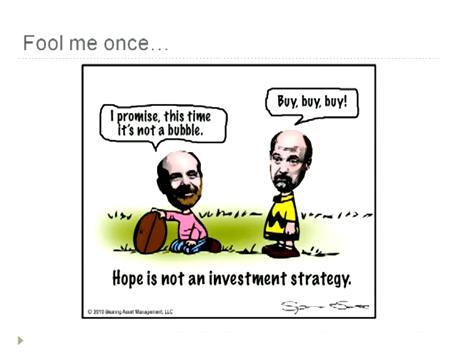
At the end of his talk, Kevin Duffy showed this cartoon. I’m not certain whether he was the creator:
Ben Davies, CEO of Hinde Capital, first explains gold’s rising value in terms of the massive money printing going on all over the world. The interviewer questions whether there isn’t a gold bubble forming and cites reports of “over leveraging” in the “non-physical” gold market. This is euphemistic language for the massive fraud widely reported in the alternative media.
The most interesting part of this video is early on when Peter discusses the banking regulation as the president of a small investment firm. Later on, he talks about his surprisingly hawkish stance, despite wide recognition as a libertarian candidate. (His candidacy is Connecticut would be impossible otherwise.)
 David Harvey asks if it is time to look beyond capitalism towards a new social order that would allow us to live within a system that really could be responsible, just, and humane?