Tag Archives: Science / Environment
DARPA Cheetah Sets Speed Record for Legged Robots
Pretty cool. Here are my questions:
1) how much is this costing the US taxpayer?
2) can I have my money back please?
3) what innovations were killed because people weren’t allowed to keep their money?
4) why are almost all my scientist and engineer friends working on government projects?
Some Asian glaciers ‘putting on mass’
 A French team used satellite data to show that glaciers in part of the Karakoram range, to the west of the Himalayan region, are putting on mass.
The reason is unclear, as glaciers in other parts of the Himalayas are losing mass – which also is the global trend. (Read more)
Cancer Cure Documentary – Dr. Burzynski Antineoplaston Therapy
Beware of snake oil, of course. But this documentary is very inspiring. Also, it points to the evils of state sponsored medicine and science.
Christopher McDougall: Are we born to run?
Firm sells solar panels – to itself, taxpayers pay
A heavily subsidized solar company received a U.S. taxpayer loan guarantee to sell solar panels to itself.
First Solar is the company. The subsidy came from the Export-Import Bank, which President Obama and Harry Reid are currently fighting to extend and expand. The underlying issue is how Obama’s insistence on green-energy subsidies and export subsidies manifests itself as rank corporate welfare. (Read more)
New evidence suggests Stone Age hunters from Europe discovered America
New archaeological evidence suggests that America was first discovered by Stone Age people from Europe – 10,000 years before the Siberian-originating ancestors of the American Indians set foot in the New World.
A remarkable series of several dozen European-style stone tools, dating back between 19,000 and 26,000 years, have been discovered at six locations along the US east coast. Three of the sites are on the Delmarva Peninsular in Maryland, discovered by archaeologist Dr Darrin Lowery of the University of Delaware. One is in Pennsylvania and another in Virginia. A sixth was discovered by scallop-dredging fishermen on the seabed 60 miles from the Virginian coast on what, in prehistoric times, would have been dry land.
The new discoveries are among the most important archaeological breakthroughs for several decades – and are set to add substantially to our understanding of humanity’s spread around the globe.
The similarity between other later east coast US and European Stone Age stone tool technologies has been noted before. But all the US European-style tools, unearthed before the discovery or dating of the recently found or dated US east coast sites, were from around 15,000 years ago – long after Stone Age Europeans (the Solutrean cultures of France and Iberia) had ceased making such artefacts. Most archaeologists had therefore rejected any possibility of a connection. But the newly-discovered and recently-dated early Maryland and other US east coast Stone Age tools are from between 26,000 and 19,000 years ago – and are therefore contemporary with the virtually identical western European material. (Read more)
The Boy Who Cried Warming
Good video about Global Warming nonsense. It focuses only on very specific issues — polar bear population — but thoroughly exposes the popular, sensational views as fraudulent.
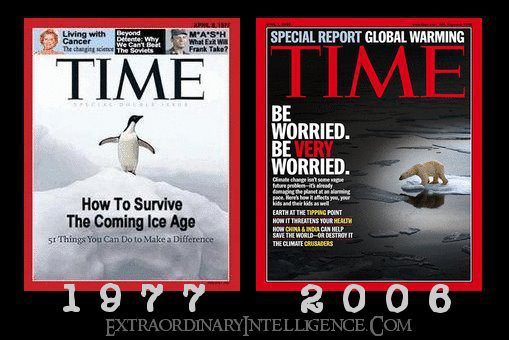
Time Magazine Covers — Global Cooling / Warming
UN panel says retool world economy for sustainability
Translation: Everybody must obey.
The world can no longer afford to ignore the environmental cost of economic growth and must redefine the very concept of national wealth, a UN panel of heads of state and environment ministers said Monday.
The panel challenged leaders to recognise that “current global development is unsustainable.”
“We need to chart a new, more sustainable course for the future, one that strengthens equality and economic growth while protecting our planet,” UN Secretary General Ban Ki-moon said in Addis Ababa to mark the release of the panel’s report, which outlines more than 50 policy recommendations. (Read more)
Academic publishers have become the enemies of science: yet more real piracy
This is the moment academic publishers gave up all pretence of being on the side of scientists. Their rhetoric has traditionally been of partnering with scientists, but the truth is that for some time now scientific publishers have been anti-science and anti-publication. The Research Works Act, introduced in the US Congress on 16 December, amounts to a declaration of war by the publishers.
The USA’s main funding agency for health-related research is the National Institutes of Health, with a $30bn annual budget. The NIH has a public access policy that says taxpayer-funded research must be freely accessible online. This means that members of the public, having paid once to have the research done, don’t have to pay for it again when they read it – a wholly reasonable policy, and one with enormous humanitarian implications because it means the results of medical research are made freely available around the world.
But, due to lobbying by academic publishers, “If passed, the Research Works Act (RWA) would prohibit the NIH’s public access policy and anything similar enacted by other federal agencies, locking publicly funded research behind paywalls.”
What we have here is a lobbying effort to take work out of the public domain and put it behind a copyright-like wall. (Read more)
Divers find large, unexplained object at bottom of Baltic Sea
A team of salvage divers has discovered an unexplained object resting at the bottom of the Baltic Sea near Sweden.
“This thing turned up. My first reaction was to tell the guys that we have a UFO here on the bottom,” said Peter Lindberg, the leader of the amateur treasure hunters.
Sonar readings show that the mysterious object is about 60 meters across, or, about the size of a jumbo jet. And it’s not alone. Nearby on the sea floor is another, smaller object with a similar shape. Even more fascinating, both objects have “drag marks” behind them on the sea floor, stretching back more than 400 feet. (Read more)
Affluence and Population Growth
The bottom line: leave people alone! Do nothing, and this problem solves itself.
What stops population growth? from Gapminder Foundation on Vimeo.
Mind Controlling Parasites
This post has nothing to do with libertarianism, corruption, or anarcho-capitalism, but THIS article is just so damn interesting. It’s a little terrifying too to think that a tiny parasite can become, to varying extents, a puppet master of other species, even humans.
Jaroslav Flegr is no kook. And yet, for years, he suspected his mind had been taken over by parasites that had invaded his brain. So the prolific biologist took his science-fiction hunch into the lab. What he’s now discovering will startle you. Could tiny organisms carried by house cats be creeping into our brains, causing everything from car wrecks to schizophrenia? A biologist’s science- fiction hunch is gaining credence and shaping the emerging science of mind- controlling parasites.
. . . .
if Flegr is right, the “latent” parasite may be quietly tweaking the connections between our neurons, changing our response to frightening situations, our trust in others, how outgoing we are, and even our preference for certain scents. And that’s not all. He also believes that the organism contributes to car crashes, suicides, and mental disorders such as schizophrenia. When you add up all the different ways it can harm us, says Flegr, “Toxoplasma might even kill as many people as malaria, or at least a million people a year.”
. . . .
Consider Polysphincta gutfreundi, a parasitic wasp that grabs hold of an orb spider and attaches a tiny egg to its belly. A wormlike larva emerges from the egg, and then releases chemicals that prompt the spider to abandon weaving its familiar spiral web and instead spin its silk thread into a special pattern that will hold the cocoon in which the larva matures. The “possessed” spider even crochets a specific geometric design in the net, camouflaging the cocoon from the wasp’s predators.
. . . .
as he was reading a book by the British evolutionary biologist Richard Dawkins, Flegr was captivated by a passage describing how a flatworm turns an ant into its slave by invading the ant’s nervous system. A drop in temperature normally causes ants to head underground, but the infected insect instead climbs to the top of a blade of grass and clamps down on it, becoming easy prey for a grazing sheep. “Its mandibles actually become locked in that position, so there’s nothing the ant can do except hang there in the air,” says Flegr. The sheep grazes on the grass and eats the ant; the worm gains entrance into the ungulate’s gut, which is exactly where it needs to be in order to complete—as the Lion King song goes—the circle of life. “It was the first I learned about this kind of manipulation, so it made a big impression on me,” Flegr says.
. . . .
After he read the book, Flegr began to make a connection that, he readily admits, others might find crazy: his behavior, he noticed, shared similarities with that of the reckless ant. For example, he says, he thought nothing of crossing the street in the middle of dense traffic, “and if cars honked at me, I didn’t jump out of the way.” He also made no effort to hide his scorn for the Communists who ruled Czechoslovakia for most of his early adulthood. “It was very risky to openly speak your mind at that time,” he says. “I was lucky I wasn’t imprisoned.” And during a research stint in eastern Turkey, when the strife-torn region frequently erupted in gunfire, he recalls being “very calm.” In contrast, he says, “my colleagues were terrified. I wondered what was wrong with myself.”
His bewilderment continued until 1990, when he joined the biology faculty of Charles University. As it happened, the 650-year-old institution had long been a world leader in documenting the health effects of T. gondii, as well as developing methods for detecting the parasite. In fact, just as Flegr was arriving, his colleagues were searching for infected individuals on whom to test their improved diagnostic kits, which is how he came to be asked one day to roll up his sleeve and donate blood. He discovered that he had the parasite—and just possibly, he thought, the key to his baffling self-destructive streak.
. . . .
He delved into T. gondii’s life cycle. After an infected cat defecates, Flegr learned, the parasite is typically picked up from the soil by scavenging or grazing animals—notably rodents, pigs, and cattle—all of which then harbor it in their brain and other body tissues. Humans, on the other hand, are exposed not only by coming into contact with litter boxes, but also, he found, by drinking water contaminated with cat feces, eating unwashed vegetables, or, especially in Europe, by consuming raw or undercooked meat. Hence the French, according to Flegr, with their love of steak prepared saignant—literally, “bleeding”—can have infection rates as high as 55 percent. (Americans will be happy to hear that the parasite resides in far fewer of them, though a still substantial portion: 10 to 20 percent.) Once inside an animal or human host, the parasite then needs to get back into the cat, the only place where it can sexually reproduce—and this is when, Flegr believed, behavioral manipulation might come into play.
. . . .
Researchers had already observed a few peculiarities about rodents with T. gondii that bolstered Flegr’s theory. The infected rodents were much more active in running wheels than uninfected rodents were, suggesting that they would be more-attractive targets for cats, which are drawn to fast-moving objects. They also were less wary of predators in exposed spaces. Little, however, was known about how the latent infection might influence humans, because we and other large mammals were widely presumed to be accidental hosts, or, as scientists are fond of putting it, a “dead end” for the parasite.
. . . .
he used a computer-based test to assess the reaction times of participants, who were instructed to press a button as soon as a white square popped up anywhere against the dark background of the monitor.
The subjects who tested positive for the parasite had significantly delayed reaction times. Flegr was especially surprised to learn, though, that the protozoan appeared to cause many sex-specific changes in personality. Compared with uninfected men, males who had the parasite were more introverted, suspicious, oblivious to other people’s opinions of them, and inclined to disregard rules. Infected women, on the other hand, presented in exactly the opposite way: they were more outgoing, trusting, image-conscious, and rule-abiding than uninfected women.
The findings were so bizarre that Flegr initially assumed his data must be flawed. So he tested other groups—civilian and military populations. Again, the same results. Then, in search of more corroborating evidence, he brought subjects in for further observation and a battery of tests, in which they were rated by someone ignorant of their infection status. To assess whether participants valued the opinions of others, the rater judged how well dressed they appeared to be. As a measure of gregariousness, participants were asked about the number of friends they’d interacted with over the past two weeks. To test whether they were prone to being suspicious, they were asked, among other things, to drink an unidentified liquid.
The results meshed well with the questionnaire findings. Compared with uninfected people of the same sex, infected men were more likely to wear rumpled old clothes; infected women tended to be more meticulously attired, many showing up for the study in expensive, designer-brand clothing. Infected men tended to have fewer friends, while infected women tended to have more. And when it came to downing the mystery fluid, reports Flegr, “the infected males were much more hesitant than uninfected men. They wanted to know why they had to do it. Would it harm them?” In contrast, the infected women were the most trusting of all subjects. “They just did what they were told,” he says.
Why men and women reacted so differently to the parasite still mystified him. . . . When under emotional strain, he read, women seek solace through social bonding and nurturing. In the lingo of psychologists, they’re inclined to “tend and befriend.” Anxious men, on the other hand, typically respond by withdrawing and becoming hostile or antisocial. Perhaps he was looking at flip sides of the same coin.
. . . .
reaction-time results revealed that infected subjects became less attentive and slowed down a minute or so into the test. This suggested to him that Toxoplasma might have an adverse impact on driving, where constant vigilance and fast reflexes are critical. He launched two major epidemiological studies in the Czech Republic, one of men and women in the general population and another of mostly male drivers in the military. Those who tested positive for the parasite, both studies showed, were about two and a half times as likely to be in a traffic accident as their uninfected peers.
. . . .
He’s published some data, he tells me, that suggest infected males might have elevated testosterone levels. Possibly for that reason, women shown photos of these men rate them as more masculine than pictures of uninfected men. “I want to investigate this more closely to see if it’s true,” he says. “Also, it could be women find infected men more attractive. That’s something else we hope to test.”
Meanwhile, two Turkish studies have replicated his studies linking Toxoplasma to traffic accidents. With up to one-third of the world infected with the parasite, Flegr now calculates that T. gondii is a likely factor in several hundred thousand road deaths each year. In addition, reanalysis of his personality-questionnaire data revealed that, just like him, many other people who have the latent infection feel intrepid in dangerous situations. “Maybe,” he says, “that’s another reason they get into traffic accidents. They don’t have a normal fear response.”
It’s almost impossible to hear about Flegr’s research without wondering whether you’re infected—especially if, like me, you’re a cat owner, favor very rare meat, and identify even a little bit with your Toxo sex stereotype.
. . . .
Many schizophrenia patients show shrinkage in parts of their cerebral cortex, and Flegr thinks the protozoan may be to blame for that. He hands me a recently published paper on the topic that he co-authored with colleagues at Charles University, including a psychiatrist named Jiri Horacek. Twelve of 44 schizophrenia patients who underwent MRI scans, the team found, had reduced gray matter in the brain—and the decrease occurred almost exclusively in those who tested positive for T. gondii.
. . . .
in a simple, elegant experiment, she and her colleagues demonstrated that the parasite did something much more remarkable. They treated one corner of each rat’s enclosure with the animal’s own odor, a second with water, a third with cat urine, and the last corner with the urine of a rabbit, a creature that does not prey on rodents. “We thought the parasite might reduce the rats’ aversion to cat odor,” she told me. “Not only did it do that, but it actually increased their attraction. They spent more time in the cat-treated areas.” She and other scientists repeated the experiment with the urine of dogs and minks, which also prey on rodents. The effect was so specific to cat urine, she says, that “we call it ‘fatal feline attraction.’”
. . . .
She began tagging the parasite with fluorescent markers and tracking its progress in the rats’ bodies. Given the surgically precise way the microbe alters behavior, Webster anticipated that it would end up in localized regions of the brain. But the results defied expectations. “We were quite surprised to find the cysts—the parasite’s dormant form—all over the brain in what otherwise appeared to be a happy, healthy rat,” she says. Nonetheless, the cysts were most abundant in a part of the brain that deals with pleasure (in human terms, we’re talking sex, drugs, and rock and roll) and in another area that’s involved in fear and anxiety (post-traumatic stress disorder affects this region of the brain).
. . . .
Webster decided to feed the antipsychotic drug to newly infected rats to see how they reacted. Lo and behold, they didn’t develop fatal feline attraction. Suddenly, attributing behavioral changes to the microbe seemed much more plausible.
As the scientific community digested the British team’s dopamine discoveries, Robert Sapolsky’s lab at Stanford announced still more attention-grabbing news. The neuroscientist and his colleagues found that T. gondii disconnects fear circuits in the brain, which might help to explain why infected rats lose their aversion to cat odor. Just as startling, reports Sapolsky, the parasite simultaneously is “able to hijack some of the circuitry related to sexual arousal” in the male rat—probably, he theorizes, by boosting dopamine levels in the reward-processing part of the brain. So when the animal catches a whiff of cat scent, the fear center fails to fully light up, as it would in a normal rat, and instead the area governing sexual pleasure begins to glow. “In other words,” he says, “Toxo makes cat odor smell sexy to male rats.”
The neurobiologist Ajai Vyas, after working with Sapolsky on this study as a postdoctoral student, decided to inspect infected rats’ testicles for signs of cysts. Sure enough, he found them there—as well as in the animals’ semen. And when the rat copulates, Vyas discovered, the protozoan moves into the female’s womb, typically infecting 60 percent of her pups, before traveling on up to her own brain—creating still more vehicles for ferrying the parasite back into the belly of a cat.
Could T. gondii be a sexually transmitted disease in humans too? “That’s what we hope to find out,” says Vyas, who now works at Nanyang Technological University, in Singapore. The researchers also discovered that infected male rats suddenly become much more attractive to females. “It’s a very strong effect,” says Vyas. “Seventy-five percent of the females would rather spend time with the infected male.”
After I return from Prague, Flegr informs me that he’s just had a paper accepted for publication that, he claims, “proves fatal feline attraction in humans.” By that he means that infected men like the smell of cat pee—or at least they rank its scent much more favorably than uninfected men do. Displaying the characteristic sex differences that define many Toxo traits, infected women have the reverse response, ranking the scent even more offensive than do women free of the parasite. The sniff test was done blind and also included urine collected from a dog, horse, hyena, and tiger. Infection did not affect how subjects rated these other samples.
. . . .
“Textbooks today still make silly statements that schizophrenia has always been around, it’s about the same incidence all over the world, and it’s existed since time immemorial,” he says. “The epidemiology literature contradicts that completely.” In fact, he says, schizophrenia did not rise in prevalence until the latter half of the 18th century, when for the first time people in Paris and London started keeping cats as pets. The so-called cat craze began among “poets and left-wing avant-garde Greenwich Village types,” says Torrey, but the trend spread rapidly—and coinciding with that development, the incidence of schizophrenia soared.
. . . .
Just as worrisome, says Torrey, the parasite may also increase the risk of suicide. In a 2011 study of 20 European countries, the national suicide rate among women increased in direct proportion to the prevalence of the latent Toxo infection in each nation’s female population.
. . . .
Indoor cats pose no threat, he says, because they don’t carry the parasite. As for outdoor cats, they shed the parasite for only three weeks of their life, typically when they’re young and have just begun hunting. During that brief period, Flegr simply recommends taking care to keep kitchen counters and tables wiped clean. (He practices what he preaches: he and his wife have two school-age children, and two outdoor cats that have free roam of their home.) Much more important for preventing exposure, he says, is to scrub vegetables thoroughly and avoid drinking water that has not been properly purified, especially in the developing world, where infection rates can reach 95 percent in some places. Also, he advises eating meat on the well-done side—or, if that’s not to your taste, freezing it before cooking, to kill the cysts.
. . . .
she and Chris Reiber, a biomedical anthropologist at Binghamton University, in New York, strongly suspected that the flu virus might boost our desire to socialize. Why? Because it spreads through close physical contact, often before symptoms emerge—meaning that it must find a new host quickly. To explore this hunch, Moore and Reiber tracked 36 subjects who received a flu vaccine, reasoning that it contains many of the same chemical components as the live virus and would thus cause the subjects’ immune systems to react as if they’d encountered the real pathogen.
The difference in the subjects’ behavior before and after vaccination was pronounced: the flu shot had the effect of nearly doubling the number of people with whom the participants came in close contact during the brief window when the live virus was maximally contagious. “People who had very limited or simple social lives were suddenly deciding that they needed to go out to bars or parties, or invite a bunch of people over,” says Reiber. “This happened with lots of our subjects. It wasn’t just one or two outliers.”
. . . .
For example, she says, many people at the end stages of AIDS and syphilis express an intense craving for sex. So, too, do individuals at the beginning of a herpes outbreak. These may just be anecdotal accounts, she concedes, but based on her own findings, she wouldn’t be surprised if these urges come from the pathogen making known its will to survive.
“We’ve found all kinds of excuses for why we do the things we do,” observes Moore. “‘My genes made me do it.’ ‘My parents are to blame.’ I’m afraid we may have reached the point where parasites may have to be added to the laundry list of excuses.”
She has a point. In fact, I’ve been wondering whether T. gondii might in some small way be contributing to my extreme extroversion—why I can’t resist striking up conversations everywhere I go, even when I’m short of time or with strangers I’ll never see again. (Read more)
Oil Companies Fined for Not Buying Nonexistent Cellulosic Ethanol
Green is the new color of corruption. “There’s just one problem: ‘Outside a handful of laboratories and workshops,’ the New York Times reports, cellulosic ethanol ‘does not exist.’
This has not, however, prevented the Environmental Protection Agency from levying penalties on petroleum companies for failing to purchase this nonexistent fuel.”