This discussion is a perfect follow-up to Peter’s discussion of the falling dollar.
Tag Archives: Sound Money
Down with Legal Tender
This Mises Daily article is excerpted from chapters 4, 5, and 6 of Denationalisation of Money: the Argument Refined, by F.A. Hayek.
It tells some of the history of the world in terms of inflation:
 Historians have again and again attempted to justify inflation by claiming that it made possible the great periods of rapid economic progress. They have even produced a series of inflationist theories of history,[2] which have, however, been clearly refuted by the evidence: prices in England and the United States were at the end of the period of their most rapid development almost exactly at the same level as 200 years earlier. But their recurring rediscoverers are usually ignorant of the earlier discussions.
From Marco Polo we learn that, in the 13th century, Chinese law made the rejection of imperial paper money punishable by death, and twenty years in chains or, in some cases death, was the penalty provided for the refusal to accept French assignats. Early English law punished repudiation as lese-majesty. At the time of the American revolution, non-acceptance of Continental notes was treated as an enemy act and sometimes worked a forfeiture of the debt.[3]
Only a few of the great powers preserved for a time tolerable monetary stability, and they brought it also to their colonial empires. But Eastern Europe and South America never knew a prolonged period of monetary stability.
I was struck by the clarification to Gresham’s Law given at the end. Something I’d noticed when I encountered the law in my studies:
It is a misunderstanding of what is called Gresham’s law to believe that the tendency for bad money to drive out good money makes a government monopoly necessary. . . . What Jevons, as so many others, seems to have overlooked, or regarded as irrelevant, is that Gresham’s law will apply only to different kinds of money between which a fixed rate of exchange is enforced by law. . . . Indeed, whenever inflation got really rapid, all sorts of objects of a more stable value, from potatoes to cigarettes and bottles of brandy to eggs and foreign currencies like dollar bills, have come to be increasingly used as money, so that at the end of the great German inflation it was contended that Gresham’s law was false and the opposite true.[20] It is not false, but it applies only if a fixed rate of exchange between the different forms of money is enforced.
To restate Gresham’s Law another way, bad money drives out good, IF IT FORCIBLY KEPT AT THE SAME PRICE.
Gold Climbs to $1,300 on Dollar Concern; Silver at 30-Year High
Gold futures rose to a record $1,300 an ounce in New York as investors sought a protection of wealth and an alternative to a weakening dollar. Bullion traded at an all-time in London and silver reached the highest price since 1980.
The dollar headed for a weekly drop against the euro on concern the Federal Reserve is moving closer to boosting debt purchases, while European equities declined. Gold, which usually moves inversely to the greenback, advanced to a record for the fourth day this week. Silver, which is used in industrial applications, headed for a fifth weekly advance in London. (Read more from bloomberg.com)
Spontaneous Examples of Commodity Money in Iraq
The bottled water brought in from the larger cities was one of the most sought-after commodities in the village, and I soon noticed villagers pricing items in not only sheep, but bottles of drinking water as well.
Then there was the standard wartime medium of exchange: cigarettes. The villagers smoked cigarettes every evening with chai tea. They were bought in the cities and brought back by the truck load. As a result they were not as valuable as sheep or bottled water; however they served as small change for the villagers.
These three moneys all circulated in the villages free of any government mandate or oversight. The exchange rate also fluctuated free of mandate. Sheep were the most stable commodity as they were held and bred in the villages.
Bottled water and cigarettes were transported in from the cities. This transport was subject to logistical difficulties, and therefore their value fluctuated. Farmers and fisherman also drank much more water in the summer months, which had a great effect on its value. (Read more from mises.org)
WOW! Sound money circulating in Indonesia!
This is a very, very big deal. Gold and silver money = liberty. Governments hate gold and silver. They only want you to value money for which they own a printing.
Ron Paul: Audit the Gold!
Russia’s Rusting Gold
Here’s a head scratcher: as everyone knows from elementary chemistry courses, gold is the most inert metal in the world – it does not rust, nor corrode. Yet this is precisely what Russian commercial precious metal trading company, International Reserve Payment System, discovered on thousands of (allegedly) 999 gold coins “St George” issued by the Central Russian Bank. The serendipitous discovery occurred after various clients of the company had requested that their gold be stored not in a safe, but in a far more secure place: “buried under an oak tree.” As the website of IRPS president German Sterligoff notes: once buried, “the coins began to oxidize under the influence of moisture.” And hence the headscratcher: nowhere in history (that we know of) does 999, and even 925 gold, oxidize, rust, stain, spot or form patinas, under any conditions. (Read more from zerohedge.com)
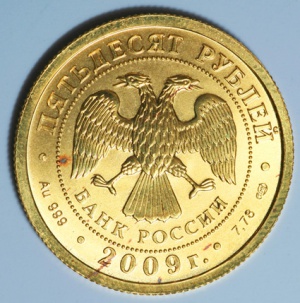
Obviously, global warming is much more severe than we thought.
Stupid or Evil? – Bernanke Puzzled by Gold Rally
Federal Reserve Chairman Ben Bernanke says he’s a bit puzzled by surging gold prices. The 30% rally from a year ago, on top of gains in previous years, might be interpreted as a loud signal from markets that big inflation pressures are building in the U.S. Gold is seen by many investors as a hedge against inflation risk.
. . . .
“I don’t fully understand movements in the gold price,” Mr. Bernanke admitted. But he suggested it might be another example of investors fleeing risky assets and flocking to assets that are perceived as less risky, not only Treasury bonds, but also ones like gold. (Read more from blogs.wsj.com)
Ron Paul on CNBC
Peter Schiff – Bullish on Gold
Abu Dhabi’s top hotel introduces gold dispensing ATM
Peter Schiff – Sovereign Bailouts and Moral Hazard
Ron Paul on the Greece Bailout & Fed Audit sabotage
66% of Greece either has a government job, or a government pension.
Greece Needs Capitalism and Freedom
The mainstream media would have us believe two myths about the Greek financial crisis: one, that the inability of the Greek government to meet its debt payments is a threat to the Euro and perhaps to the European Union itself; and, two, that Greek “austerity” would be a disaster for the Greek people.
The mainstream media takes it for granted that the proper “solution” is for some entity to bail out the Greeks—perhaps the European Union (EU), the European Central Bank (ECB), the International Monetary Fund (IMF), or some combination. Furthermore, the assumption is that when markets go up it is due to speculation that a bailout is imminent and that when markets go down it is due to some roadblock to an expected bailout. When the governments and their agencies agree upon the proper form of new loans, and/or loan guarantees, along with a token reduction in Greek spending, all will be well. In other words, the mainstream media portrays this financial crisis as one that can only be resolved by more government intervention.
First lets look at the so-called threat to the Euro, which is equated as a threat to the EU itself. Greece uses the Euro as its legal monetary unit. When Greece joined the EuroZone (not all EU members are members of the EuroZone, meaning they have not yet exchanged their national currencies for Euros), the Greek drachma was exchanged for Euros. Now all transactions in Greece are denominated in Euros. Greek citizens buy and sell using Euros. The Greek government spends Euros and, when it runs a budget deficit, it borrows Euros from private banks…the ECB being restricted by treaty from buying sovereign debt. The Greek crisis is simply that the Greek government is spending more Euros than it receives in tax payments, and private banks are balking at lending it more.
Since the Greeks no longer have a national currency, they cannot debase it and pay off their creditors with cheapened drachmas. So, the Greek government is left with the choice of raising taxes, cutting spending, or some combination of the two that will satisfy its creditors. Now, would someone please tell me why and in what form this Greek financial crisis, serious as it is to the Greeks themselves, constitutes a threat to the Euro? (Read more from patrickbarron.blogspot.com)