He tears down the house of European regulation. Love his irreverence.
Tag Archives: War on Commerce
World’s Easiest Economic Quiz
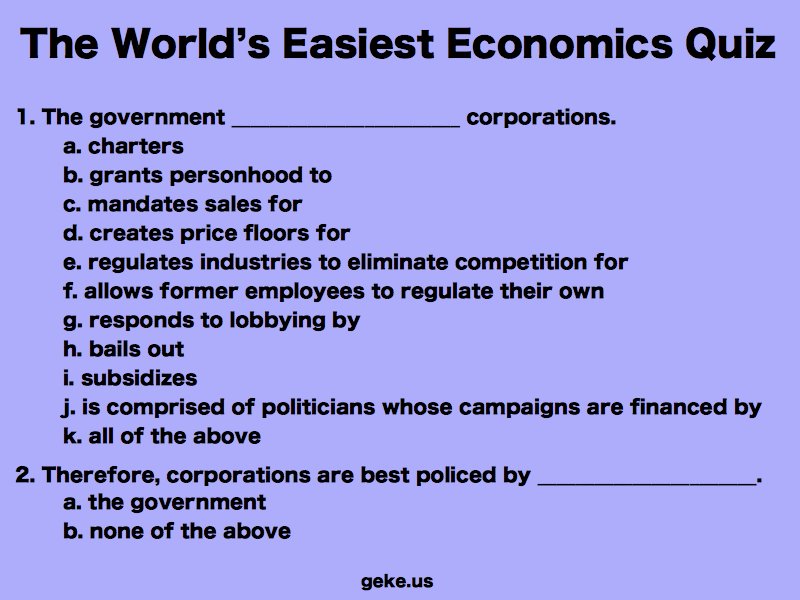
Many more economic memes at geke.us/.
Starting Over with Regulation
I don’t think this article reaches the right conclusion, namely, to let markets do the regulating, but it does point out the absurdity of government regulation:
 Government oversight of day care seems like a good idea—you wouldn’t want children cooped up in an airless basement—but this proposal went far beyond basic health and safety.
The new rules would dictate exactly how to do just about everything: how many block sets (“at least two (2) … with a minimum of ten (10) blocks per set”), where the children can play with the blocks (on “a flat building surface” that is “not in the main traffic area”) and when caregivers must wash their hands (before “eating food,” “after wiping a child’s nose,” etc.).
This is the way regulation works in America: Regulators try to imagine every possible mistake and then dictate a solution. The complexity is astounding.
Under a recent federal directive, the number of health-care reimbursement categories will soon increase from 18,000 to 140,000, including 21 separate categories for “spacecraft accidents” and 12 for bee stings. There are over 140 million words of binding federal statutes and regulations, and states and municipalities add several billion more.
. . . .
Consider our federal special-education laws, passed in the mid-1970s to end the shameful neglect of the small percentage of students with special needs. Special ed has now grown to consume 20% of the total K-12 budget in the U.S. Programs for gifted children, by contrast, get less than half of 1%.
Is this the correct balance? No one is even asking the question, because the regulations dictate the outcome.
The Butter shortage in Norway
Many Norwegians who live close to Sweden do their grocery shopping across the border where prices are lower, but to import butter has proven more difficult.
“They (Norway) have, as we see it, very restrictive trading politics, borderline protectionist,” Jonas Carlberg at the Swedish Dairy Association (Svensk Mjölk) told daily Dagens Nyheter, adding that the high custom duty is a way to protect domestic production in Norway.
But the shortage has made people turn to desperate measures, according to news agency TT.
A Russian man was caught on Friday trying to bring 90 kilogrammes of butter over the Swedish border to Norway without paying the custom duty. (Read more)
***
Prices spike as butter shortage spreads through Norway (Read more)
***
A comment from reddit:
In Norway, all milk and butter production is ruled over by an old and state-sanctioned cartel/corporation called TINE. The goal of TINE is to raise the prices on dairy products as high as humanly possible; with this, they have great success. For example: Currently, one litre of milk costs 14 Norwegian kroner = 2.431184 US$. Keep in mind that 1 US gallon = 3.78541178 litres and you can calculate the price/gallon for yourself…
As a result of this huge overprice, the result is the same as it always have been: overproduction. More is being produced, than sold. So what happens?
TINE implements quotas; each farmer is only allowed to produce x amounts of milk each year. This year, however, the production was smaller than otherwise due to the weather. So what does TINE do?
Nothing. Every grain of their being is geared towards reducing production, so they have no ideological idea that they can even do anything else. In spite of this shortage having been advertised from months and months away, they never increased the quotas for the farmers that could produce more.
I would also like to point out a couple of dirty tricks the TINE corporation uses to shut down any and all competition:
They have invented the Jarlsberg cheese, a cheese that was made exclusively to use much milk; they also lobbied for export subsidies for said cheese. We use milk worth 90 NOK to produce Jarlsberg, then it is exported for around 35-40 NOK; the other 50 NOK, around 8-9$, are subsidized by the state. This way we pay the Americans to eat our surplus milk storage and keep prices high.
Oh, and they have also blocked our enjoyment of Edamer. You see, some time ago dutch edamer cheese got popular in Norway. TINE lobbied the department of agriculture and had a tariff put up, then started producing their own shitty copies.
Same story with feta cheese. Around the early 2000’s, Arla corporation that operates in Denmark/Sweden started marketing and creating a market for feta cheese in Norway. They made great success with this. What happened then was that TINE sent a little letter to the agricultural ministry, which was, as per custom, precided over by a previous TINE CEO, and had them reinterpret the rules creatively. Previously imported cheese was judged based on the weight of the cheese itself; feta cheese on the other hand is lying in an oil solution to give it taste. Now the rules were suddenly interpreted so that the oil solution is counted as part of the cheese, thus doubling the import tolls on feta cheese. Oh and suddenly TINE launched their own shitty feta rip offs on the market as well.
tl;dr: The “butter crisis” is a result of a centrally planned Soviet-system of milk production, coupled with a rush for profit by the TINE corporation. As a result the consumer is sucked dry by the unscrupulous monopolist cunts.
Man catches 881-pound tuna, seized by feds
A Massachusetts fisherman pulled in an 881-pound tuna this week only to have the federal authorities take it away. It sounds like a libertarian twist on the classic novella by Ernest Hemingway, The Old Man and the Sea, but for Carlos Rafael, the saga is completely true.
Rafael and his crew were using nets to catch bottom-dwellers when they inadvertently snagged the giant tuna. However, federal fishery enforcement agents took control of the behemoth when the boat returned to port. The reason for the seizure was procedural: While Rafael had tuna permits, fishermen are by law only allowed to catch tuna with a rod and reel.
. . . .
In an interview with the Standard-Times of New Bedford, Rafael disputes the claims from the National Oceanic and Atmospheric Administration’s (NOAA) enforcement division that the humungous tuna was trawled from the bottom of the Atlantic. “They didn’t catch that fish on the bottom,” he said. “They probably got it in the mid-water when they were setting out and it just got corralled in the net. That only happens once in a blue moon.”
And while Rafael is denied the mother of all fish stories, the federal impoundment of his catch also means he’s probably losing out on a giant payday. A 754-pound tuna recently sold for nearly $396,000. NOAA regulators do not share any of the proceeds from the fish’s eventual sale with a fisherman found in violation of federal rules.
“They said it had to be caught with rod and reel,” a frustrated Rafael said. “We didn’t try to hide anything. We did everything by the book. Nobody ever told me we couldn’t catch it with a net.” (Read more)
Mock Union Protest Sign

All of modern U.S. economic history in three parts, by Peter Schiff
Peter Schiff’s reaction to Obama Jobs (“stimulus”) Speech
Schiff: Jobs Report, Gartman on gold, Gross on bonds, Government sues banks
Banning Rock ‘n’ Roll? Gibson Guitar CEO Shreds the Feds.
Lumber unions are suspected of being behind this. The company was importing Indian timber (and employing 1,200 Americans).
Hair dresser wants to make house calls — forbidden in California
The Government War on Jobs
Great discussion @ 7:20 the end of this video about how government “protection” of women, minorities and disabled people make it very scary for entrepreneurs to hire them.
Recommend starting @ 6:00
June Nanny of the Month Award — War on Lemonade Stands
War on DC taxis
Government often consists of creating arbitrary restrictions, then selling exceptions to them. Here, for example:
Amazon ends deal with 25,000 California websites rather than collect tax
Gov. Jerry Brown has signed into law California’s tax on Internet sales through affiliate advertising which will immediately cut small-business website revenue 20% to 30%, experts say.
The bill, AB 28X, takes effect immediately. The state Board of Equalization says the tax will raise $200 million a year, but critics claim it will raise nothing because online retailers will end their affiliate programs rather than collect the tax.
Amazon has already emailed its termination of its affiliate advertising program with 25,000 websites. The letter says, in part:
(The bill) specifically imposes the collection of taxes from consumers on sales by online retailers – including but not limited to those referred by California-based marketing affiliates like you – even if those retailers have no physical presence in the state.
We oppose this bill because it is unconstitutional and counterproductive. It is supported by big-box retailers, most of which are based outside California, that seek to harm the affiliate advertising programs of their competitors. Similar legislation in other states has led to job and income losses, and little, if any, new tax revenue. We deeply regret that we must take this action.