Below are some excerpts from a great essay by Chris Hedges. The only thing I disagree with is his surprise that the state chooses to increase its authority.
I’m no longer surprised when government courts rule that the government is right, and we underlings are wrong. This is Hoppe’s argument for what he calls “a private law society” (what others call anarcho-captialism). A monopoly on justice will always rule in its own favor.
Historian and author Tom Woods makes a strong case for nullification being a better protector of the Constitution than the panel of providentially appointed judges.
The government also gets to unilaterally decide how much to charge you for this “service” and kidnaps you if you refuse to pay, labelling you a “tax evader.”
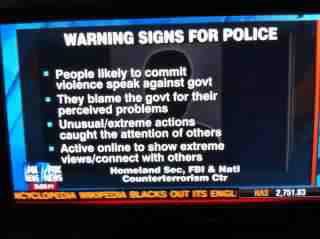
 Totalitarian systems disempower an unsuspecting population by gradually making legal what was once illegal. They incrementally corrupt and distort law to exclusively serve the goals of the inner sanctums of power and strip protection from the citizen. Law soon becomes the primary tool to advance the crimes of the elite and punish those who tell the truth. The state saturates the airwaves with official propaganda to replace news. Fear, and finally terror, creates an intellectual and moral void. . . .
And a conviction of Bradley Manning, or any of the five others charged by the Obama administration under the Espionage Act of 1917 with passing on government secrets to the press, would effectively terminate public knowledge of the internal workings of the corporate state. What we live under cannot be called democracy. What we will live under if the Supreme Court upholds the use of the Espionage Act to punish those who expose war crimes and state lies will be a species of corporate fascism. And this closed society is, perhaps, only a few weeks or months away.
Few other Americans are as acutely aware of our descent into corporate totalitarianism as Daniel Ellsberg, who leaked the Pentagon Papers in 1971 to The New York Times and is one of Manning’s most ardent and vocal defenders.
. . . .
The Supreme Court has yet to hear a case involving the Espionage Act. But one of these six cases will probably soon reach the court. If it, as expected, rules that the government is permitted to use the Espionage Act against whistle-blowers, the United States will have a de facto official secrets act. A ruling in favor of the government would instantly criminalize all disclosures of classified information to the public. It would shut down one of the most important functions of the press. And at that point any challenges to the official versions of events would dry up.
The Obama administration, to make matters worse, has mounted a war not only against those who leak information but those who publish it, including Assange. The Obama administration is attempting to force New York Times reporter James Risen to name the source, or sources, that told him about a failed effort by the Central Intelligence Agency to sabotage Iran’s nuclear program. Jeffrey Sterling, a former CIA officer, is charged under the Espionage Act for allegedly leaking information about the program to Risen. If Risen confirms in court that Sterling was his source, Sterling probably will be convicted. A Supreme Court ruling in favor of the Espionage Act would also remove the legal protection that traditionally allows journalists to refuse to reveal their sources. (Read more)