Tag Archives: Healthcare

Not Left vs Right, Power vs Liberty

“These are perilous times to believe in liberty. Because I oppose Obama’s expansion of government (socialized health care), people assume I was for Bush’s expansion of government (wars, domestic spying, suspending habeas corpus for detainees, monitoring domestic travel, etc.).

Such is the world through the lens of left-versus-right glasses. I’ve been lumped together with neo-cons, called a Republican agent, and faced such comments as, ‘Think of [alternative-energy subsidies] this way: It’s a new weapon to use against the Middle East. It’s weapons research. That should satisfy your tiny repubtard mind.’

I’ll note that I voted for neither McCain nor Obama — neither for the old white guy who believes in bank bailouts and expanding foreign, undeclared wars, nor for the young black guy who believes in bank bailouts and expanding foreign, undeclared wars.

In both cases, dissenters were/are portrayed as fringe, radical, unreasonable, and irrelevant. In both cases, the conflict is crammed into a paradigm of left versus right, and, in both cases, it’s an uphill battle for those of us who oppose an expansion of government.” (from DailyIowan.com)

Healthcare flame war highlights

These are perilous times to believe in liberty. Because I oppose Obama’s plan for expanding government, people assume I was for Bush’s expansion of government, his wars, etc. Such is the world through the lenses of left-vs-right glasses.

I’ve been lumped together with neo-cons, called a Republican agent and faced comments like: “You Republicans want taxes to kill people in Iraq, while Democrats want taxes to *save* people in America.”

I’ll note that I voted for neither McCain nor Obama – neither the old white guy who believed in bank bailouts and expanding foreign, undeclared wars, nor the young black guy who believes in bank bailouts and expanding foreign, undeclared wars.

The opponents of socialized healthcare are demonized, just as the opponents of the Iraq war were demonized. In both cases, it’s ordinary people resisting the power of government. In both cases, dissenters are portrayed as fringe, radical and irrelevant, and the conflict is crammed into a paradigm of left-versus-right. In both cases, it’s an uphill battle for those of us who oppose an expansion of government.

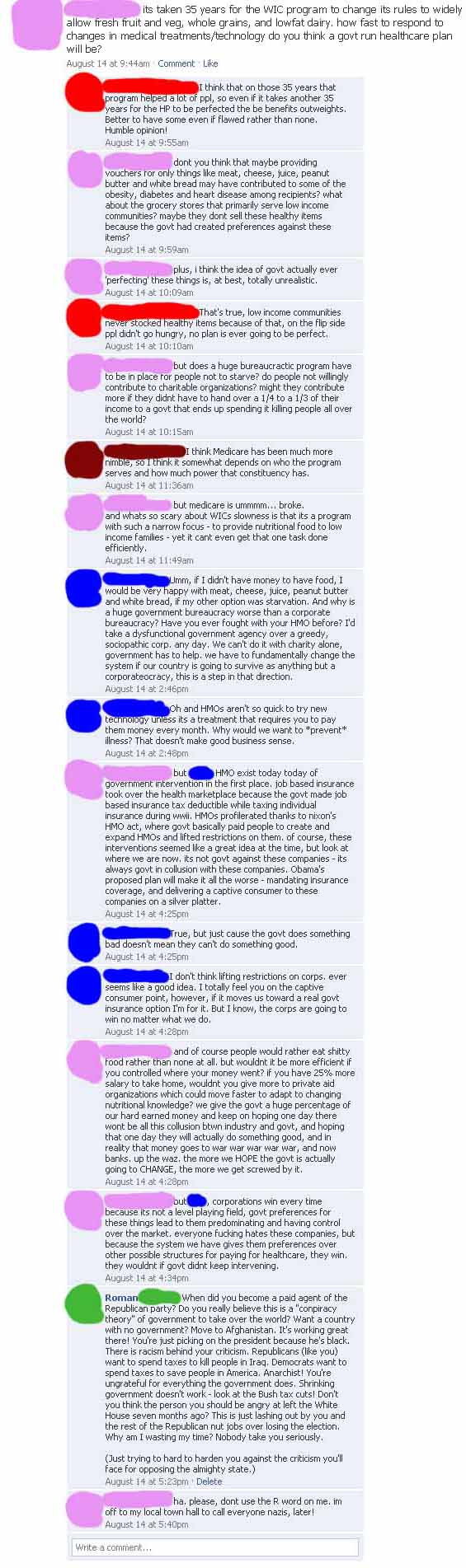
Anyway, here are some flame wars, and excerpts from emails I’ve received from friends about their own struggles. Esoteridactyl, you have my thanks and admiration.

I got dragged into a facebook flame war on the subject. Someone posted about how “stupid those stupid fucking townhall protesters are”. I had to comment that, well, many people have very serious concerns and willfully mis-representing their arguments does disservice to oneself.

Anyway, we went back and forth a few rounds on that, until I delivered the closer: I support the interpretation that Roe v Wade guarantees certain privacy rights; how can you oppose gov’t intrusion into fertility, but support it for every other health decision. The sputtering rage was priceless.

***

so, i am officially out of the closet on health care, at least on facebook. and i hate to admit it, but im so scared everyone i know is going to hate me :( or that i wont have the energy or will to effectively argue the position. this shit is hard!

. . . .

its just such a frustrating thing to have to keep reassuring people that i dont want to kill all the poor people.

. . . .

oh boy, here we go: “Dude, I’m sorry but if you keep on this townhall-meeting propaganda status kick, I might have to defriend you, just a warning.”

. . . .

i feel like im having an argument with myself a year ago

***

Comment wars on Reddit. I should have known better than to bring the ideas of economic freedom to a post about one their most sacred cows, subsidies of alternative energy. I’ve since learned that most liberty-minded people are hiding out in the Libertarian subreddit, leaving politics and economics for the statists.

rangerkozak -6 points 15 days ago[-]

Here in Iowa, I know a guy in the bio-diesel industry who readily admits it’s complete bullshit, but if you close your eyes, tap your ruby slippers together and say “bio-diesel” or “sustainable” or “electric car”, then money begins to fall from the sky.

Problem is, the money is taken from you and me at the point of a gun. This is nothing but a giant subsidy of less efficient energy production which wouldn’t be able to compete in a free market.

ParanoydAndroid 13 points 15 days ago* [-]

This is nothing but a giant subsidy of less efficient energy production which wouldn’t be able to compete in a free market.

Exactly. Since this technology wouldn’t be able to compete in the open market, it wouldn’t get developed. This way we provide the money, the technology gets developed and improved, the efficiency increases, and then it becomes marketable without subsidies.

Suddenly everyone has cheaper fuel sources, renewable energy makes our lifestyle more sustainable, and everyone wins.

Or we could keep rabble-rousing about how since the technology is bad right now then that it means it could never, ever improve our lives at any point in the future, whatever floats your boat.

rangerkozak -6 points 15 days ago[-]

Double Facepalm!

“War is peace. Freedom is slavery. Ignorance is strength.” ~George Orwell

captainwasabi -1 points 14 days ago[+] (0 children)

Think of it this way. It’s a new weapon to use against the middle east. It’s weapons research. That should satisfy your tiny repubtard mind.

bad_llama 6 points 15 days ago* [-]

Problem is, the money is taken from you and me at the point of a gun.

Stop with the hyperbole.

rangerkozak -1 points 15 days ago[+] (22 children)

This is no hyperbole. If you want to see the guns and just how real they are, then stop paying your taxes.

Our government’s benevolence is financed by money taken from us under threat of violence.
This is no hyperbole. If you want to see the guns and just how real they are, then stop paying your taxes. Our government’s benevolence is financed by money taken from us under threat of violence.

Braggs 3 points 15 days ago[+] (0 children)

Going even further, if the government would have kept its nose out of the commercial sector in the first place (i.e. subsidies on gasoline/diesel vehicles and petroleum products) then the increased prices (due to lack of government funding) would have already forced the commercial sector to provide more economical alternatives. What is happening is the government competing against itself.

bad_llama 3 points 15 days ago* [+] (19 children)

You live in a society that has a governing body. You are represented in this governing body. You can vote, you can protest, you can debate freely. There are a million and one ways to make a change in this system. If you don’t like something (like the ways our taxes are spent) you are free to try to change it. The thing is, everyone else in this society has a say in how it operates (how it spends taxes) as well. If you have a compelling argument and can sway the people in the society to agree with you, change will happen in your favor. If you don’t have a compelling argument, society will not agree with you and things will keep moving along with or without you.

Let me say again, you live in a society. That is a fact. Nothing you can do will change this. Everything you do affects others and everything others do affects you. Everyone gives and takes according to the agreed upon rules. That is how a society functions and this is how a society advances.

rangerkozak comment score below threshold[+] (17 children)
rangerkozak -6 points 15 days ago* [-]

The fact of a society is no excuse for a tyranny. What in our Constitution gives government the right to redistribute wealth from some industries to others???

Speaking of facts, in America, 1/6th of the labor force is employed DIRECTLY BY GOVERNMENT. (source)

The taxes on every five people support the salary (and benefits) of a sixth. So I would be very, very hesitant to call for more government programs, more government spending, more government good ideas.

Yes, we live in a society. I’m not calling for anarchy, I’m calling for economic freedom, and you should too.
The fact of a society is no excuse for a tyranny. What in our Constitution gives government the right to redistribute wealth from some industries to others??? Speaking of facts, in America, 1/6th of the labor force is employed DIRECTLY BY GOVERNMENT. ([source](http://www.lostrepublic.com/archives/637)) The taxes on every five people support the salary (and benefits) of a sixth. So I would be very, very hesitant to call for more government programs, more government spending, more government good ideas. Yes, we live in a society. I’m not calling for anarchy, I’m calling for economic freedom, and you should too.

[deleted] 5 points 15 days ago[-]

There are countries that operate as you suggest. The problem is they are dirt-poor and nobody wants to live there.

Look around at all the really good countries – the countries where it is possible to accumulate wealth and have a nice life-style. Do you notice how those countries all have taxes and social programs and strong central governments?

Maybe your “economic freedom” fantasy just doesn’t work as well as you think.

rangerkozak -5 points 15 days ago[-]

The fantasy is the success of centrally-planned economies. There is tremendous evidence suggesting that liberty works best:

* West German vs East Germany
* South Korea vs North Korea
* Hong Kong in the 80s vs China in the 80s
* Estonia vs Latvia or Lithuania
* Botswana vs the rest of Africa
* Chile vs the rest of S. America

This debate was settled (again) when the Berlin wall fell, at yet socialist ideas continue to rise from the grave. I’ll never understand the public’s lust for tyranny.

Recommend Hayek’s Road to Serfdom

dethbunny 1 point 15 days ago* [-]

Chile? The same Chile that was ruled by Augusto Pinochet for 16 years? What a shining beacon of liberty! . . . .

rangerkozak -2 points 14 days ago[-]

Obviously, Pinochet was a murderous dictator, and deserved the condemnation he receives. In everything but economics, he was a tyrant.

If you care to to look at economics, however: The Global Competitiveness Report for 2007-2008 ranks Chile as being the 26th most competitive country in the world and the first in Latin America

WRT Scandinavia in general, and Sweden in particular, there are some good excerpted essays here which cast doubt on the common perception. They are authored by Swedes.

***

***

***

A smart comment I saw on reddit in response to this article:

genius_in_progress 6 points7 points8 points 2 hours ago* [+] (1 child)

Brilliant article!
The US government actively pursues policies that both drive up demand and drive down supply.
To drive supply down:

* Professional licensure and immigration restrictions artificially limit the supply of physicians
* Perverse incentives at the FDA regarding safety and efficacy standards artificially restrict the supply of medication
* A large regulatory burden and a prohibition against selling health insurance across state lines artificially restrict the supply of insurance

To drive demand up:

* Publicly funded programs encourage over-use (Medicare and Medicaid)
* Tort law encourages doctors to order excessive tests and procedures, to avoid malpractice suits
* Tax incentives for employers to shop for insurance on behalf of their employees. If employees chose their own insurance, they would likely opt for lower premiums and higher deductibles, and would therefore be more selective about what health care expenses they incur

If that’s not a recipe for high prices, I don’t know what is.

A Four-Step Healthcare Solution

#3 is especially interesting.

“It’s true that the US health-care system is a mess, but this demonstrates not market but government failure. To cure the problem requires not different or more government regulations and bureaucracies, as self-serving politicians want us to believe, but the elimination of all existing government controls.

. . . .

1. Eliminate all licensing requirements for medical schools, hospitals, pharmacies, and medical doctors and other health-care personnel. Their supply would almost instantly increase, prices would fall, and a greater variety of health-care services would appear on the market.

Competing voluntary accreditation agencies would take the place of compulsory government licensing — if health-care providers believe that such accreditation would enhance their own reputation, and that their consumers care about reputation, and are willing to pay for it.

2. Eliminate all government restrictions on the production and sale of pharmaceutical products and medical devices. This means no more Food and Drug Administration, which presently hinders innovation and increases costs.

Costs and prices would fall, and a wider variety of better products would reach the market sooner. The market would force consumers to act in accordance with their own — rather than the government’s — risk assessment. And competing drug and device manufacturers and sellers, to safeguard against product liability suits as much as to attract customers, would provide increasingly better product descriptions and guarantees.

3. Deregulate the health-insurance industry. Private enterprise can offer insurance against events over whose outcome the insured possesses no control. One cannot insure oneself against suicide or bankruptcy, for example, because it is in one’s own hands to bring these events about.

Because a person’s health, or lack of it, lies increasingly within his own control, many, if not most health risks, are actually uninsurable. ‘Insurance’ against risks whose likelihood an individual can systematically influence falls within that person’s own responsibility.

All insurance, moreover, involves the pooling of individual risks. It implies that insurers pay more to some and less to others. But no one knows in advance, and with certainty, who the ‘winners’ and ‘losers’ will be. . . . I would not want to pool my personal accident risks with those of professional football players, for instance, but exclusively with those of people in circumstances similar to my own, at lower costs.

Because of legal restrictions on the health insurers’ right of refusal — to exclude any individual risk as uninsurable — the present health-insurance system is only partly concerned with insurance. The industry cannot discriminate freely among different groups’ risks.

As a result, health insurers cover a multitude of uninsurable risks, alongside, and pooled with, genuine insurance risks. They do not discriminate among various groups of people which pose significantly different insurance risks. The industry thus runs a system of income redistribution — benefiting irresponsible actors and high-risk groups at the expense of responsible individuals and low-risk groups. Accordingly, the industry’s prices are high and ballooning.

To deregulate the industry means to restore it to unrestricted freedom of contract: to allow a health insurer to offer any contract whatsoever, to include or exclude any risk, and to discriminate among any groups of individuals. . . On average, prices would drastically fall. And the reform would restore individual responsibility in health care.

4. Eliminate all subsidies to the sick or unhealthy. Subsidies create more of whatever is being subsidized. Subsidies for the ill and diseased promote carelessness, indigence, and dependency. If we eliminate such subsidies, we would strengthen the will to live healthy lives and to work for a living. In the first instance, that means abolishing Medicare and Medicaid.” (Read more from mises.org)

Another target of Obamacare: Americans’ right to financial privacy

By Diana Furchtgott-Roth

“Buried in the 1,017 pages of the House Democrats’ health-care bill is a little-noticed provision that for the first time could give the government access to the checking or credit-card information of every American. Under section 163, which is entitled ‘Administrative Simplification,’ the bill sets new ‘standards’ for electronic transactions between individuals and their health-care providers.

According to section 163, the standards will ‘enable the real-time (or near real-time) determination of an individual’s financial responsibility at the point of service . . .’ In addition, they will ‘enable electronic funds transfers, in order to allow automated reconciliation with related health care payment and remittance advice.'”
(from nationalreview.com)

A friend of mine who describes himself as liberal and pacifist put it this way: I support the interpretation that Roe v Wade guarantees certain privacy rights; how can you oppose gov’t intrusion into fertility, but support it for every other health decision.

Obama and the Post Office

Fantastic Lew Rockwell essay on campaignforliberty.com:

“Writing in The State and Revolution in 1917, Vladimir Lenin summed up the economic aim of socialism as follows: ‘To organize the whole economy on the lines of the postal service….’

Incredible, isn’t it? After centuries of treatises and miles of paper and tubs of ink, this is the great historical turning point: government employees carrying sacks of paper mail from house to house, and operating at an economic loss.

It’s fascinating how it all comes down to the post office, again and again in the history of public policy. And so it is in our time, with Obama’s admission/gaffe/slip concerning the post office and its analogy to what he wants to do with health care.

Here is a transcript of his spontaneous talk at a high school. A student raised a question about the government’s provision of health services and its impact on private services.

‘How can a private company compete against the government? My answer is that if the private insurance companies are providing a good bargain, and if the public option has to be self-sustaining, meaning that taxpayers aren’t subsidizing it, but it has to run on charging premiums and providing good services, and a good network of doctors, just like private insurers do, then I think private insurers should be able to compete.

‘They do it all the time. If you think about it, UPS and Fed-Ex are doing just fine. It’s the Post Office that’s always having problems…. there is nothing inevitable about this somehow destroying the private marketplace. As long as it is not set up where the government is being subsidized by the taxpayers so that even if they are providing a good deal, we keep having to pony up more and more money.’

Now, these comments are nothing short of incredible. The Post Office has been on the loser list for many decades. Most recently, it has been included on the GAO’s high-risk list, increasing its debt to $10.2 billion and incurring a cash shortfall of $1 billion.

Note that the post office is not being shut down for this mess. On the contrary, it is being subsidized not only with tax dollars but, most importantly, with laws. Title 18 (I.83.1696) says that ‘Whoever establishes any private express for the conveyance of letters or packets’ can be fined and jailed. Moreover, the law (39.I.6.606) says that any letter delivered by unlawful means can be seized and stolen by the government. It is immune from antitrust action and criminal liability. [emphasis added]

. . . .

Therefore Obama is right in a strange way: private enterprise has triumphed and government service is terrible. Everyone knows this. It is utterly preposterous that a government mail service exists at all. There is no theory of economics that supports it. There is not now nor has there ever been any economic reason for government postal service. It should be immediately abolished and private enterprise should take over. Even on the basis of Obama’s thin and strange statements, you might argue this conclusion.

But perhaps Obama meant to suggest that the reason the Post Office is so bad is because it has to compete with private enterprise. If he meant that, he lives in a socialist fantasy land, and we have a very dangerous man on our hands. In the real world, no living person could possibly believe that mail service would be improved by getting rid of the efficient producers and granting a totalitarian monopoly to a single government-backed provider.

. . . .

The right path to health-care reform is the market path (no subsidies, no monopolies such as drug patents, no licensure, no anything) that tends toward universal distribution at very low prices and relentless improvement in service. The wrong path is to make health care run the same way as the post office. Obama seems to favor the latter path, even though he admits that it is the least well-performing one. This is surely the definition of fanaticism. If the mobs aren’t angry, they should be.” (Read more on campaignforliberty.com)

More on Demonizing National Healthcare Opposition

I’ve been disgusted by what little I’ve seen of big media’s healthcare opposition coverage. As usual, the media is trying to squeeze a people vs. government issue into a left vs. right paradigm. So long as we are fighting each other, government is free to run rampant.

God bless the internet, lest I might think myself un-American for opposing Obamacare. I’m please to see strong criticism of the coverage from my usual sources.

Great commentary by Southern Avenger:

Some guy reacts to MSNBC host equating cries of “socialism” to using the N-word:

Fox “news” has been a checkered ally of the liberty movement. They seem like party hacks. When Republicans propose war, tyrannical government powers, and endless spending, Fox “news” becomes their #1 cheerleader, but when Democrats propose war, tyrannical government powers, and endless spending, Fox works to expose the threat to our liberty. Here, Fox interviews a Michigan man who confronted his congressman:

In the above interview, the man who confronted his congressman referenced this NY Post article, in which two of Obama’s advisers, including Ezekiel Emanuel, brother of chief of staff Rahm Emanuel, discuss healthcare rationing. I actually think they offer very level-headed thoughts on how socialized healthcare would work. You can’t provide unlimited use of finite (and expensive) goods and services. Of course, most of the socialists behind Obamacare like to pretend you can.

As Tyler Durden wrote in this essay: “There is no system that provides for unlimited wants with limited resources. Our choice is whether it should be rationed by free people making their own economic calculations or by a bureaucracy run by Congressional committee (whose members, like the Russian commissars, will, I guarantee you, still get the best health care the gulag hospitaligo can provide).”

Lastly, hear Peter Schiff discuss bringing free market forces back to healthcare. I think the example of cosmetic surgeries provided at the end is spectacular:

10 Surprising Facts about American Health Care

1: Americans have better survival rates than Europeans for common cancers.
2: Americans have lower cancer mortality rates than Canadians.
3: Americans have better access to treatment for chronic diseases than patients in other developed countries.
4: Americans have better access to preventive cancer screening than Canadians.
5: Lower income Americans are in better health than comparable Canadians.
6: Americans spend less time waiting for care than patients in Canada and the U.K.
7: People in countries with more government control of health care are highly dissatisfied and believe reform is needed.
8: Americans are more satisfied with the care they receive than Canadians.
9: Americans have much better access to important new technologies like medical imaging than patients in Canada or the U.K.
10: Americans are responsible for the vast majority of all health care innovations.

Details and references at ncpa.org.

Seven New US Military Bases in Colombia

“In a recent edition of the Wall Street Journal, Mary Anastasia O’Grady laments an apparent shift left in the Obama administration’s Latin America policy. Clearly, O’Grady hasn’t been keeping up to date with current events. If she had been, she would have heard about negotiations underway between the U.S. and Colombia to establish at least seven U.S. military bases in Colombia. Last I heard, folks on the left tend to oppose increased militarization; it’s tough to see seven new military bases as a move to the left.” (Read more from commondreams.org)

Change?

Healthcare Mythology

Wow! This is the best healthcare commentary I’ve read in a long time, excerpted for your convenience (original here):

by Tyler Durden

There are large groups of people in this country who want socialized medicine and they sense that the stars are aligning, and now is their time to succeed. They rarely call it socialized medicine, but instead “single payer health care” or “universal coverage” or something that their public relations people have told them sounds better. Whatever they call it, they believe (or pretend to believe) a lot of wrong-headed things, and they must be stopped. Step one is understanding how and why they are wrong. Step two is kicking their asses back to Cuba where they can get in line with Michael Moore and Al Gore for their free gastric bypasses. . . .

Myth #1 Health Care Costs are Soaring

No, they are not. The amount we spend on health care has indeed risen, in absolute terms, after inflation, and as a percentage of our incomes and GDP. That does not mean costs are soaring.

You cannot judge the �cost� of something by simply what you spend. You must also judge what you get. I’m reasonably certain the cost of 1950’s level health care has dropped in real terms over the last 60 years (and you can probably have a barber from the year 1500 bleed you for almost nothing nowadays). Of course, with 1950’s health care, lots of things will kill you that 2009 health care could prevent. . . .

In the case of health care, the fact that we spend so much more on it now is largely a positive. The negative part is if some, or a lot, of that spending is wasteful. Of course, that is mostly the government’s fault and is not the part on which the socialists want you to focus [emphasis added]. We spend so much more on health care, even relative to other advances, mostly because it is worth so much more to us. Similarly, we spend so much more on computers, compact discs, HDTV, and those wonderful one shot espresso makers that make it like having a barista in your own home.

Myth #2 The Canadian Drug Story

We have a (relatively) free market in the US where drug companies spend a ton to develop new wonder drugs, a non-trivial amount of which is spent to satisfy regulatory requirements. The cost of this development is called a �fixed cost.� Once it’s developed it does not cost that much to make each pill. That’s called a �variable cost.� If people only paid the variable cost (or a bit more) for each pill the whole thing would not work. You see, the company would never get back the massive fixed cost of creating the drug in the first place, and so no company would try to develop one. Thus, companies have to, and do, charge more than the variable cost of making each pill.[2] Some look at this system and say to the drug companies �gee, it doesn’t cost you much to make one more pill, so it’s unfair that you charge much more than your cost.� They are completely wrong and not looking at all the costs. . . .

[Canadians] have socialized medicine and they bargain as the only Canadian buyer for drugs, paying well below normal costs. Drug companies that spent the enormous fixed costs to create new miracles are charging a relatively high cost in the free and still largely competitive world (the US) to recoup their fixed cost and to make a profit. But socialist societies like Canada limit the price they are allowed to charge. The US-based company is then faced with a dilemma. What Canada will pay is not enough to ever have justified creating the miracle pill. But, once created, perhaps Canada is paying more than the variable cost of each pill. Thus, the company can make some money by also selling to Canada at a lower price as it’s still more than it costs them to make that last pill. . . .

I’m a big fan of Canadians in general . . . but when it comes to pharmaceuticals they are lucky parasitic hosers.

Myth #3 Socialized Medicine Works In Some Places

This is a corollary to the �Canada as parasite� parable above. The funny part is socialized medicine has never been truly tested. Those touting socialism’s success have never seen a world without a relatively (for now) free US to make their new drugs, surgical techniques, and other medical advancements for them. When (and I hope this doesn’t happen) the US joins in the insanity of socialized medicine we will see that when you remove the brain from the body, the engine from a car, the candy from the striper, it just does not work. . . .

To put it simply, right now the US’s free system massively intellectually subsidizes the world’s unfree (socialized) ones. That sucks. The only thing that would suck worse is joining them without anyone to subsidize us all.

Myth #4 A Public Option Can Co-Exist with a Private Option

Part of the current junta’s plan is to add a �public option� for health insurance. That is health insurance provided by the government (actually provided by you and your neighbors � this is a good thing to remember whenever you find yourselves thinking anything comes from the government, really, if you take away anything from this essay take away this!). They claim this �public option� can co-exist fairly alongside private health insurance, increasing competition and keeping the private system �honest�, and not deteriorate to a single payer (socialized medicine) system. They are wrong, or very dishonest, as in unguarded moments they admit that the single payer socialized system is what they really want. The New York Times disagrees with me, thinking the two can co-exist. But the New York Times still thinks Stalin was a pretty decent Joe. . . .

The government does not co-exist or compete fairly with private enterprise. It does not play well with others. The regulator cannot be a competitor at the same time. It cannot compete fairly while it owns the armed forces and courts. Finally, it cannot be a fair competitor if when the �public option� screws up (can’t pay its bills), the government implicitly or explicitly guarantees its debts. We have seen what happens in that case and don’t need a re-run.

The first thing the government does is underprice the private system. You can easily be forgiven for thinking this is a good thing. Why not, cheaper is better right? Wrong. They will underprice private enterprise by charging less to the purchaser of health insurance, not by actually creating it cheaper. Who makes up the difference? Well, you and your family do if you pay taxes, or your kids will pay taxes, or their kids will pay taxes. The government can always underprice competition, not through the old fashioned way of doing it better, they never do that, but by robbing Peter to pay for Paul. . . .

Second, the government ultimately always cheats when it’s involved in �honest� competition. Try mailing a first class letter through Fed-Ex [See Post Office sues Cub Scouts to maintain monopoly], or placing an off-track bet with a bookie, or playing a lottery through a private company. Uh, you can’t, so please stop trying. . . . Once the government discovers it cannot win, it changes the rules. You see, the government has the power to legislate, steal, imprison, and kill. Those are advantages most private firms do not have, save Google, and you didn’t hear that from me. . . .

Perhaps the best example of the destructive �public option� is our nation’s schools. Here we clearly have a government provided �public option� competing with (and in fact dominating in size) private schooling. But, is it fair? Does it work well? Not by a long-shot. To send your kids to private school (i.e., a school that competes with the government) you need to first pay your taxes. Absent vouchers or tax credits . . . if you eschew the �public option� you have to pay for education twice. . . .

With a �public option� things inevitably would go the horrific way of our public schools. Instead of existing to please customers (patients and students respectively) the �public option� in schools exists largely to benefit empowered stakeholders of the system (health administrators and unionized school employees respectively), who will shamelessly pretend to give a darn about sick people and children. Watch the analogy play out if we go this route in health care. . . .

Myth #5 We Can Have Health Care Without Rationing

Rationing has to occur. This sounds cold and cruel, but it is reality. . . . [Healthcare is] going to be rationed by some means. The alternatives come down to the marketplace or the government. To choose between those alternatives you judge on morality and efficacy. . . .

There is no system that provides for unlimited wants with limited resources. Our choice is whether it should be rationed by free people making their own economic calculations or by a bureaucracy run by Congressional committee (whose members, like the Russian commissars, will, I guarantee you, still get the best health care the gulag hospitaligo can provide). Free people making their own choices only consume what they value above price, using funds they have earned or been given voluntarily. With socialized medicine health care is rationed by committees of politicians trying to get re-elected and increase their own power, and people consume as much of it as the commissars deem permissible. I do not find these tough alternatives to choose between.

Myth #6 Health Care is A Right

Nope, it’s not. But we are at the nuclear bomb of the discussion. The one guaranteed to get me yelled at or perhaps picketed by a mob waving signs printed up with George Soros’s money. Those advocating socialized medicine love to scream �health care is a right.� They are loud, they are scary, but they are wrong about rights. . . .

Listing rights generally involves enumerating things you may do without interference (the right to free speech) or may not be done to you without your permission (illegal search and seizure, loud boy-band music in public spaces). They are protections, not gifts of material goods. Material goods and services must be taken from others, or provided by their labor, so if you believe you have an absolute right to them, and others don’t choose to provide it to you, you then have a �right� to steal from them. But what about their far more fundamental right not to be robbed?

. . . .

Lots of politicians understand that the simple free system leaves them out in the cold. No power for them. No committees to sit on to decide people’s lives. No lies to tell their constituents how they (the government) brought them the health care they so desperately need. No fat checks from lobbyists as the crony capitalists pay dearly to make the only profits possible under this system, those bestowed by the government. Libertarians are often accused wrongly of loving �big business,� but we don’t, particularly when they predictably turn themselves into crony capitalists who try to succeed by wheedling from the government. On the other hand the socialists love cronies of all sorts, ones who command large enterprises all the better. Socialists are far closer than libertarians to building and countenancing the all-powerful corporate state they claim to fear. Odd I know!

(Read the complete essay at zerohedge.blogspot.com)
Texas stands up to Obama care

“Gov. Rick Perry, raising the specter of a showdown with the Obama administration, suggested Thursday that he would consider invoking states’ rights protections under the 10th Amendment to resist the president’s healthcare plan, which he said would be ‘disastrous’ for Texas.” (Read more from lewrockwell.com)

Never thought I’d say it, but God bless Texas – for this, as well as their fanatic devotion to the 2nd amendment.

Rand Paul on Obamacare

Rand Paul: Who are [the 40 million uninsured in America]? . . . a third of them make more than $50,000 a year, a third of them are elligible for medicaid but haven’t figured out how to apply for it, and about 20% of them are not citizens. A good percentage of them are also uninsured for a short period of time.

Ron Paul: Healthcare crisis or government crisis?

Managed care was introduced during Nixon years. It brought PPOs, HMOs, and tax credits. Coorporate medicine developed from this. The drug companies, health management companies, and insurance companies who most effectively took over the government-mandated money ended up in charge of the system.

Don’t let anyone tell you that today’s high cost of medicine is caused by the free market. It was caused by government manipulations.