* Dow’s 10% year gain is BS. Foreign currencies did better.
* US dollar gains is also BS. Gold was up 27%! Silver was up 75%! Does that sound like a strong dollar?
* Mining stocks are beginning to lead.
* Commodities (CRB) up 18%. Oil up 17%. Cattle up 20%. Copper up 34%. Corn 40%. Wheat 43%. Soy beans way up. Sugar up 52%. Coffee 63%. Cotton up 90%.
* China may switch investments from dollars to euros in 2011.
* Kudlow show calls for more government welfare in China & less individual responsibility.
Banks Open Loan Spigot
This is not good necessarily good news. This is the newly printed money, which has been sitting dormant in the form of excess bank reserves finding its way into the economy — a harbinger for further price inflation.
 Some big U.S. banks are starting to increase their lending to businesses as demand for loans rises and healthier banks seek to grab customers from weaker rivals.
After declining steadily for most of the past two years, the amount of commercial and industrial loans held by commercial banks inched upward during the past two months, according to the Federal Reserve.
Moody’s Analytics estimates that commercial and industrial lending in the fourth quarter has grown 0.2% from the third quarter, to $1.22 trillion, the first quarterly increase in two years. Moody’s predicts such lending will rise 3% next year.
An uptick in business lending is an optimistic sign for the economy and can help to make the recovery self-sustaining.  (Read more from wsj.com)
On Private Roads
Coming Soon: Municipal Meltdown
George Ought to Pay
A very simple story about socialism for the New Year:
Tom Dilorenzo on “FDR’s Folly”
Great lecture entitled A Recipe for the Next Great Depression. Available here.
Ron Paul, Tom Woods, Jim Rogers and Judge Napolitano Take On the Fed
Two Views of China’s modern Collectivism
I found this video last week, and couldn’t believe the whole-hearted endorsement of collectivization.
“China’s wealthiest village . . . just five years ago the combined assets of the village were valued at 1.7 billion dollars. Now they total over 6 billion. The village offers a microcosm of China’s success story . . . The village cooperative already owns two helicopters . . . its investing in a fleet of twenty planes . . . the villagers mainly attribute their riches to one man, Wu Run Bau, the former village chief. He kept property under collective ownership and made each villager a stake holder in Huaxi’s fortunes.”
Notice that much of villages wealth is attributed to property values and government spending.
Then I saw this video which more accurately identifies cause and effect in a collectivized economy, and the fraud inherent in GDP figures:
Price of a Newspaper in Weimar Germany
| Date | Price in marks |
| Jan 1921 | 0.30 |
| May 1922 | 1 |
| Oct 1922 | 8 |
| Feb 1923 | 100 |
| Sep 1923 | 1,000 |
| Oct 1, 1923 | 2,000 |
| Oct 15, 1923 | 20,000 |
| Oct 29, 1923 | 1,000,000 |
| Nov 9, 1923 | 15,000,000 |
| Nov 17, 1923 | 70,000,000 |
(Source: Mankiw, Macroeconomics, 5th ed. pp. 105-106)
I found this chart in the wonder Mises Institute lecture, Currency Failures from Argentina to Zimbabwe: A Brief History of Inflation:
UN mulls internet regulation options
The United Nations is considering whether to set up an inter-governmental working group to harmonise global efforts by policy makers to regulate the internet.
Establishment of such a group has the backing of several countries, spearheaded by Brazil.
At a meeting in New York on Wednesday, representatives from Brazil called for an international body made up of Government representatives that would attempt to create global standards for policing the internet – specifically in reaction to challenges such as WikiLeaks. (Read more from itnews.com.au)
MSM finally covers Portugal’s drug de-criminalization
Ten years ago, the Lisbon neighborhood was a hellhole, a “drug supermarket” where some 5,000 users lined up every day to buy heroin and sneaked into a hillside honeycomb of derelict housing to shoot up. In dark, stinking corners, addicts – some with maggots squirming under track marks – staggered between the occasional corpse, scavenging used, bloody needles.
At that time, Portugal, like the junkies of Casal Ventoso, had hit rock bottom: An estimated 100,000 people – an astonishing 1 percent of the population – were addicted to illegal drugs. So, like anyone with little to lose, the Portuguese took a risky leap: They decriminalized the use of all drugs in a groundbreaking law in 2000.
. . . .
Drugs in Portugal are still illegal. But here’s what Portugal did: It changed the law so that users are sent to counseling and sometimes treatment instead of criminal courts and prison. The switch from drugs as a criminal issue to a public health one was aimed at preventing users from going underground.
Other European countries treat drugs as a public health problem, too, but Portugal stands out as the only one that has written that approach into law. The result: More people tried drugs, but fewer ended up addicted.
Here’s what happened between 2000 and 2008:
– There were small increases in illicit drug use among adults, but decreases for adolescents and problem users, such as drug addicts and prisoners.
– Drug-related court cases dropped 66 percent.
– Drug-related HIV cases dropped 75 percent. In 2002, 49 percent of people with AIDS were addicts; by 2008 that number fell to 28 percent.
– The number of regular users held steady at less than 3 percent of the population for marijuana and less than 0.3 percent for heroin and cocaine – figures which show decriminalization brought no surge in drug use.
– The number of people treated for drug addiction rose 20 percent from 2001 to 2008.
Portuguese Prime Minister Jose Socrates, one of the chief architects of Portugal’s new drug strategy, says he was inspired partly by his own experience of helping his brother beat addiction.
“It was a very hard change to make at the time because the drug issue involves lots of prejudices,” he said. “You just need to rid yourselves of prejudice and take an intelligent approach.”
Officials have not yet worked out the cost of the program, but they expect no increase in spending, since most of the money was diverted from the justice system to the public health service. (Read more from washingtonpost.com)
The lawsuit against HSBC & JP Morgan for silver market manipulation
TSA misses loaded gun, classifies results of tests
Last fall, as he had done hundreds of times, Iranian-American businessman Farid Seif passed through security at a Houston airport and boarded an international flight.
He didn’t realize he had forgotten to remove the loaded snub nose “baby” Glock pistol from his computer bag.
. . . .
Experts tell ABC News that every year since the September 11 terror attacks, federal agencies have conducted random, covert “red team tests,” where undercover agents try to see just how much they can get past security checks at major U.S. airports. And while the Department of Homeland Security closely guards the results as classified, those that have leaked in media reports have been shocking.
. . . .
According to one report, undercover TSA agents testing security at a Newark airport terminal on one day in 2006 found that TSA screeners failed to detect concealed bombs and guns 20 out of 22 times. A 2007 government audit leaked to USA Today revealed that undercover agents were successful slipping simulated explosives and bomb parts through Los Angeles’s LAX airport in 50 out of 70 attempts, and at Chicago’s O’Hare airport agents made 75 attempts and succeeded in getting through undetected 45 times. (Read more from abcnews.go.com)
Nomads No More: Arabs lose land in fight against Israeli desert demolition
4th Amendment Metalic-ink Undies
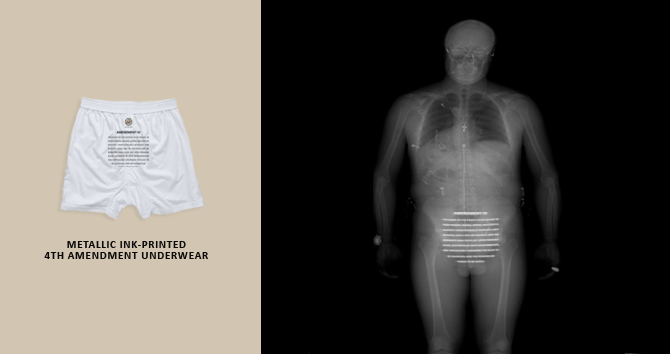
(From Cargo Collective)