This video is a few years old. I found it here. It offers good footage of the Palestinian farmer, settlers and Israeli soldiers. I’m fairly certain the people filming are international human rights activists. I’ve heard the settlers in Hebron are the most fanatic of all.
Check out Anna in the Middle East to hear the perspective of an activist. I’ve met Anna a couple times.
This is a great talk by hedge fund manager Kevin Duffy about Austrian Economics and Investing. It included some great quotes which demonstrate interventionists in big business, government, media and academia being wrong about the economy, corrupting history, vilifying free markets. I transcribed some of them below.
“At the rate things are going, we are all going to end up working for the Japanese.” -Lester Thurow, MIT, economist, 1989
“The United States is rapidly become a colony of Japan.” -Congresswoman Helen Bentley (R-MD), 1990
“The Cold War is over, and Japan won.” -Senator Paul Tsongas (D-MA), 1992
Austrians were able to see the bubble.
As it pertains to the investor: “Entrepreneurial judgement cannot be bought on the market. The entrepreneurial idea that carries on and brings profit is precisely the idea which did not occur to the majority. It is not correct foresight as such that yields profits, but foresight better than that of the rest. The prize goes only to the dissenters, who do not let themselves be misled by the errors accepted by the multitude.” -Ludwig von Mises
Discussing the investing challenge resulting from that fact that Austrian Economics tells you what will happen but not when. (It is in fact impossible to time markets, as Mises discusses in chapter 38 of human action.)
Vilifying free markets:
“This was about the invisible hand having a party, a non-regulated drinking party, with rating agencies handing out the fake IDs!” -Paul McCully, PIMCO, on the financial meltdown
“This laissez faire really has killed us.” -Jim Cramer, interviewing Rep. Barney Frank (D-MA), Jan 21, 2010
“No one likes to put the taxpayer into situations like this . . . Government intervention is not something I came down here wanting to espouse, but it sure is better than the alternative.” -Hentry Paulson, Treasury Secretary, on the government takeover of Fannie Mae and Freddie Mac, Sept 8, 2008
“Depression scholars – including Bernanke – tend to see the Hoover administration’s approach of balancing budgets and tightening belts during the downturn as a tragic mistake.” -Time 2009 Person of the Year article, Dec 28 2009
“Those who contended that during the period of my administration our economic system was one of laissez faire have little knowledge of the extent of government regulation.” -Herbert Hoover
“Nobody saw this coming” -Angelo Mozilo, CEO, Contrywide Financial, July 24 2007
When markets crash, instead of blaming interventionists and inflationists, there begins a witch hunt against private investors who saw it coming, often short sellers.
“It’s very natural for us all to overreact in times of stress, but I’m not a fan of unmitigated shorting. We have nearly $2 trillion in hedge funds that simply don’t have any reporting responsibilities.” -Charles Schwab, BusinessWeek, July 16, 2008
“I’m for markets. But when it felt like it had gotten abusive, when it was free money to short-sellers who were piling on, it felt less like the market and more like it was being manipulated, I corssed over.” -Lloyd Blankfein, CEO, Goldman Sachs, January 2010
Applauding regulation after Enron:
“Conviction on all 49 counts makes this unlikely in the future. This is good: it restores confidence… We were in the biggest bubble in history… I don’t think that’s going to happen for a long time… There were lessons I think that were learned.” -Jeremy Seigel, as appeared on CNBC, May 26, 2006
“Now we have a greater appreciate of the role of watchdogs. Sarbanes-Oxley was a good idea, is a good idea. Leave it alone. We need it to prevent the enrons of the future.” -Anthony M. Sabino, law professor, St. John’s University, Washington Post, May 26, 2006
Business Week Cover: It’s a low, low, low, low-rate world.
Time Cover: The New Sheriffs of Wall Street (Three women, because the problems were caused by too much testosterone, as opposed to intervention, subsidizing irresponsibility, artificially low interest)
Newsweek Cover: America’s Back! The remarkable tale of our economic turnaround (Celebrating the stimulus)
Business Week Cover: Obamanomics is working better than you think. Who Says? Wall Street. (Picture of Obama-look-alike shooting a giant nickle like a basketball)
“One trillion dollars is a big number. This is enough to buy all of Greece’s debt twice, with enough left over to buy all of Portugal’s debt. It was meant to remove any potential for contagion. Problem solved.” -Alan Skrainka, Chief Market Strategist, Edward Jones, Barron’s, May 15 2010
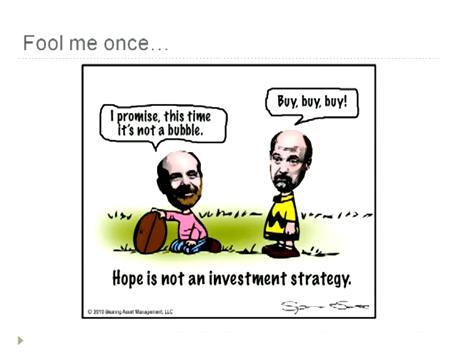
At the end of his talk, Kevin Duffy showed this cartoon. I’m not certain whether he was the creator:
Ben Davies, CEO of Hinde Capital, first explains gold’s rising value in terms of the massive money printing going on all over the world. The interviewer questions whether there isn’t a gold bubble forming and cites reports of “over leveraging” in the “non-physical” gold market. This is euphemistic language for the massive fraud widely reported in the alternative media.
The most interesting part of this video is early on when Peter discusses the banking regulation as the president of a small investment firm. Later on, he talks about his surprisingly hawkish stance, despite wide recognition as a libertarian candidate. (His candidacy is Connecticut would be impossible otherwise.)
Libertarians differ widely on the issue of capital punishment. Murray Rothbard offers his perspective here. Discussion here.
The gist of it putting punishment decisions in the hands of the victim or the victim’s representative. I like it, though one problem is the possibility of intimidation by the criminal or his allies.
One of the comments in the discussion reflect some work currently being done to image a world with restitution, but no punishment:
Rarely do I disagree with Rothbard, and this is one of those disagreements. While I do agree with Restitutional Justice, I don’t agree with the notion that an aggressor surrenders his rights when he violates the rights of others. Haven’t we all agreed to this point that these are Natural Rights, rights which are ironclad and irremovable without the consent of the person in question? From what Rothbard had argued, it all seems periously close to Vengeance than Justice, which has more to do with consoling the victim than undoing the harm that has been done.
It is possible for a murderer to be punished without violating his natural rights. Simply being marked as a murderer in the first place in public means he will likely be economically exiled, if not completely exiled. In the theoretical world of anarchistic Libertarianism, such people would have a tough time affording insurances of any sort; their life would likely become short and painful. The good news is that in such a world there are plenty of avenues to regain trust, even for crimes as monstrous as murder, although they would always be tough. In prison, or in this case capital punishment, there is no avenue to productively regain the trust of the local community.
Sure capital punishment can deter future crimes but with human beings as imperfect as they are, I don’t think its wise to let them take away lives not rightfully belonging to them. Innocents could always be caught in the crossfire, as too often they have.
* A Chinese rating agency rated US sovereign debt modestly, and Chinese debt higher. This makes a lot of sense as China is the world’s biggest creditor and we are the world’s biggest debtor, but US rating agencies are likely under a lot of political pressure.
* A lot of bank & corporate debt has lowest average maturity of last thirty years. The boom in short-term lending is a symptom of artificially low mortgages. Lenders do not want to be locked in a low rate. The maturity of all this debt will create problems if lenders don’t want to roll it over.
I was disappointed last week to discover that despite his co-sponsorship of the Audit the Fed amendment, Rep. Dave Loebsack voted against its inclusion in a package of financial reforms.
The Audit the Fed amendment had 320 co-sponsors and broad bi-partisan support. The fact that Loebsack and more than 100 other co-sponsors betrayed the amendment at its decisive moment reflects the power of the Federal Reserve.
The Fed is a semi-private bank that sets interest rates by an elaborate process that ultimately amounts to printing money and thereby diluting the value of the money in our wallets, bank accounts and mattresses. (Read more from press-citizen.com)
The International Monetary Fund today called the government’s spending cuts into question, warning western countries that cutting budget deficits this year risked derailing economic recovery.
. . . .
“Most advanced economies do not need to tighten before 2011, because tightening sooner could undermine the fledgling recovery, but they should not add further stimulus,” the IMF said in an update to its twice-yearly world economic outlook. (Read more from guardian.co.uk)
Americans avoided television in historic levels over the past week.
CBS, NBC, ABC and Fox together had the smallest number of prime-time viewers last week in two decades of record-keeping, the Nielsen Co. said. Given the dominance of the big broadcasters before then, you’d probably have to go back to the early days of television to find such a collective shrug. (Read more from washingtontimes.com)
This essay from mises.org is about Emma Goldman and her evolution from anarcho-communism to a very individualistic anarchism which, I think, strongly resembles anarcho-capitalism.
I was struck by a small portion of the essay with compared the dangerous allies of libertarianism around the turn of last century with present-day ones. I also raises the question of how anarchists should label themselves.
When Mother Earth was suppressed, and its editor and publisher, a 51-year-old woman who had spent nearly 35 years — her entire adult life so far — in this country, was deported, the first American libertarian movement truly came to an end. In effect, the movement’s organizers had committed an important tactical error. Like the libertarians of our current movement, they had seen that a fully consistent libertarian must be an anarchist, but they had made the tactical mistake of frankly calling themselves by that name.
They used the word “libertarian” in describing themselves, too, but the main term of self-description they used was “anarchist.” They thought of their movement, not as the libertarian movement, but as the anarchist movement. And since, like libertarians of today, they were a tiny minority in the population, they sought to make common cause with other unconventional thinkers who seemed to share many or even most of their goals. The members of the first libertarian movement, regarding themselves as anarchists, made common cause with other anarchists — most of whom were European immigrants with rather different ideas from those of Benjamin R. Tucker and his associates when it came to matters like economics and political violence.
Inevitably, when certain of their more numerous anarchist allies got the wrong sort of publicity, that bad publicity rubbed off on Tucker and his associates. In the last years of the 19th century and the early years of the 20th century, after the Haymarket affair, the attempt on Frick’s life, and the assassination of President McKinley by a self-proclaimed anarchist, there came to be widespread public prejudice against anarchists.
. . . .
Today’s libertarians have allies who vastly outnumber them, just as the libertarians of 1901 did. But we contemporary libertarians have taken the path Benjamin Tucker and his associates avoided. Our allies are what Tucker and his associates would have called “liberals” — we call them “minarchists” or “limited-government libertarians” — and sometimes their behavior is embarrassing to us, just as Tucker and his associates were sometimes embarrassed by the behavior of their anarchist allies a hundred years ago.
There is a key difference, however. Tucker’s allies embarrassed him by attempting and sometimes carrying out assassinations — murders. Our allies embarrass us by lending their moral support to state-sponsored murder — as when they support the Iraq and Afghanistan wars — or by nominating a conservative like Bob Barr to represent the Libertarian Party in the 2008 election. (Read more from mises.org)
In a previous conversation, Graham told me: “The problem with the Tea Party, I think it’s just unsustainable because they can never come up with a coherent vision for governing the country. It will die out.” (Read more from nytimes.com)
My coherent vision for governing the country: let people keep more of their own money and solve more of their own problems.
As always, Southern Avenger’s analysis is excellent: