Tag Archives: Austrian School / Libertarian Theory

For a New Liberty: The Libertarian Manifesto by Murray Rothbard

* non-aggression principle

* applying the same moral standards to the state as we do to individuals

* divine right of kings -> common good / public welfare / fallibility of market

* taxation as legalized / organized theft

* emotivists vs. utilitarians vs. natural rights (absolutist)

* a theory of justice in property (23:30) — hypothetical case of government-granted property

* @ 28:40 the connection between self ownership and property ownership

* extrapolation to ownership of goods & land

* attributing actions to collective nouns like “society” or “nation” instead of individuals. (noted by historian Parker T. Moon)

* “the very words conceal the facts and make international relations a glamorous drama in which personalized nations are the actors, and all too easily we forget the flesh and blood men and women who are the true actors.”

* definition of freedom (private property not invaded)

* shouting fire in a crowded theater
* “Empire building is done not by nations but by men. The problem before us is to discover the men — the active interested minorities in each nation who are directly interested in imperialism and then to analyze the reasons why the majorities pay the expense, and fight the war necessitated by imperialistic expansion.”

Larry Summers: Natural Disasters boost the economy

A friend of mine: open quoteAny time you think that the government employs people who are in any way cognizant of reality…remember this: High ranking Obomba economic adviser claims tsunami could “temporarily boost” the japanese and global economy. Broken window fallacy…did anyone fail to learn this in econ 101? if you burn down your house and have to build another, are you better off? close quote

***

Tsunami an economic disaster? Not necessarily
open quoteHONOLULU (HawaiiNewsNow) – The natural disaster of a tsunami could actually provide a temporary boost to the global economy.

Larry Summers, former director of President Obama’s economic council and a former head of the World Bank, said rebuilding could temporarily boost the Japanese economy.

Summers suggested this in an interview Friday on CNBC. He added that the global economy is more resilient than most people think.

In Hawaii, disruptive weather events are good for some businesses but bad for others.

Stores that sell generators and hardware supplies experience a run on these items when a tsunami or bad weather approach; other retailers find their usual sales interrupted as people focus on evacuating and stockpiling essential supplies instead of their usual shopping.

HawaiiNewsNow correspondent Tannya Joaquin found three gas stations that had run out of fuel more than an hour before the first harbor wave was to have arrived.

The tsunami is an expense item for hotels, which have extensive plans in place to take care of guests’ needs, usually through “vertical evacuation,” escorting guests at least three stories up. Much of the expense comes from bringing in extra people to take care of guests.close quote (from hawaiinewsnow.com)

***

Larry Summers needs to take a break from corrupting the minds of Harvard students and see what the outside of classroom looks like. He can start by reading this:

Natural Disasters, It Turns Out, Are Bad
open quoteIt seems that we may never rid ourselves of the broken-window fallacy.

Hurricane Katrina certainly did not stop economists from proclaiming the silver lining of natural disasters. On September 9, 2005, Labor Secretary Elaine Chao told USA Today that demand could create a labor shortage that could push up wage rates and that “We’re going to see a tremendous boom in construction.” On December 3rd, 2005, Nigel Gault, chief domestic economist at Global Insight, said, “We are now at the point where Hurricane Katrina’s effects are adding to job creation rather than detracting from it.”

And it’s not only that disasters just have a silver lining: economists have long believed that natural disasters and wars are actually good for the economy! Until recently they have not made any attempt to empirically test their views. However, in 2002 Mark Skidmore and Hideki Toya published a paper where they found a positive correlation between disasters and human capital, productivity, and GDP growth.

Now the good news. A recently published paper in Economic Inquiry by Cuaresma, Hlouskova, and Obersteiner brings the positive benefits of disasters into question. Not only does it counter the silver lining of new construction jobs, it also finds that disasters actually subtract from economic performance. In addition the paper provides clues to the entire confusion over this issue.

Economists have generally rested their case for the benefits of disasters on “creative destruction,” but our authors are quick to point out that Schumpeter’s view of creative destruction is one that is driven by competition, where those associated with disasters are not; they are just destruction.close quote (Read more from mises.org)

The Social Snobbery of Free Trade

open quote7 March 2011

Mr. Ian Fletcher

Dear Ian:

In your latest essay at The Huffington Post, you allege that supporters of free trade are guilty of “social snobbery” (“The Social Snobbery of Free Trade,” March 7). You offer three, and only three, pieces of evidence for this proposition. The first is a quotation from New York Times columnist Thomas Friedman, and the second is a quotation from Barack Obama – each suggesting that working-class people too quickly blame trade for whatever economic misfortunes they suffer. The third piece of evidence is the fact that, while most members of the mainstream media are center-left on a majority of issues, they are well-paid and “lean right” on trade.

You masterfully massacre a straw man. Contrary to your explicit claim in the case of Friedman, and your implication in the case of Obama, the pronouncements of economically confused journalists and professional politicians aren’t even remotely appropriate examples of the best arguments for free trade.

Here’s a challenge for you. Search for examples of snobbery in the arguments for free trade made by scholars such as Adam Smith, Frederic Bastiat, Jagdish Bhagwati, Henry George, Daniel Griswold, Douglas Irwin, Fritz Machlup, Martin Wolf, and other economists and researchers who are recognized authorities on trade. You’ll come up empty. (Note: pointing out that many people do not understand economics is not an instance of snobbery.)

If nothing else, you have chutzpah to pin the label “snobs” on free traders – who argue that individuals ought simply be left free to spend their money in whatever ways they choose – while you promote a policy of giving third-party strangers in Washington the power to obstruct, for some allegedly higher good, these private, individual consumption choices.

Sincerely,
Donald J. Boudreauxclose quote (Read more from cafehayek.com)

When Money Dies — The Nightmare of 1923 and Its Cause

open quoteFor a detailed account of the descent of an entire country into despair and barbarism read Adam Fergusson’s When Money Dies: The Nightmare of Deficit Spending, Devaluation, and Hyperinflation in Weimar Germany.

First published in 1975, republished in 2010, and made available through the Mises Institute, When Money Dies should dispel the notion that the rule of men is superior to the rule of law. Why “the rule of law”? Because it was the violation of the rule of law by governments themselves that supplanted the peaceful, liberal order of a gold-based international monetary system with one in which central banks, at governments’ behest, could print fiduciary media without limit.

The full implication of this change was seen in Weimar Germany, the German people’s first experiment with representative democracy, where civilized society fell victim to the evils of the monetary printing press. For all practical purposes, the German mark was not worth the paper upon which it was printed. Eventually the Reichsbank issued the largest denomination note ever printed in the history of the world, a one-hundred-trillion-mark note, which no one would accept for payment. Be very careful if you believe that it can’t happen today.close quote (Read more from mises.org)

Krugman vs. Murphy

I wonder what Paul Krugman is thinking. In his latest attack on the Austrian school, Great Leaps Backward, he notes the rising tide of its popularity and describes it as a repudiation of 75 years of economic progress since the work of John Maynard Keynes.

Robert Murphy of the Mises Institute has been trying to shame Krugman into an economic debate by raising over $60,000 for charity should Krugman accept.

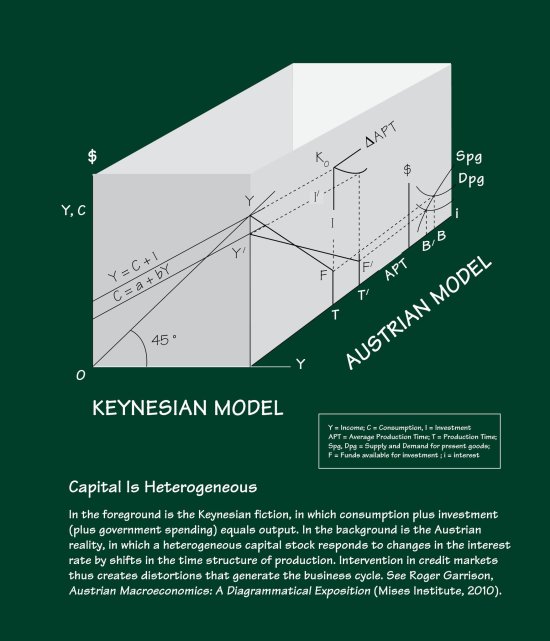
In this fantastic essay, Murphy rebuts Krugman’s latest assault. I highly recommend the essay, it includes the clearest explanation of Austrian Capital and Interest theories I’ve seen, followed by an exhaustive rebuttal.