Tag Archives: Welfare

The Myth of European Socialism

Euro Zone Grapples With Debt Crisis
The European Commission warns that public finances in half of the 16 euro-zone nations are at high risk of becoming unsustainable

Governments will spend the next year and beyond balancing the urgent need to fix public-sector debt and deficits — without imperiling what appears to be a feeble economic recovery.
(Read more from online.wsj.com)

Commentary by Patrick Barron: Many people support increasing social welfare programs in the U.S. by citing the experience of Europe; that is, that Europe has far more generous welfare benefits than the U.s. and seems to be doing “just fine”. Well, the European Commission itself disputes the long-term viability of many of Europe’s finances.

[But] None of the welfare plans in any of the Eurozone countries are financially sound. They are simply state-sponsored Ponzi schemes that must crash when the demographic reality of a declining birthrate makes their payment impossible.

From Mutual Aid to Welfare State: How Fraternal Societies Fought Poverty and Taught Character

Most of my socialist leaning friends would be at a loss to tell me how to poor were cared for before the growth of our massive welfare state. Perhaps they assume that before Medic Aid in 1965, people were stepping over corpses on their way to work. Most of my non-socialist friends also do not know.

The following are excerpts from an important essay about the role Fraternal Societies used to play before government killed them off.

Thoough I’m not certain it was written as an academic study, I makes me think of how few academics pursue things that actually matter. Most humanities Phd’s I know are the first to admit their subject is bullshit. They compare lengths of dresses, catalog break-dance movies, and deciding how the trauma of immigration is evident in some obscure writer’s description of nature. What a waste…

Mutual aid was one of the cornerstones of social welfare in the United States until the early 20th century. The fraternal society was a leading example. The statistical record of fraternalism was impressive. A conservative estimate is that one-third of adult American males belonged to lodges in 1910. A fraternal analogue existed for virtually every major service of the modern welfare state including orphanages, hospitals, job exchanges, homes for the elderly, and scholarship programs.

But societies also gave benefits that were much less quantifiable. By joining a lodge, an initiate adopted, at least implicitly, a set of survival values.

Societies dedicated themselves to the advancement of mutualism, self-reliance, business training, thrift, leadership skills, self-government, self-control, and good moral character. These values, which can fit under the rubric of social capital, reflected a kind of fraternal consensus that cut across such seemingly intractable divisions as race, sex, and income.

The record of five societies that thrived at or near the turn of the century illustrates the many variants of this system. Each had a distinct membership base. Two of the societies, the Independent Order of Saint Luke and the United Order of True Reformers, were all-black. Both had been founded by ex-slaves after the Civil War and specialized initially in sickness and burial insurance. The other societies had entirely white memberships. The Loyal Order of Moose was an exclusively male society that emphasized sickness and burial benefits. It became best known during the 20th century for its orphanage, Mooseheart, near Aurora, Illinois. The Security Benefit Association (originally the Knights and Ladies of Security) followed in a similar tradition but broke from the mainstream by allowing men and women to join on equal terms. During the 1910s and the 1920s, the Knights and Ladies of Security established a hospital, a home for the elderly, and an orphanage all in a single location near Topeka. The Ladies of the Maccabees was an all-white, all-female society. It provided such health benefits as surgical care. It is worth noting that the women who belonged to these societies, regarded themselves as members of fraternal rather than sororal societies. For them, fraternity, much like liberty and equality, was the common heritage of both men and women. To this end, an official of the Ladies of the Maccabees asserted that “Fraternity in these modern days has been wrested from its original significance and has come to mean a sisterhood, as well as a brotherhood, in the human family.”

. . . .

During the 1930s, officials of the homes for the elderly and orphans of the SBA cited Social Security and other welfare programs as justification not only for rejecting applicants but for closing down entirely. The Security Benefit Association, for instance, closed its orphanage because of “a lack of demand or need for that form of benevolence attributable to public funds now available for the support of dependent children.” It used the same justification to discontinue its home for the elderly several years later. While Mooseheart remained open and even increased capacity, applications fell off rapidly in the decades after the Depression because of a rise in social-welfare alternatives such as Aid to Families with Dependent Children.

Mutual aid was a creature of necessity. Once this necessity ended, so too did the primary reason for the existence of fraternalism. Without a return to this necessity any revival of mutual aid will remain limited. Moreover, fraternal membership, although still heavily working class, no longer includes the very poor who most need social welfare services.

Nevertheless, a reinvigoration of mutual aid (though not necessarily through fraternal societies) is not out of the question in the 21st century. One reform that would encourage such a trend is to repeal or revise laws that subsidize third-party insurance. Perhaps the leading example is legislation enacted during World War II, which exempts employer-provided fringe benefits, such as health insurance, from income tax. According to John C. Goodman, the annual value of this exemption adds up to an enormous $130 billion. For a typical autoworker, for example, it is over $1,200 per year. Federal tax policy has not only tied workers to their jobs but has undermined their incentives to purchase health insurance through non-governmental organizations such as fraternal societies. It has also created a perverse system where workers lose all their benefits when they change jobs or become unemployed. By contrast, if individuals had the same tax incentives to purchase insurance from associations, such as lodges, as they do now from their employer they could still retain full coverage even if they changed jobs.

The shift from mutual aid and self-help to the welfare state was not just a simple bookkeeping transfer of service provisions from one set of institutions to another. As many of the leaders of fraternal societies had feared, much was lost in an exchange that transcended monetary calculations. The old relationships of voluntary reciprocity and autonomy have slowly given way to paternalistic dependency. Instead of mutual aid, the dominant social-welfare arrangements of Americans have increasingly become characterized by impersonal bureaucracies controlled by outsiders. (Read more from heritage.org)

About the author: David T. Beito is assistant professor of history at the University of Alabama in Tuscaloosa and is the author of From Mutual Aid to the Welfare State: Fraternal Societies and Social Services, 1890-1967 (University of North Carolina Press).

The Welfare State and the Promise of Protection

by Robert Higgs

Our predecessors dealt with their worries by relying on religious faith. For tangible assistance, they turned to kinfolk, neighbors, friends, coreligionists, and comrades in lodges, mutual-benefit societies, ethnic associations, labor unions, and a vast assortment of other voluntary groups. Those who fell between the cracks of the voluntary societies received assistance from cities and counties, but governmentally supplied assistance was kept meager and its recipients stigmatized.

In the 20th century, especially during the past seventy years, Americans have placed their faith in government — increasingly the federal government. Since Franklin Delano Roosevelt assumed the presidency in 1933, voluntary relief has taken a back seat to government assistance. Eventually, hardly any source of distress remained unattended by a government program. Old age, unemployment, illness, poverty, physical disability, loss of spousal support, childrearing need, workplace injury, consumer misfortune, foolish investment, borrowing blunder, traffic accident, environmental hazard, and loss from flood, fire, or hurricane all became subject to government succor.

. . . .

Our ancestors relied on themselves; we rely on the welfare state. But the “safety net” that governments have stretched beneath us seems more and more to be a spider’s web in which we are entangled and from which we must extricate ourselves if we are to preserve a prosperous and free society.

. . . .

The modern welfare state is often viewed as originating in Imperial Germany in the 1880s, when the Iron Chancellor, Prince Otto von Bismarck, established compulsory accident, sickness, and old-age insurance for workers. Bismarck was no altruist. He intended his social programs to divert workingmen from revolutionary socialism and to purchase their loyalty to the Kaiser’s regime; to a large extent he seems to have achieved his objectives.

. . . .

We can have a free society or a welfare state. We cannot have both. (Read more from mises.org)

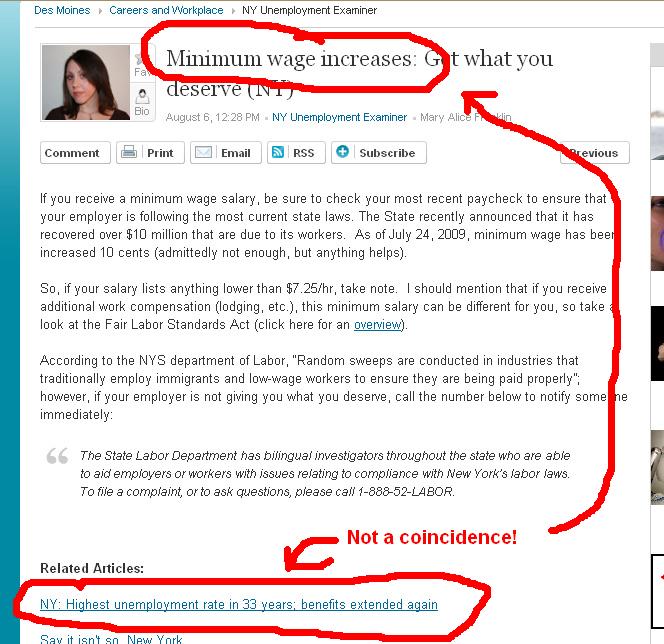
Minimum wage & Unemployment. This is not a coincidence!

I found this on examiner.com. Truth, staring you in the face.

Minimum wage laws cause unemployment and higher prices. They harm exactly the people they are designed to help. If someone cannot produce something worth $7.25 an hour (or whatever the minimum wage), you do not help him by making it illegal for him to work.

To paraphrase Ron Paul: the goal of improving the standard of living for Americans is certainly a noble one, but if this could be accomplished simply by passing laws which require employers to pay more money to their employees, then what is the moral justification for stopping at $7.25? Why not raise the minimum wage to $8 or $10? or for that matter why not $15 or $20 or $100?

Clearly, if the minimum wage were $100, you could imagine businesses, large and small, restructuring their production methods to favor automation, and fewer, more highly skilled employees. You can also imagine prices rising, because these means of production are less efficient. A small increase in the minimum wage has exactly the same effect, though its impact isn’t clearly discernible as unemployment numbers get overwhelmed by other factors.

On Child Labor Laws

I often debate my friends’ casual (naive?) suggestions that the state control commerce, fight the war on drugs, and bailout incompetent companies. I argue, as Bastiat does in The Law, that government is our collective defense of life, liberty and property, and that whatever government does beyond this mandate is offensive to both freedom and prosperity because government must take from one to do for another.

When my friends give ground in the debate, they usually do so grudgingly, retreating to the sacred cows of statists – public education, public transportation, pollution laws and child labor laws.

There is much to be said about each of these. Below, I excerpt a couple of articles from mises.org regarding child labor laws.

The first is a long list of snippets from the Child Labor Amendment Debate in the 1920s.

The Trouble With Child Labor Laws
“Let’s say you want your computer fixed or your software explained. You can shell out big bucks to the Geek Squad, or you can ask – but you can’t hire – a typical teenager, or even a preteen. Their experience with computers and the online world is vastly superior to that of most people over the age of 30. From the point of view of online technology, it is the young who rule. And yet they are professionally powerless: they are forbidden by law from earning wages from their expertise.

Might these folks have something to offer the workplace? And might the young benefit from a bit of early work experience, too? Perhaps – but we’ll never know, thanks to antiquated federal, state, and local laws that make it a crime to hire a kid.

Pop culture accepts these laws as a normal part of national life, a means to forestall a Dickensian nightmare of sweat shops and the capitalist exploitation of children. It’s time we rid ourselves of images of children tied to rug looms in the developing world. The kids I’m talking about are one of the most courted of all consumer sectors. Society wants them to consume, but law forbids them to produce.

You might be surprised to know that the laws against ‘child labor’ do not date from the 18th century. Indeed, the national law against child labor didn’t pass until the Great Depression – in 1938, with the Fair Labor Standards Act. It was the same law that gave us a minimum wage and defined what constitutes full-time and part-time work. It was a handy way to raise wages and lower the unemployment rate: simply define whole sectors of the potential workforce as unemployable.

By the time this legislation passed, however, it was mostly a symbol, a classic case of Washington chasing a trend in order to take credit for it. Youth labor was expected in the 17th and 18th centuries – even welcome, since remunerative work opportunities were newly present. But as prosperity grew with the advance of commerce, more kids left the workforce. By 1930, only 6.4 percent of kids between the ages of 10 and 15 were actually employed, and 3 out of 4 of those were in agriculture.

In wealthier, urban, industrialized areas, child labor was largely gone, as more and more kids were being schooled. Cultural factors were important here, but the most important consideration was economic. More developed economies permit parents to ‘purchase’ their children’s education out of the family’s surplus income – if only by foregoing what would otherwise be their earnings.

The law itself, then, forestalled no nightmare, nor did it impose one. In those days, there was rising confidence that education was the key to saving the youth of America. Stay in school, get a degree or two, and you would be fixed up for life. Of course, that was before academic standards slipped further and further, and schools themselves began to function as a national child-sitting service.” (Read more from mises.org)

***

The Child Labor Amendment Debate of the 1920s
“Few causes are so shrouded in sanctimonious mist as the movement, early in the twentieth century, to abolish child labor. Sympathetic journalists and historians dubbed it ‘the crusade for the children’ and depicted its foes as avaricious manufacturers.

Some self-styled ‘child savers,’ especially the women novelists and inveterate reformers of New England, were sincerely concerned about exploited children. Others, however, intended to reconstruct the family and install ‘government as overparent,’ to use the words of Colorado Judge Ben Lindsey. Opponents of the Child Labor Amendment, far from being the calloused plutocrats of legend, included noted Progressives, urban Catholics, and thousands of farm families.

The fight over the amendment highlighted the growing breach between those loyal to Jeffersonian America and those who sought to concentrate power in the grandest overparent, Washington, D.C.

. . . .

Here you are, a Jeffersonian Democrat, the cardinal principle of which doctrine was the integrity of the states, urging me, a Hamiltonian Republican, to support a constitutional amendment enabling the national government to deal with the children of the states. Strange times, these are. But I think I can encourage you to expect favorable action, as the women always get nowadays what they ask for. – Senator William Borah (RID)

to a constituent, 1924:

[A] communistic effort to nationalize children, making them primarily responsible to the government instead of to their parents. It strikes at the home. It appears to be a definite positive plan to destroy the Republic and substitute a social democracy. – Clarence E. Martin, President American Bar Association” (Read more from mises.org)

Schwarzenegger’s proposal to end welfare

Since beginning my autodidactic study of economics, I’ve begun to see welfare as a surprisingly destructive force. It plunders economically the productive people who pay for it, and plunders morally the communities who receive it as well as the bureaucracies which administer it.

“This week, California’s Gov. Arnold Schwarzenegger is taking that goal quite literally, proposing to eliminate cash assistance for the state’s poorest families altogether. Legislators, poverty researchers and poor parents alike greeted with astonishment his unprecedented call to drop the state’s welfare-to-work program, known as CalWORKs.

The governor’s proposal would make California the only state in the nation to reject Temporary Assistance to Needy Families block grants, the federal program that allows states to draw funds as long as they impose strict time limits and work requirements on recipients.

Rejecting the $3.7 billion federal grant would save the state its matching portion of $1.8 billion. But it also would result in the loss of $600 million in federal stimulus funds – money economists and poverty watchers say is desperately needed to invigorate a moribund economy.

The proposal landed in uncharted territory in the Capitol and beyond, with no one able to predict what legislators ultimately will do as the extraordinary recession deepens.

As of late Wednesday afternoon, Schwarzenegger’s proposal to eliminate CalWORKs appeared to be, if not dead on arrival in the Democrat-controlled Legislature, then on life support.” (Read more from mercurynews.com)

Sweden: Poorer Than You Think

I’m pretty excited about today’s posts.

When I speak about freedom and Austrian Economics and the evils inherent in Socialism, people often tell me they are not speaking of Socialism as was manifest in the Soviet Union, they are speaking of socialist democracies like Sweden. In other words, they don’t believe in big crimes, but think little crimes are okay.

I believe that in socialist democracies it’s not the socialist (ie. coercive) institutions which are working, it’s the pockets of freedom that exist around them. Encroaching socialism can appear very benign in a prosperous country, because it’s proponents claim credit for the wealth and opportunities created by the remaining pockets of freedom.

Today, I excerpt from three outstanding essays I found at the Ludwig Von Mises Institute.

Sweden: Poorer Than You Think by William L. Anderson

One of the enduring myths of the ‘Third Way’ welfare state is that a nation as a whole can have a high standard of living–even if no one really has to work–as long as government transfers massive amounts of wealth from those who are well off to those who are less well off. For the past four decades, we have been inundated with news stories, books, and public commentary, all of which have exhorted us to be like Sweden.

The Swedes, we have been told, enjoy free medical care, generous welfare benefits, time off from work, and subsidies for just about everything. When one counters that Swedes pay enormously high taxes, the standard reply is, ‘That is true, but look at what they receive for their payments.’

According to a recent study, however, the cat is out of the bag. Relative to household in the United States, Swedish family income is considerably less. In fact, the study concludes, average income in Sweden is less than average income for black Americans, which comprise the lowest-income socioeconomic group in this country.

. . . .

In defense of the Swedes, let me first say that simple comparisons of income can be deceiving. While I have never been to Sweden (even though I have relatives there), I would think that even the poorest sections of Stockholm and other Swedish cities are more livable and attractive than what one finds in many U.S. cities. Even with the high taxes, I think I would rather live in downtown Stockholm than in downtown Detroit or Newark.

However, the study alerts us to something that is much more important, and that is that the European welfare states are not making their citizens wealthier. Over time, the cracks in these relatively wealthy nations are growing larger, and if the disease is not arrested, much of Europe will tumble off into real poverty in the not-so-distant future. Europeans–and, most likely, Americans–seem destined to learn the hard way that large, seemingly intractable welfare systems have their way of destroying the Goose that Laid the Golden Eggs.

While people can debate the present condition of Swedes in Stockholm versus blacks in Harlem, there is a deep issue here that people seem to forget when it comes to welfare states: they are destructive at their roots. Advocates of welfarism concentrate only upon distribution while vilifying production. Such a state of affairs cannot go on forever as governments are forced to cannibalize their own capital structure over time in order to make the system to continue to work.

. . . .

The Swedes and other northern Europeans are somewhat lucky in that they have had a relatively high standard of living. People in southern European nations like Italy and Spain–where high taxes and vast regulatory agencies abound–find themselves to be much poorer and with no prospects of real improvement.

Unfortunately, many Europeans (like our Canadian neighbors) believe that a vast welfare apparatus makes them morally superior to nations that do not have the same scope of benefits. (While one can point out that the United States has a huge welfare bureaucracy itself, it does not offer the same ‘generous,’ long-term benefits of the European states.) While they prattle on about their moral superiority and their egalitarianism, however, something else is happening. They are slowly becoming poorer and poorer, and the welfare state cannot save them. It can only accelerate their downward slide. (Read more from mises.org)

The Sweden Myth

The Sweden Myth by Stefan Karlsson

The alleged recent success of the Swedish economy has allowed welfare statists both inside and outside of Sweden to argue that high taxes and an extensive welfare state are good for the economy. To fully understand this fallacy, we should review Sweden’s economic history.

Until the second half of the 19th century, Sweden was fairly poor. But far-reaching free market reforms in the 1860s allowed Sweden to benefit from the spreading Industrial Revolution.

And so, during the late 19th and early 20th centuries, Sweden saw its economy rapidly industrializing, driven by the many Swedish inventors and entrepreneurs.

During that time, Sweden produced extraordinarily many inventions, given its small population, including: dynamite, invented by Alfred Nobel (who established the Nobel Prize); the self-aligning ball bearing, invented by Sven Wingquist (who used this to create the SKF company); the sun-valve, invented by Gustav Dahlen (who used it to found industrial gas company AGA); the gas absorption refrigerator, invented by Baltzar von Platen (which was later used by Electrolux).

In addition, there were countless non-inventing entrepreneurs during that period: car manufacturers Volvo and Saab, and telecommunications company Ericsson. Indeed, with just a few exceptions, nearly all large Swedish companies were started during the late 19th and early 20th centuries, which was not only a period of strong growth, but also the time when the foundation for later economic growth was laid.

Another factor which continued Swedish prosperity was the fact that Sweden was able to stay out of both World Wars, and indeed all other wars as well. Sweden is in fact the country with the longest consecutive period of peace, having fought no war since 1809, when Sweden was invaded by Russia, losing Finland to the invader. . . .

As a result of its free market policies, the resourcefulness of its people, and its successful avoidance of war, Sweden had the highest per-capita income growth in the world between 1870 and 1950, by which time Sweden had become one of the world’s richest countries, behind only the United States and Switzerland, and Denmark (who have since also fallen behind because of high taxes).

But the foundation for future trouble had already been created. In 1932, the Social Democrats rose to power in the face of the Great Depression. And like FDR in America and Adolf Hitler in Germany, they started to expand government power over the economy. Until 1932, government spending had been kept below 10% of GDP in Sweden, but the Social Democrats, under their leader Per Albin Hansson, wanted to change this and remake Sweden into a ‘folkhem’ (‘people’s home’), a term Swedish Social Democrats adopted from the Fascists in Italy.

Between 1950 and 1976, Sweden experienced an expansion in government spending unprecedented during a period of peace, with government spending to GDP rising from about 20% in 1950 to more than 50% in 1975. Virtually every year, taxes were increased while the welfare state expanded relentlessly, both in the form of a sharp increase in the number of government employees and ever more transfer payment benefits.

During the first 20 years, this relentless government expansion took place seemingly without ill effect, as Sweden benefited from rapid global growth – although Sweden’s growth had already started to slip in relative terms, from well above average to just average. This changed in the 1970s after Olof Palme, from the left wing of the Social Democratic party became Prime Minister. Palme stepped up the socialist transformation in Sweden, rapidly increasing anti-business regulations and sharply increased payroll taxes.

The payroll-tax increases, along with increasing wage demands from unions, made Swedish businesses highly uncompetitive on the global markets, something which Palme decided to solve by devaluing the Swedish krona. As a result, price inflation rose sharply, leading to repeated devaluations. . . .

. . . . the recession became Sweden’s deepest by far since the Great Depression, with GDP in 1993 being 5% lower than in 1990, with employment falling more than 10%, and the budget deficit rising to more than 10% of GDP. By then Sweden had fallen to between 15th and 20th place in international income comparisons, a decline from which it has never
since recovered.

After this deep downturn, Sweden has performed much better for a number of reasons. The 20% decline in the value of the krona in late 1992 gave a strong boost to exports and together with the dramatic lowering of interest rates, this helped kick-start a cyclical recovery in late 1993. Moreover, a number of free market reforms implemented during Ingvar Carlsson and conservative Carl Bildt (who was Prime Minister between 1991 and 1994) had helped raise the structural growth potential of the Swedish economy.

Apart from the already mentioned reforms of reduced marginal tax rates and abolished currency controls, deregulated bank lending and significantly lower inflation, this included privatizations of several state-owned companies and deregulation of several key sectors, including the retail sector, the telecommunications sector and the airline industry. Also, when the massive budget deficit was eliminated, even the Social Democrats realized the need for deep spending cuts, which together with the typical cyclical decline in the burden of spending during booms helped reduce the extremely bloated burden of government spending somewhat.

All of this has helped Sweden recover in relative terms from the stagnation of the 1970s and 1980s and the deep economic downturn in the early 1990s. It is this relative recovery that is now seized upon by the Social Democrats and their sympathizers inside and outside of Sweden when they claim that the Swedish model of high taxes and a big welfare state is successful.

Yet as should be clear, the relative improvement of performance is due not to high taxes (lower now than previously), but to free-market reforms. (Read more from mises.org)

How the Welfare State Corrupted Sweden

How the Welfare State Corrupted Sweden by Per Bylund

Old people in Sweden say that to be Swedish means to supply for your own, to take care of your self, and never be a burden on anyone else’s shoulders. Independence and hard work was the common perception of a decent life, and the common perception of morality. That was less than one hundred years ago.

My late grandmother used to say something had gone wrong with the world. She was proud to never have asked for help, to have always been able to rely on herself and her husband. . . .

My grandmother, born in 1920, was of the last generation to have that special personal pride, of having a firm and deeply rooted morality, of being a sovereign in life no matter what – to be the sole master of one’s fate. The people of her generation experienced and endured one or two world wars (though Sweden never took part) and were raised by poor Swedish farmers and industrial workers. They witnessed and were the driving force behind the Swedish ‘wonder.’

They would gladly offer to help those in need even if they only had little, but were not likely to accept anyone’s help if offered. They felt pride in being competent to take care of themselves; they cherished independence of others, of never having to ask for help. They figured, if they couldn’t make it themselves, they had no right to ask for help.

. . . .

[Today] Swedes generally welcome proposals to hand over more power to politicians and they even tend to ask for higher taxes.

Decent morality is long gone. It was completely destroyed in little more than two generations – through public welfare benefits and the concept of welfare rights.

. . . .

[M]y parents’ generation went to public schools where they were taught mathematics and languages as well as the superiority of welfare and the morality of the state. They learned the workings of the machinery of the welfare state and gained a totally new (mis)conception of rights: all citizens enjoy a right – only through being citizens – to education, health care, unemployment, and social security.

Being an individual, they were taught, means having a right to support for your individual needs. Everybody has a right to all the resources necessary to pursue one’s own and society’s happiness, they were told. And everybody should enjoy the right to put their children in state daycare centers while working, making it possible for every family to earn two salaries (but not enough time to raise their children). The opportunities for “the good life,” at least financially, must have seemed enormous to the older generations.

This new morality permeated the populace and became the “natural” state of things, at least in their minds. This generation, born during the two or three decades following World War II, became considerably different from their parents’ generation morally and philosophically. They got used to the enormous post-war economic growth (thanks to Sweden never entering the war) and the ever-increasing welfare rights of the rapidly growing state.

. . . .

The voting masses, children of the welfare state dependent on its system of logic, supported the tax hikes, which quickly climbed to 50% and higher. And they demanded social benefits at taxpayers’ expense. . . .

Through the powerful labor unions, wage-earning Swedes were awarded raises every year regardless of real productivity, and in time annual raises of salaries became normality. People who didn’t get a raise started considering themselves “punished” by their evil employer, and there were increasing demands for legal help in the struggle against employers. One has a “right” to a better salary next year just as the current salary must be better than last year’s; so the thinking goes. . . .

The children of this generation, born in the 1970s, ’80s, and ’90s commonly had a “free” upbringing (based on the ideals of 1968), essentially meaning a childhood “free from rules” and “free of responsibility.” For this generation there is no causality whatsoever in social life; whatever you do is not your responsibility – even having children. These are the current younger adults in Swedish society.

I am myself part of this second generation of people raised with and by the welfare state. A significant difference between my generation and the preceding one is that most of us were not raised by our parents at all. We were raised by the authorities in state daycare centers from the time of infancy; then pushed on to public schools, public high schools, and public universities; and later to employment in the public sector and more education via the powerful labor unions and their educational associations. The state is ever-present and is to many the only means of survival – and its welfare benefits the only possible way to gain independence. . . .

On May 14, the national trade workers’ union demanded the state “redistribute” jobs through offering people in their 60s state pensions if they step down and their employers employ young, unemployed people in their stead. In the labor union’s calculations, such a stunt would “create” 55,000 jobs.

What this shows is that the only perceivable way of finding jobs for the young seems to be to “relieve” older people of theirs; job positions are scarce and unemployment is increasing even as demand for goods and services is going up – thanks to heavy state regulation in the marketplace. The welfare state creates problems and conflicts on many levels, forcing people to compete for shares of continuously decreasing wealth. . . .

My mother, a middle school teacher, has had to face her pupils’ parents demanding she do “something” about their stressful family situation. They demand “society” take responsibility for their children’s upbringing since they have already spent “too many years” caring for them. (“Caring” usually means dropping them off at the public daycare center at 7 am and picking them up again at 6 pm.)

They loudly stress their “right” to be relieved from this burden. . . .

What we are now seeing in Sweden is the perfectly logical consequence of the welfare state: when handing out benefits and thereby taking away the individual’s responsibility for his or her own life, a new kind of individual is created – the immature, irresponsible, and dependent. In effect, what the welfare state has created is a population of psychological and moral children – just as parents who never let their children face problems, take responsibility, and come up with solutions themselves, make their offspring needy, spoiled, and utterly demanding. (Read more from mises.org)

Why a Minimum Wage is Misguided

During the Great Depression, Herbert Hoover coerced captains of industry into “voluntarily” propping up wages. President Hoover is quoted in Murray Rothbard’s America’s Great Depression (available for free here): “[Wage rates] were maintained until the cost of living had decreased and the profits had practically vanished. They are now the highest real wages in the world.”

Rothbard continues: “But was there any causal link between this fact and the highest unemployment rate in American history? This question Hoover ignored.”

George Reisman is an economist of the Austrian School who studied directly under Ludwig Von Mises at New York University. My Austrian Economics Professor calls Reisman his favorite living Austrian Economist. In this essay, Reisman disposes of both the popular and scholarly Keynesian theories that wages must remain high for the common good.

“The popular version of the Keynesian doctrine, which is championed above all by the labor unions, is simply that a fall in wage rates, in reducing the incomes of wage earners, causes a fall in consumer spending, which allegedly serves to worsen the problem of unemployment. This doctrine can be disposed of fairly simply. . .

First of all, it overlooks the fact that at lower wage rates more workers will be employed. The effect of this is to enable total wage payments and consumer spending in the economic system to remain the same or even increase while the wages of the individual worker decline. For example, 10 workers each employed at 90 percent of the wages earn the same total wages and can spend just as much in buying consumers’ goods as could 9 workers each earning the original wage. (It’s as simple as the fact that 10 times .9 equals 9 times 1.) And, of course, more than 10 workers employed at 90 percent of the wage per worker would earn more collectively and spend more for consumers’ goods collectively than was possible before.

The popular version of the Keynesian doctrine also overlooks the fact that even if total wage payments and consumer spending did decline, business sales revenues would not decline insofar as reduced wage payments made possible increased expenditures for capital goods. Indeed, to the extent that additional spending for capital goods took the place of wage payments and the consumer spending supported by wage payments, not only would sales revenues in the economic system remain the same, but, what is particularly important for the process of economic recovery, the amount of profit earned on those same total sales revenues would actually increase.” (Read more from mises.org)

See Also Milton Friedman’s commentary:

The minimum wage, like almost all government regulation, has the effect of reducing competition and impoverishing our country.

Health Insurance before the Welfare State

“Fraternal organizations and friendly societies provided health insurance for hundreds of thousands of Americans and Britons before the surge of the welfare state. Their rapid disappearance underscores the fragility of voluntary institutions when challenged by government power.”

“At their peak, fraternal organizations and friendly societies provided health insurance for millions of Americans and Britons, mostly lower-middle-class tradesmen and skilled artisans. By 1886, the Independent Order of Oddfellows and the Ancient Order of Foresters each claimed more than 600,000 members worldwide. In the 1920s, roughly every third adult male in the United States belonged to a fraternal organization.

These groups were characterized by independent lodges, democratic governance, a ritual, and mutual aid for members (and often their families). Although camaderie was a leading incentive to join, disability insurance was also an attractive benefit.

Despite their popularity, however, such groups had all but vanished within two decades after being pushed aside by the surge of the welfare state. What accounts for their rise and fall?

The answer, according to Pavel Chalupnicek and Lukas Dvorak (both from the University of Prague), lies in the concept of social capital, and individual’s ability to use his or her network of friends and acquaintances for economic gain. Social capital, they explain, enables many people to function better in society, but its value depreciates rapidly in the presence of certain kinds of government activities.” (Read more from independent.org)