The term hyper-inflation itself is interesting. It is a word which seems to universally mean the sudden, dramatic drop in the value of money (ie. the sudden, dramatic rise in prices). The word inflation is more contested.
The government prefers to consider inflation a rise in prices. Why? Because government measures inflation by the heavily manipulable consumer price index, which can be twisted to ignore food and fuel costs. The government hates bad economic news. It also adjusts its many redistribution of wealth according to the CPI, so having control over it helps.
Followers of the Austrian School (me) use the term inflation to mean, simply, an increase in the monetary supply. Price increases are merely a consequence of inflation, as is the wage/price spiral so many economists enjoy obsessing over. So when government, and government minions scrutinize about what they call inflation, my friends and I think they are paying attention to the sideshow of prices, and avoiding the real issue: the printing of money out of thin air.
We do lack a word, however, for the sudden, dramatic drop in the value of money (rise in prices), hence we rely on hyper-inflation.
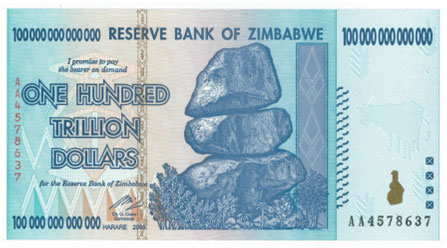
What does it look like?
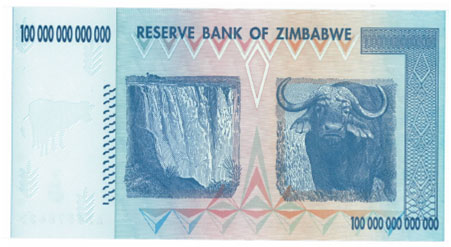
Here is a note for a hundred trillion Zimbabwean dollars. I don’t think it’s worth the paper it’s printed on. Initially, governments like printing money, because it transfers wealth more subtly than taxation, but eventually you get this: