Regulation does not protect consumers. It is written by companies with political pull to crush competitors.
Monthly Archives: December 2009
Does the Vaccine Matter?
Here is a fantastic article about the Vaccine controversy, emailed to me by the infamous Esoteridactyl:
 To further protect the populace, the federal government has spent upwards of $3billion stockpiling millions of doses of antiviral drugs like Tamiflu—which are being used both to prevent swine flu and to treat those who fall ill.
But what if everything we think we know about fighting influenza is wrong? What if flu vaccines do not protect people from dying—particularly the elderly, who account for 90 percent of deaths from seasonal flu? And what if the expensive antiviral drugs that the government has stockpiled over the past few years also have little, if any, power to reduce the number of people who die or are hospitalized? The U.S. government—with the support of leaders in the public-health and medical communities—has put its faith in the power of vaccines and antiviral drugs to limit the spread and lethality of swine flu. Other plans to contain the pandemic seem anemic by comparison. Yet some top flu researchers are deeply skeptical of both flu vaccines and antivirals. Like the engineers who warned for years about the levees of New Orleans, these experts caution that our defenses may be flawed, and quite possibly useless against a truly lethal flu. And that unless we are willing to ask fundamental questions about the science behind flu vaccines and antiviral drugs, we could find ourselves, in a bad epidemic, as helpless as the citizens of New Orleans during Hurricane Katrina.
. . . .
We think we have the flu anytime we fall ill with an ailment that brings on headache, malaise, fever, coughing, sneezing, and that achy feeling as if we’ve been sleeping on a bed of rocks, but researchers have found that at most half, and perhaps as few as 7 or 8 percent, of such cases are actually caused by an influenza virus in any given year. More than 200 known viruses and other pathogens can cause the suite of symptoms known as “influenza-like illness”; respiratory syncytial virus, bocavirus, coronavirus, and rhinovirus are just a few of the bugs that can make a person feel rotten. And depending on the season, in up to two-thirds of the cases of flu-like illness, no cause at all can be found.
. . . .
The worst flu pandemic in recorded history was the “Spanish flu” of 1918–19, at the end of World WarI. A third of the world’s population was infected, with at least 40million and perhaps as many as 100million people dying—more than were killed in World Wars I and II combined.
. . . .
Public-health officials consider vaccine their most formidable defense against the pandemic—indeed, against any flu—and on the surface, their faith seems justified. . . . But while vaccines for, say, whooping cough and polio clearly and dramatically reduced death rates from those diseases, the impact of flu vaccine has been harder to determine.
. . . .
study after study has found that people who get a flu shot in the fall are about half as likely to die that winter—from any cause—as people who do not. . . . “For a vaccine to reduce mortality by 50 percent and up to 90 percent in some studies means it has to prevent deaths not just from influenza, but also from falls, fires, heart disease, strokes, and car accidents. That’s not a vaccine, that’s a miracle.” . . . “People told me, ‘No good can come of [asking] this,’” she says. “‘Potentially a lot of bad could happen’ for me professionally by raising any criticism that might dissuade people from getting vaccinated, because of course, ‘We know that vaccine works.’ This was the prevailing wisdom.”
. . . .
To test their thesis, Jackson and her colleagues combed through eight years of medical data on more than 72,000 people 65 and older. They looked at who got flu shots and who didn’t. Then they examined which group’s members were more likely to die of any cause when it was not flu season. . . . healthy people chose to get the vaccine, while the “frail elderly” didn’t or couldn’t. In fact, the healthy-user effect explained the entire benefit that other researchers were attributing to flu vaccine, suggesting that the vaccine itself might not reduce mortality at all.
. . . .
Jackson’s papers were turned down for publication in the top-ranked medical journals. One flu expert who reviewed her studies for the Journal of the American Medical Association wrote, “To accept these results would be to say that the earth is flat!”
. . . .
The history of flu vaccination suggests other reasons to doubt claims that it dramatically reduces mortality. In 2004, for example, vaccine production fell behind, causing a 40 percent drop in immunization rates. Yet mortality did not rise. In addition, vaccine “mismatches” occurred in 1968 and 1997: in both years, the vaccine that had been produced in the summer protected against one set of viruses, but come winter, a different set was circulating. In effect, nobody was vaccinated. Yet death rates from all causes, including flu and the various illnesses it can exacerbate, did not budge. Sumit Majumdar, a physician and researcher at the University of Alberta, in Canada, offers another historical observation: rising rates of vaccination of the elderly over the past two decades have not coincided with a lower overall mortality rate. In 1989, only 15 percent of people over age 65 in the U.S. and Canada were vaccinated against flu. Today, more than 65 percent are immunized. Yet death rates among the elderly during flu season have increased rather than decreased.
. . . .
The CDC recommends the use of two drugs against H1N1: oseltamivir and zanamivir, better known by their brand names, Tamiflu and Relenza, which together form the second pillar of the government’s anti-pandemic-flu strategy. Public-health officials at the state and local levels are also recommending the drugs. Guidelines issued by the New York City Department of Health, says Newman, “encourage us to give a prescription to just about every patient with the sniffles,” a practice that some experts worry will quickly lead to resistant strains of the virus . . .  (Read more from theatlantic.com)
Gold, TARP
1978: The Coming Ice Age!
Complete with experts, data, spooky music, and the promise of “hunger and death on a scale unprecedented.”
Fool me once . . .
I refuse to be afraid of what Television tells me to fear.
Omitting Motive of 9/11 Attacks
1/8th of Americans on Food Stamps
A record 37.2 million people, or about one out of every eight Americans, received food stamps in September, as the recession drove a surging jobless rate, according to a government report. (Read more from bloomberg.com)
Dollar Adjusted Dow Jones
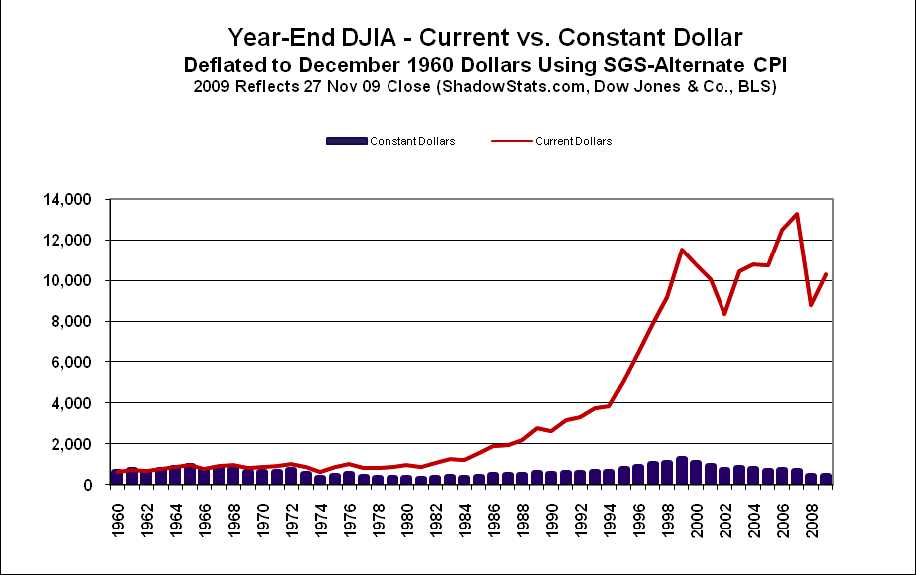
This and other wonder charts are from ShadowStats.com.
Peter Schiff leading Chris Dodd!
From a campaign email:
A new Rasmussen poll has anti-tax candidate Peter Schiff AHEAD of Chris Dodd. This is an early Christmas gift for the Peter Schiff campaign. Before we could email our campaign pollster for his analysis, he had already emailed us, “Rasmussen Poll: EXCELLENT NUMBERS!” “These numbers are striking considering the campaign is still in our initial stages, and we are still beating Dodd,” he explained.
Our campaign is energized by these numbers, especially when you put them in context:
1. Dodd’s a five-term US Senator.
2. Our campaign hasn’t even started yet. (We launch our campaign headquarters next week.)
3. Most Connecticut voters don’t yet know Peter and haven’t heard his story.
Kevin Tuma Cartoon: More of the same
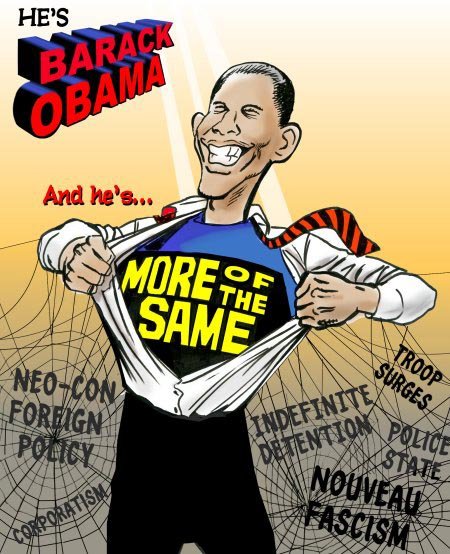
Obama Adopts the Bush Doctrine
Ron Paul asks Hillary Clinton if she supports Bush Doctrine
Challenging Virginia’s Unconstitutional Regulation of Yoga Teacher Training
Arming Goldman
“I just wrote my first reference for a gun permit,” said a friend, who told me of swearing to the good character of a Goldman Sachs Group Inc. banker who applied to the local police for a permit to buy a pistol. The banker had told this friend of mine that senior Goldman people have loaded up on firearms and are now equipped to defend themselves if there is a populist uprising against the bank. (Read more from bloomberg.com)
Ron Paul on Afghanistan
Interesting points:
* We don’t know the actual current troop level in Afghanistan.
* Cost of war doesn’t include money paid to contractors.
* Hundreds of thousands in lobbying my military contractors.
US lawmakers: New tax should pay for Afghan war
More change I can believe in.
Influential US lawmakers on Thursday called for levying a new income tax to pay for the war in Afghanistan, warning its costs pose a mortal threat to efforts like a sweeping health care overhaul.
“Regardless of whether one favors the war or not, if it is to be fought, it ought to be paid for,” the lawmakers, all prominent Democratic allies of President Barack Obama, said in a joint statement.
The proposed “Share The Sacrifice Act of 2010” came with Obama set to announce within weeks his decision on whether to send more US troops to fight the war, now in its ninth year. (Read more from google.com)