Daily Archives: 15 December 2011
Rand Paul prevents war with Russia
 A few days ago, some Republican senators attempted to lay the groundwork for a shooting war with Russia. I wish I were exaggerating.
Last week, while most senators were focused on the important national issues of war funding and Americans’ constitutional liberties, Senator Marco Rubio (R-FL) seemed more concerned with the fate of a foreign country. Behind the scenes, Rubio moved to have a unanimous consent vote that would have hastened Georgia’s entry into NATO. The unanimous consent vote never happened because Senator Rand Paul single-handedly prevented it.
This is not a triviality. Make no mistake: Bringing Georgia into NATO could lead to a new military conflict for the United States, which is why any move that would facilitate Georgia’s entry into the alliance should be publicly debated. Rubio’s attempt to push this through by unanimous consent — that is to say, without any formal debate or vote — is highly suspect and calls into question the senator’s better judgment.
But what Sen. Rubio is advocating is nothing new. Examining the political context of McCain’s declaration of solidarity with Georgia in 2008 should give Americans pause about the Washington establishment’s foreign policy agenda. After the 2008 South Ossetia conflict, Pat Buchanan wrote:
Who is Randy Scheunemann? He is the principal foreign policy adviser to John McCain and potential successor to Henry Kissinger and Zbigniew Brzezinski as national security adviser to the president of the United States. But Randy Scheunemann has another identity, another role. He is a dual loyalist, a foreign agent whose assignment is to get America committed to spilling the blood of her sons for client regimes who have made this moral mercenary a rich man.
[emphasis added]
Continued Buchanan:
From January 2007 to March 2008, the McCain campaign paid Scheunemann $70,000 — pocket change compared to the $290,000 his Orion Strategies banked in those same 15 months from the Georgian regime of Mikheil Saakashvili. What were Mikheil’s marching orders to Tbilisi’s man in Washington? Get Georgia a NATO war guarantee. Get America committed to fight Russia, if necessary, on behalf of Georgia. Scheunemann came close to succeeding.
Buchanan’s description of Scheunemann and his activities is instructive because Georgia’s entry into NATO would commit the United States to fighting for Georgia. Buchanan explains what would have happened in 2008 if Georgia had been part of NATO at that time:
Had [Scheunemann succeeded], U.S. soldiers and Marines from Idaho and West Virginia would be killing Russians in the Caucasus, and dying to protect Scheunemann’s client, who launched this idiotic war the night of Aug. 7. That people like Scheunemann hire themselves out to put American lives on the line for their clients is a classic corruption of American democracy.
. . . .
FLASHBACK: CIA plane filled with cocaine
A private jet that crash-landed almost one year ago in eastern Mexico carrying 3.3 tons of cocaine had previously been used for CIA “rendition” flights, a newspaper report said here Thursday, citing documents from the United States and the European Parliament. (Read more)
U.S. Agents Launder Mexican Profits of Drug Cartels
Undercover American narcotics agents have laundered or smuggled millions of dollars in drug proceeds as part of Washington’s expanding role in Mexico’s fight against drug cartels, according to current and former federal law enforcement officials.
The agents, primarily with the Drug Enforcement Administration, have handled shipments of hundreds of thousands of dollars in illegal cash across borders, those officials said, to identify how criminal organizations move their money, where they keep their assets and, most important, who their leaders are.
They said agents had deposited the drug proceeds in accounts designated by traffickers, or in shell accounts set up by agents. (Read more)
Starting Over with Regulation
I don’t think this article reaches the right conclusion, namely, to let markets do the regulating, but it does point out the absurdity of government regulation:
Government oversight of day care seems like a good idea—you wouldn’t want children cooped up in an airless basement—but this proposal went far beyond basic health and safety.
The new rules would dictate exactly how to do just about everything: how many block sets (“at least two (2) … with a minimum of ten (10) blocks per set”), where the children can play with the blocks (on “a flat building surface” that is “not in the main traffic area”) and when caregivers must wash their hands (before “eating food,” “after wiping a child’s nose,” etc.).
This is the way regulation works in America: Regulators try to imagine every possible mistake and then dictate a solution. The complexity is astounding.
Under a recent federal directive, the number of health-care reimbursement categories will soon increase from 18,000 to 140,000, including 21 separate categories for “spacecraft accidents” and 12 for bee stings. There are over 140 million words of binding federal statutes and regulations, and states and municipalities add several billion more.
. . . .
Consider our federal special-education laws, passed in the mid-1970s to end the shameful neglect of the small percentage of students with special needs. Special ed has now grown to consume 20% of the total K-12 budget in the U.S. Programs for gifted children, by contrast, get less than half of 1%.
Is this the correct balance? No one is even asking the question, because the regulations dictate the outcome.
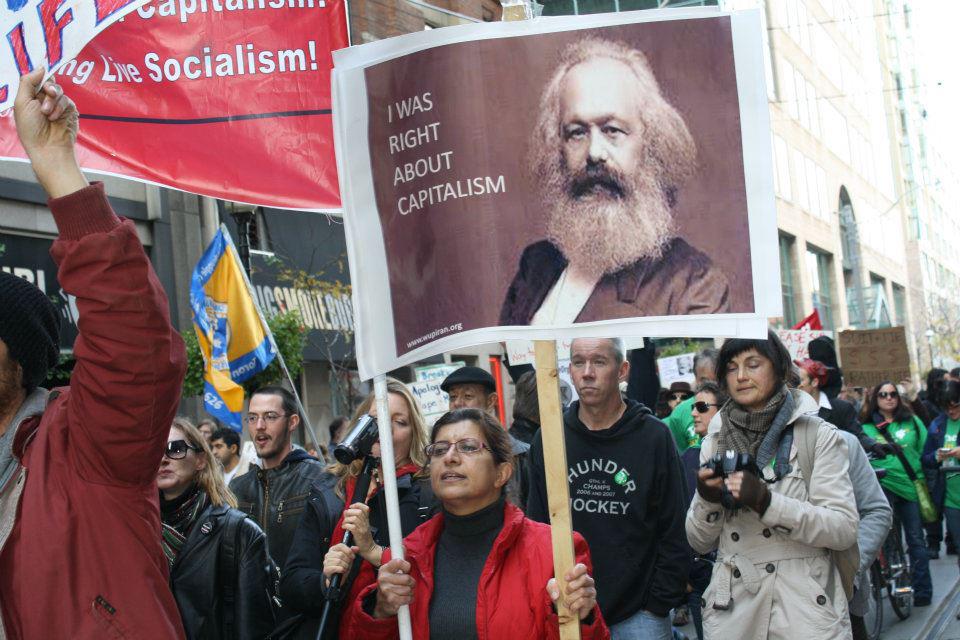
Occupy Wall Street Marxists