I think this is a very inspiring talk. It taught me a lot about economics, life, and intellectual property. It’s inspiring because it makes me feel like we are capable of improving the world. We only need to not steal from one another.
Tag Archives: Austrian School / Libertarian Theory
Must See: The Economics of Recycling
War of Words. Defining Inflation & Hyper Inflation.
The term hyper-inflation itself is interesting. It is a word which seems to universally mean the sudden, dramatic drop in the value of money (ie. the sudden, dramatic rise in prices). The word inflation is more contested.
The government prefers to consider inflation a rise in prices. Why? Because government measures inflation by the heavily manipulable consumer price index, which can be twisted to ignore food and fuel costs. The government hates bad economic news. It also adjusts its many redistribution of wealth according to the CPI, so having control over it helps.
Followers of the Austrian School (me) use the term inflation to mean, simply, an increase in the monetary supply. Price increases are merely a consequence of inflation, as is the wage/price spiral so many economists enjoy obsessing over. So when government, and government minions scrutinize about what they call inflation, my friends and I think they are paying attention to the sideshow of prices, and avoiding the real issue: the printing of money out of thin air.
We do lack a word, however, for the sudden, dramatic drop in the value of money (rise in prices), hence we rely on hyper-inflation.
What does it look like?
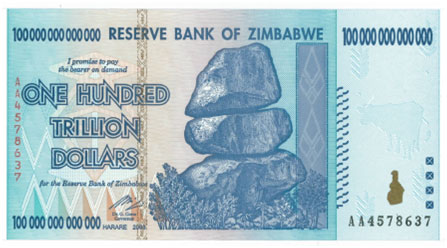
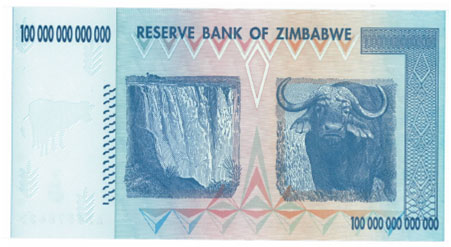
Here is a note for a hundred trillion Zimbabwean dollars. I don’t think it’s worth the paper it’s printed on. Initially, governments like printing money, because it transfers wealth more subtly than taxation, but eventually you get this:
Libertarianism in the military
Austrian Economists on Limited Government
Austrian Economist speaks to EU Parliament
My Austrian Economic professor recently spoke before the EU Parliament.
Here is his account:
I recently made my second trip to speak at the European Parliament. Last year I spoke in Brussels to a committee on international development about the benefits of sound money for developing countries. This year I spoke in Strasbourg, France as part of a panel of three Austrian School economists, representing the Right Approach Group, which seeks market solutions to current economic problems. Now, just consider these first two lines. Yes, the European Parliament, which is just one branch of the many-tentacled European Government, has two offices—one in Brussels and one in Strasbourg. This fact alone illustrates why the organization is unpopular with the European taxpayer—it spends too much money on itself.
Last year I was wowed by the size and beauty of the Parliament’s offices in Brussels. It is a modern masterpiece of architecture—lots of glass, huge open areas, vast meeting halls, multiple cafeterias and coffee shops, not to mention the hundreds, perhaps thousands, of offices for the members, their staffs, and the unionized civil service. The office complex in Strasbourg is the same—vast, beautiful, and busy. But busy doing what? Well, for one thing, moving. Each month the entire European government moves from its main offices in Brussels to Strasbourg for one week. The cost of this move is enormous. Twice each month the members and their staffs must pack and ship files and other official documents, then travel and reside at significant expense in another city. Strasbourg is much smaller than Brussels, so the prices of hotels rise to reflect the increased demand. And we have not even touched the cost of lost productivity—which assumes, of course, that one believes that something beneficial to Europe really comes out of its alleged continental government. This is the elephant in the living room–does Europe really need a continental government?
. . . .
But another, more grandiose agenda arose—political integration that would weaken each nation’s sovereignty. To some extent this has been achieved. The Euro—the European Union’s standard money—is administered and controlled by the European Central Bank (ECB), a supposedly independent entity. Although it is just as susceptible to political pressure as is our Federal Reserve Bank, no nation in the Euro Zone (not all EU members are in the Euro Zone) has total control of the ECB. Furthermore, the EU has managed to impose many standard economic regulations on its members and it has been partially successful in standardizing taxation throughout the EU. The purpose of tax standardization is to prevent shifts of business headquarters from high tax countries to low tax countries within the EU. Moving headquarters is very easy to do now that there is relatively free movement of people and goods throughout the EU. But the “tax equalization” movement became a cover for closing the door to the few tax havens that remained in Europe. At one of the large worldwide economic summits recently, French President Nicholas Sarkozy called for the world to close down tax havens in places like the Cayman Islands. So the real purpose of tax equalization is to fleece business everywhere on the planet in order to prevent European headquartered companies from escaping Europe’s onerous taxation.
The downside of all this, as the so-called “Euro Skeptics” claim, is that the EU has become a giant protectionist zone which greatly restricts trade outside its borders and engages in massive transfer payments within it borders. Half of the EU budget goes to farm subsidies, and they are a constant source of controversy. My wife and I had a front row seat to one incident. Our hotel in Strasbourg was only a few minutes’ walk from the EU complex, on a broad avenue that led to the beautiful heart of the city, about two miles away. The farm lobby held a demonstration by marching from the downtown area to the Parliament. The demonstrators chanted slogans, carried signs, drove tractors, and even herded a few reluctant cows. That evening the “France 24 English” television station explained that the farmers want their milk subsidies increased, because the price of milk is so low. One member of the Parliament voiced his support. Apparently he had no conception of basic economics; to wit, subsidies encourage production, and more production lowers the market price. Increasing subsidies would encourage even more production and cause the price to go even lower. Ah, well, we Americans cannot take the moral high ground here, with our own outrageous farm subsidies. Furthermore, like America, the EU blocks imports of cheap food from its poorer neighbors. We Americans block cheap sugar cane imports form dirt poor Caribbean nations, while Europe blocks farm products from Africa. Taxpayers on both continents not only get the honor of paying higher prices for food staples, but we also get the honor of propping up tyrannical and corrupt regimes through our foreign aid.
. . . .
My talk went well. The audience was attentive, as confirmed by the excellent participation in the Q&A session at the end. I was on three-person panel of Austrian School economists. Our twin goals were to educate and form alliances—educate potential allies in Austrian School principles so as to encourage them to use their influence to adopt sound economic policies. . . . As enjoyable as are my talks to those already friendly to Austrian School principles, we must face facts that we are outnumbered by the Keynesians in the halls of power. These are the people who must be presented with the likely consequences of their well-intended but disastrous actions. My points were simple—the actions of the past year to debase money, stimulate the economy, re-regulate the economy, and bail out failed industries must be repealed. The window of opportunity to do so is rapidly closing. The excess reserves injected into the banking system have not been leveraged, via the fractional reserve banking system, into massive amounts of new money media…yet. Only a small percentage of the stimulus package has been spent…yet. There is still time to prevent onerous and foolish new regulations on the financial system. And the bailouts must stop. The other two speakers—Professor Jorg Guido Hulsmann of the University of Angers and Dr. Thorsten Polleit of the Frankfurt School of Management—made similar points.
Austrian Economist Patrick Barron after his presentation to EU
My Austrian Economics mentor, Patrick Barron and Benjamin Harnwell from Strasbourg, France regarding the historic Austrian Economic presentation they made to Members of the European Union Parliament on July 14, 2009.
Interview by Radio Free Market – from behind the lines of Socialism, from the heart of America, the voice of free people and free markets, hosted by Michael McKay.
Economics 101: Say’s Law
I wanted to share an excerpt from an email I sent to a friend:
. . . but what you allude to later is a version of what we Austrians call Say’s Law, Supply = Demand, or at least their tendency toward equilibrium. It contradicts Marx’s claim of capitalism always overproducing. It also contradicts the super-popular Keynesian notion that all problems can be solved by creating artificial demand with money from a printing press, i.e. money that isn’t backed by production. (See Paul Krugman, or just about any other main-stream voice in economics.)
In contrast with the Keynesian notion that demand can be manipulated, Austrians believe demand can only increase if supplies of goods and services increase.
Another was to look at Say’s law is that you produce in proportion to your desire for other goods and service. You produce legal services, I (hopefully) will produce books, a farmer produces corn – then we use our production to create demand for other goods and services. Indirect exchange.
So don’t believe people who tell you that government, which produces nothing besides a very inefficient postal service (Hidden History: Post Office sues Cub Scouts to maintain monopoly), can “create demand” by spending money that’s either printed from thin air, or forcibly taken from the actual producers.
Krugman’s Intellectual Waterloo
Here is a brief article from mises.org followed by the email debate I had after sending it to a friend:
“Last Monday evening, Lew Rockwell, from a tip by someone named ‘Travis,’ posted this damning quote of Paul Krugman’s from a 2002 New York Times editorial:
To fight this recession the Fed needs…soaring household spending to offset moribund business investment. [So] Alan Greenspan needs to create a housing bubble to replace the Nasdaq bubble.
Krugman. 2002. Calling for a housing bubble.
What’s more, by explicitly calling for a new bubble to replace the recently burst one, he anticipated by 6 years the Onion‘s hilarious “report” that “demand for a new investment bubble began months ago, when the subprime mortgage bubble burst and left the business world without a suitable source of pretend income.” Except Krugman was being serious.
The quote caught on in the blogosphere, to such an extent that Krugman actually responded in his New York Times blog Wednesday morning:
Guys, read it again. It wasn’t a piece of policy advocacy, it was just economic analysis. What I said was that the only way the Fed could get traction would be if it could inflate a housing bubble. And that’s just what happened.
So with a deft little two-step, Krugman paints himself as a doctor who gave an excellent diagnostic, and not a disastrous prescription. One of his ditto-heads posted on his blog that saying Krugman advocated or caused the housing bubble was ‘Like saying Nostradamus caused the rise of European fascism.’
. . . .
Mark Thornton on the Mises blog followed up with a devastating collection of 2001 Krugman quotes clearly documenting his support for inducing a housing bubble. The most damning of this batch is the following from a 2001 interview with Lou Dobbs:
Meanwhile, economic policy should encourage other spending to offset the temporary slump in business investment. Low interest rates, which promote spending on housing and other durable goods, are the main answer. [emphasis added]
How the hell can anyone spin that as a purely academic musing, and not a policy recommendation for artificially inducing housing spending?” (Read more from mises.org)
Him:
Hi Roman,
Read the “quote” which isn’t a quote at all really. If you read the article by Krugman he was paraphrasing another guy, some investment banker and that “quote” was his words not Krugman. I don’t think Krugman was advocating that at all. I think the most salient part of the eight year old article lies in the last two paragraphs.
Misquoting and manipulating other peoples words smacks too much of FoxNoise. So I think that Lew Rockewll and the mysterious “Travis” are full of crap.
www.npr.org/templates/story/story.php?storyId=105783108
Me:
W.r.t. Paul Krugman, I read your email and was appalled by the possibility that both Lew Rockwell and the Mises Institute made a very sloppy (mis)quotation. I was going to write to them. But after looking at Krugman’s editorial, I don’t think they did.
Word for word:
“To fight this recession the Fed needs more than a snapback; it needs soaring household spending to offset moribund business investment. And to do that, as Paul McCulley of Pimco put it, Alan Greenspan needs to create a housing bubble to replace the Nasdaq bubble.”
Krugman clearly calls for a housing bubble.
This is consistent with his unrelenting justification of government spending, and the philosophy of his hero, Maynard Keynes, who thought that all problems could be spent away without future reprocussions. Unfortunately, the future is now here. In 1927 Keynes famously said there would be no more market crashes, ever. Somehow his disastrous policies and predictions have not diminished their persistence.
Not surprisingly, I disagree outright with the NPR story you sent. You’re welcome to disagree, but I’ll tell you the basic arguments.
I recently read Murray Rothbard’s book, “America’s Great Depression,” which I think is a very thorough refutation of Milton Friedman’s explanation of the Great Depression. After reading about Hoover’s massive and unending interference in monetary policy, trade policy, labor laws, industry, I’m really not sure how Milton Friedman can claim Hoover didn’t do enough. In fact, during the 1932 presidential campaign, Hoover was accused of being socialist.
It was his “help” which caused the depression. In 1921 the market suffered a bigger proportional crash than in 1929, but president Harding resisted the urging of then-secretary-of-commerce Hoover and didn’t “help.” By the time Hoover convinced him to help the economy recovered. Eight years later Hoover was ready, willing and able to take advange of the crash and institute a bunch of government controls which kept the economy crippled for a decade. FDR’s New Deal was an expansion of Hoover’s policies.
A quick note about the causes of the crash.
The AUSTRIAN BUSINESS CYCLE THEORY is what makes Austrian Economics different from other libertarians, like those of Milton Friedman’s Chicago Monetarist school.
Milton Friedman, like Krugman, Keynes, Marx and most television commentators believe that crashes spring from the bowels of capitalism. This is implied in the NPR article you sent. Freedom doesn’t work. We are asked to believe that all of a sudden, many entrepreneurs, who make a career out of predicting and meeting human desires, make bad predictions.
The Austrian Business Cycle Theory offers an explanation for these clusters of entreupreneurial errors. They are caused by loose monetary policy. Specifically, artificially low interest rates. This, incidentally, is exactly what Krugman called for when he suggested Greenspan create a housing bubble.
Monetary expansion by both banks and government in the 1920s caused the 1929 crash. Monetary expansion in the 90’s caused the internet bubble, then the 2001 crash, which was papered over by more monetary expansion i.e. the housing bubble. It is government, not free markets causing these crashes.
The worst thing that can come of this crisis is the condemnation of economic freedom.
Him:
Roman,
I stand corrected. You are right. And I admit that you have piqued my interest in Rothbard’s book, as long as it is not more right wing revisionist history. It sounds like it is not.
But “Waterloo” for Krugman sounds a bit overly dramatic to me.
The fact of the matter is that I believe in the “Tragedy of the Commons”. And i apply this to economics, the market as well as the environment. Man is by nature greedy. That is not in itself a bad thing. And enlightened self-interest is a positive outgrowth of that but that is not always what happens when markets are deregulated and self serving politicians are bought of by big monied interests. . I believe we need government to do certain things like enforce child labor laws, environmental and health standards, taxes to fund the military, interstate highways, etc. How much control and intervention is open to debate the democratic process.
***
Stay tuned for a discussion of child labor laws from the Austrian perspective. . . .
Austrian Economics gaining popularity, rebutting critics
“The Mises-Hayek theory of the business cycle — and of our recent housing bubble in particular — is gaining more and more adherents in the “real world.” To give anecdotal evidence: Five years ago, when I’d write a Mises Daily article, the fan mail would pour in from college students. But now, I get questions from hedge-fund managers and others working in the financial sector. Austrian economics is no longer a hobby; this is serious stuff.
Because of the popularity of the Austrian message — where Exhibit A is the Ron Paul campaign — mainstream economists are taking the time to explain why (in their opinion of course) the Mises-Hayek theory is nonsense. In the past I’ve answered Tyler Cowen and Paul Krugman’s objections, but today’s focus will be the recent critique penned by Australian economist John Quiggin.
Quiggin’s piece deserves careful scrutiny. In the interest of brevity, I am going to dive right into his objections. If you need a more introductory exposition of Austrian business-cycle theory (ABCT), try this collection or, if you prefer a PowerPoint presentation, check out Roger Garrison’s amazing creations.” (Read more from mises.org)
Austrian Economics – dissenting voices then and now
This brief lecture by the Mises Institute’s director of editorial affairs offers a fantastic glimpse at the long struggle for truth by economists of the Austrian School.